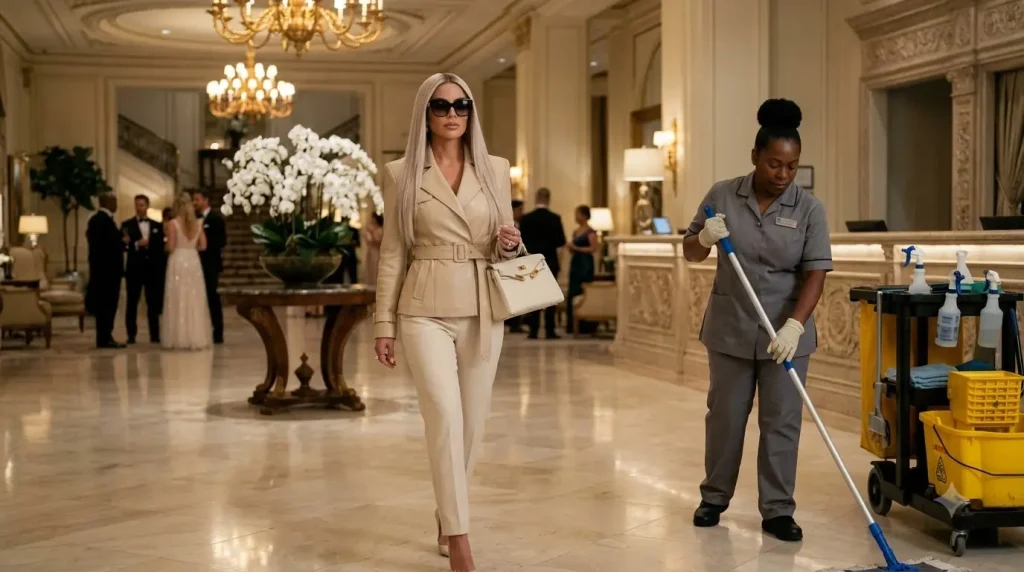
The bride held the skirt of her gown away from the service door.
She watched the hotel owner sign the banquet sheet with a plain silver pen.
There was no music out in the service corridor.
Only the rhythmic hum of ice machines and the distant rattle of dessert carts rolling toward the staging line.
The owner handed the clipboard back to the captain.
She looked toward the bride.
The dark circles under the owner’s eyes were visible now under the fluorescent bulbs.
She had changed into a clean dark blazer and trousers, but she had not put on makeup.
Her hair remained pulled back in the same functional bun.
The bride stepped into the narrow hallway.
“You didn’t stay for dinner.”
The owner offered a faint, tired smile.
“Weddings belong to families.”
“You redesigned the platform so my dad could be there.”
“That was engineering.”
The bride shook her head gently.
“That was kindness disguised as architecture.”
The owner leaned back against the steel doorframe.
“How is your husband?”
“Exhausted.”
The bride adjusted the diamond bracelet on her right wrist.
It had been a gift from his sister that morning.
She looked down at the glittering stones.
“He spent three hours in the courtyard talking to our father.”
The owner said nothing.
Silence was often the only respectful container for someone else’s grief.
The bride continued softly.
“His sister didn’t just pay for upgrades.”
“She paid for his college tuition eight years ago.”
“She helped him secure his first apartment deposit.”
“She reminded him of that every Thanksgiving.”
The owner looked down at her own hands.
Her gold signet ring caught the overhead light.
“Gratitude can become a debt that never matures,” the owner said.
The bride looked up sharply.
“Is that what it is?”
“People who use money to purchase control rarely want the principal repaid.”
“Why?”
“Because if you clear the balance, they lose the right to dictate the terms of your life.”
The bride swallowed hard.
Tears welled in the corners of her eyes, but she did not let them spill across her makeup.
“We wrote her a check before the reception started.”
The owner raised an eyebrow slightly.
“For the full amount?”
“For every dime she transferred into the wedding account.”
“Where did you get the funds?”
“We liquidated our down payment savings.”
The bride smiled through the wetness in her eyes.
“We will rent our apartment for two more years.”
“We will buy an older car when mine dies.”
“And when she comes to our house for dinner, she will be sitting at a table she does not own.”
The owner looked at the young woman in the white lace gown.
For the first time all day, genuine admiration settled across her features.
“That is the most expensive check you will ever write.”
“Yes.”
“And it will buy the cheapest peace you will ever find.”
The bride touched the owner’s forearm lightly.
“What will happen to her partnership?”
The owner straightened from the doorframe.
Her expression did not harden, but the professional coolness returned to her posture.
“My corporate team reviews five hundred proposals a quarter.”
“Her firm had reached final diligence for a regional luxury retail lease in our Charlotte property.”
“She was scheduled to sign the master agreement next Tuesday.”
The bride held her breath.
“Will you cancel it?”
“I do not cancel contracts out of personal pique.”
The owner adjusted her blazer cuffs.
“That would make me as volatile as she was with that paper cup.”
“Then what will you do?”
“Tomorrow morning at eight, my legal counsel will send her executive board a copy of our guest-conduct code.”
“We will include the hotel’s security footage from twelve fifty-three this afternoon.”
“No editorial comments.”
“No angry covering letters.”
“Just the raw video of their chief brand officer assaulting a uniformed hospitality worker in a crowded lobby.”
The bride’s lips parted.
“Her board will remove her.”
“Her board will evaluate whether her temperament aligns with their fiduciary responsibilities.”
The owner looked down the long corridor toward the freight elevators.
“If they choose to retain her, we will decline the lease because her leadership does not meet our corporate standards for operational integrity.”
“And if they replace her?”
“Then we will negotiate with her successor.”
The owner met the bride’s eyes.
“Accountability is not about destroying an adversary.”
“It is about removing their ability to inflict damage without consequence.”
The bride nodded slowly.
She turned to walk back toward the music and the laughter of the ballroom.
At the threshold, she paused and looked back over her shoulder.
“Thank you for holding the mop.”
The owner smiled faintly.
“Someone had to clean the floor.”
By eleven forty-five that night, the winter garden was quiet.
The candles had burned down to pools of warm wax.
Petals from white roses littered the damp flagstones.
The rich tourist, Julianna Vance, sat on a stone bench beside the silent fountain.
Her pale blue evening gown was pulled tightly around her knees against the chill of the glass pavilion.
Her makeup was smudged near her temples.
She had not touched food all evening.
A shadow fell across the flagstones.
Julianna looked up.
Her half-brother stood above her.
His tuxedo jacket was unbuttoned.
His tie was undone and draped loosely over his collar.
In his right hand, he held a sealed white envelope.
He did not sit down beside her.
Julianna wiped a strand of blonde hair from her forehead.
“The ceremony was lovely, David.”
“Yes.”
“She looked very beautiful.”
“She did.”
David stepped forward and laid the envelope on the stone bench between them.
Julianna looked at the paper.
She did not touch it.
“What is that?”
“Ninety-four thousand dollars.”
Julianna went entirely still.
“David, don’t.”
“The quartet.”
“The floral installations.”
“The vintage champagne.”
“The upgrades to the bridal suite you ordered without asking her.”
His voice was steady.
It lacked the hurried defensiveness he had carried since childhood.
“It is drawn on our joint savings account.”





