Julianna’s eyes filled with sudden, bitter tears.
“I didn’t do it to buy you.”
“You did.”
“I’m your sister!”
“You are my sister when it is convenient for you to be generous.”
David shoved both hands into his trouser pockets.
“And you are my creditor every time I make a decision you don’t like.”
“I put you through school, David!”
Her voice cracked in the empty pavilion.
“When Dad lost the firm, who paid the bursar?”
“Who made sure you didn’t have to work twenty hours a week while studying for your boards?”
David looked down at her with an expression that carried neither hatred nor regret.
“You did, Julianna.”
“And I thanked you every single day for six years.”
He knelt down on one knee so his eyes were level with hers.
“But somewhere along the way, you started believing that because you saved our family from drowning, you owned the water.”
Julianna looked away, staring into the dark glass of the ceiling.
“You think I am cruel.”
“I think you are terrified of being ordinary.”
David pointed back toward the empty lobby.
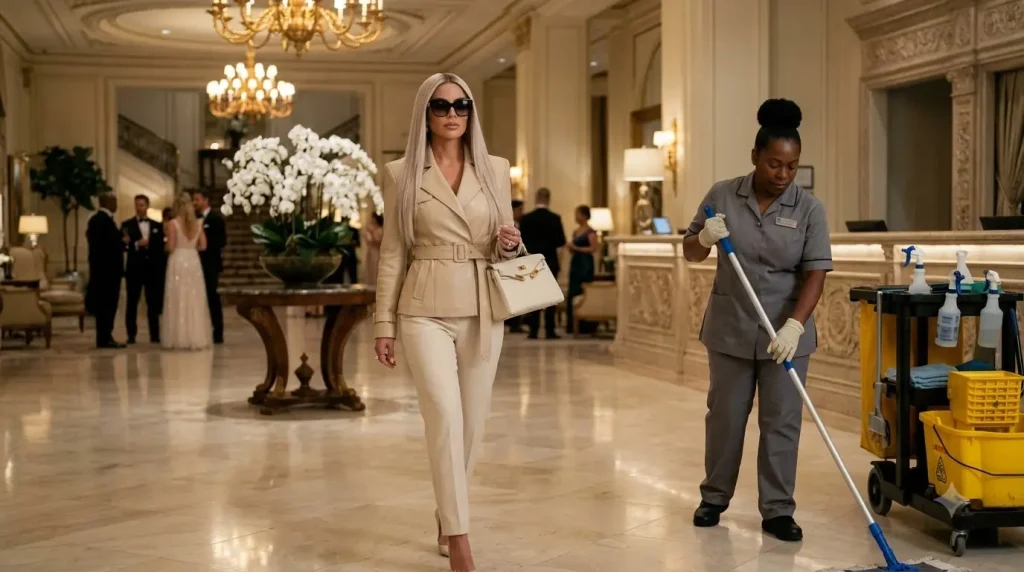
“You threw hot coffee on a woman who was doing honest work because she asked you to take three steps to your left.”
“I didn’t know who she was!”
“That is the entire horror of it, Julianna.”
David stood up slowly.
“If she had been a fifty-year-old immigrant grandmother working for minimum wage to support her grandchildren, you would have felt completely justified.”
“You only started crying when you found out she owned the deed to the building.”
Julianna buried her face in her hands.
Her shoulders trembled under the blue silk of her dress.
“She’s going to send the tape to my board.”
David did not offer comfort.
“Yes.”
“They will strip my equity shares.”
“Probably.”
“They might force me out of the company entirely.”
David looked at his watch.
Midnight.
The first day of his married life had begun.
“Then you will have to find out who you are when you don’t have a balance sheet to hide behind.”
He reached down and pushed the envelope an inch closer to her handbag.
“Take the check, Julianna.”
“Cash it.”
“And when you are ready to be a sister without an invoice, our door will be unlocked.”
He turned and walked through the glass archway into the main hotel.
His footsteps faded into the distant hum of the building.
Julianna sat alone beside the cold water.
She looked at the plain white paper on the stone.
For the first time in thirty-two years, the room around her was completely silent, and no amount of money could fill the space.
On the nineteenth floor, the executive offices were dark except for the corner suite.
The hotel owner, Maya Thompson, sat behind a wide desk of dark reclaimed walnut.
On the screen in front of her were seventy-two scanned documents.
Beside her, General Manager Marcus Vance and the housekeeping director, Sarah, sat in leather armchairs.
Sarah had brought three thick cardboard folders from the sub-basement archive.
The clock on the wall ticked past twelve thirty.
Maya did not touch the coffee cup resting on her blotter.
She had spent three hours reading handwritten incident reports spanning the previous eighteen months.
Her jaw remained set in a hard, rigid line.
“Page twelve,” Maya said.
Her voice cut through the quiet room.
Marcus cleared his throat nervously.
“Yes, ma’am.”
“A guest in Suite 1402 threw an iron at a laundry runner because his tuxedo trousers had a crease along the pleat.”
Maya looked up from the glass screen.
“The runner had a laceration on his forearm that required three butterfly bandages.”
“What was the operational resolution, Marcus?”
Marcus adjusted his tie.
His collar felt suddenly damp.
“The guest was a platinum-tier loyalty member with thirty-four corporate bookings a year.”
“I asked what the resolution was.”
“We comped two nights of his stay.”
Marcus lowered his eyes.
“And we issued the runner a five-hundred-dollar discretionary service bonus from the administrative contingency pool.”
Maya looked at the housekeeping director.
“Sarah, did the runner want to file a police report?”
Sarah looked down at her hands.
“He wanted to.”
“Why didn’t he?”
“Our assistant front-desk manager told him that corporate might review his visa status if a formal police investigation disrupted the property during the medical conference.”
The room went completely airless.
Maya leaned forward.
Her dark eyes were colder than the marble in the lobby.
“Who told him that?”
“David Miller,” Sarah answered in a whisper.
“The assistant night manager.”
Maya tapped the walnut desk twice with her index finger.
“Terminate David Miller before seven o’clock tomorrow morning.”
Marcus blinked.
“Ma’am, David has been with the Bellmont group for six years—”
“He threatened an employee’s legal residency to protect a guest who committed felony assault with a household appliance.”
Maya’s voice did not rise.
The absolute stillness of her delivery was far more lethal than shouting.
“If you hesitate to sign his separation paperwork, Marcus, I will accept your resignation beside his.”
Marcus swallowed hard.
“Understood.”
Maya turned back to the digital matrix.
“Seventy-two reports in eighteen months.”
“Sixteen instances of objects thrown.”
“Twenty-eight documented verbal slurs involving race, national origin, or perceived social class.”
“Nine instances of unwanted physical contact by guests during room-turnover service.”
She closed the laptop screen with a controlled, definitive click.
“Every single one was resolved with room credits, free champagne, and hush money paid to our workers.”
She stood up.
She walked to the floor-to-ceiling window overlooking the city lights.
The traffic on the boulevard below had thinned to an occasional cab.
“We built an operational system where our staff was trained to believe that dignity had a market price.”
Marcus looked at the carpet.
“The hospitality industry has always operated on discretionary deference, Mrs. Thompson.”
“Deference to guest comfort is hospitality, Marcus.”
Maya turned around to face him.
“Deference to guest violence is cowardice.”
She pointed toward the cardboard folders on the table.





