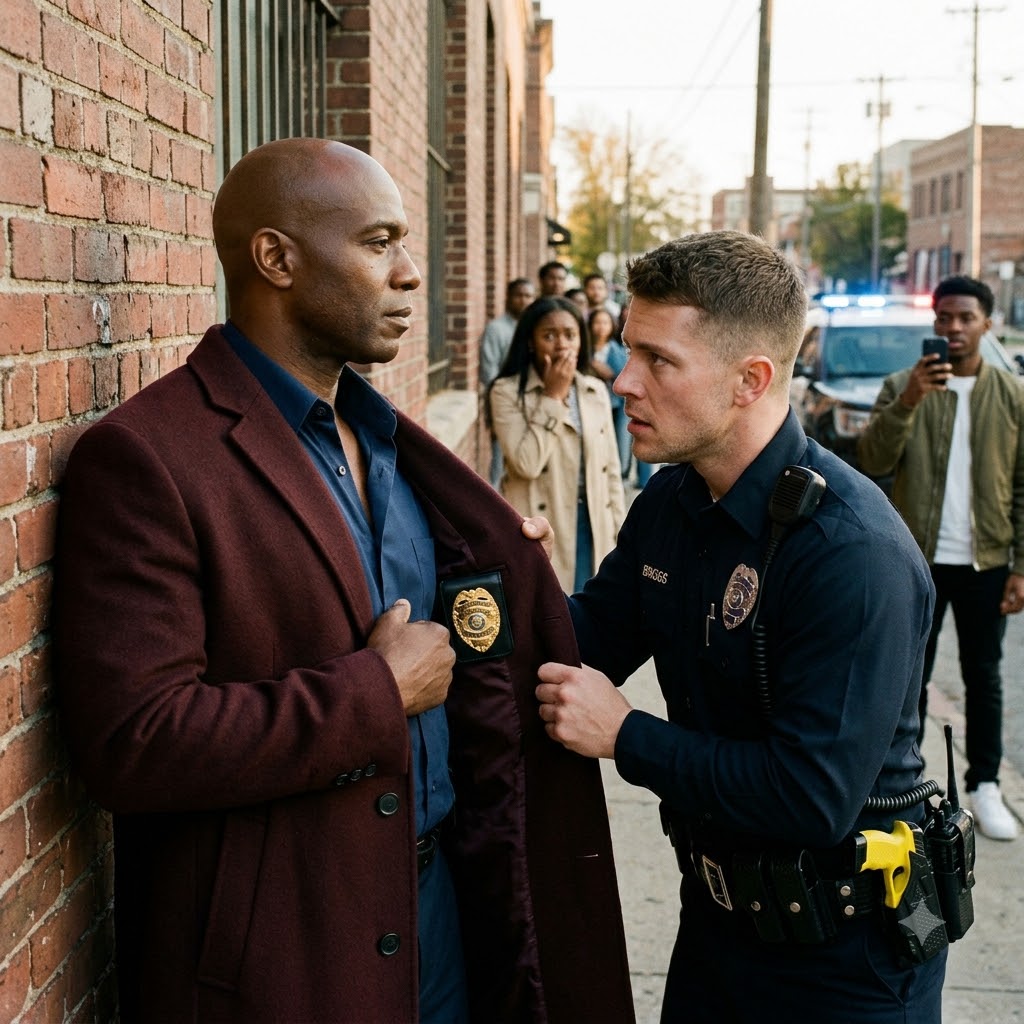
“No. Get out. Walk the plaza,” Miller ordered, already pushing his door open into the rain. “Take a lap past the coffee shop, down to the corner of Fourth, and back. Show the flag. There’s been a lot of panhandlers hassling the morning train crowd, and the merchants are crying to the councilman. Let ’em know who owns the pavement. Ten minutes, meet me back at the car.”
“Got it, Sarge.”
Miller didn’t wait for the confirmation. He pulled his collar up against the mist and strode briskly toward the mouth of the service alley, his heavy boots splashing through oil-sheened puddles. Just before he vanished around the brick corner, he glanced back over his shoulder—not at Kyle, Kyle noticed, but up and down the roofline of the buildings across the street, as if checking the weather.
Kyle stepped out of the cruiser and slammed the door. The cold mist immediately beaded on his cap visor and stung his cheeks. He zipped his slicker halfway, leaving the brass shield visible at his chest, and began his walk down the wide brick promenade of the Mercer Street Plaza.
The morning rush was thickening. The hiss of hydraulic bus brakes mingled with the clatter of metal shutters rolling up over storefronts. From the open door of Mercer Market—a corner bodega that had recently gentrified enough to sell four-dollar croissants alongside lottery tickets—drifted the warm, rich scent of dark roast coffee and toasted sourdough.
Kyle walked with his thumbs hooked into his duty belt, mimicking Miller’s slow, heavy-footed stride. He noticed how the stream of commuters parted around him without breaking pace. A woman in a camel-hair coat pulled her purse closer to her ribs as she passed. Two high school kids leaning against a bus shelter stopped laughing and stared at their shoes. The subtle shift in the air around him sent a quiet, unmistakable hum through Kyle’s blood. It wasn’t arrogance, he told himself. It was order. Someone had to be the wall between civilization and the chaos waiting in the alleys.
Then the radio clipped to his left shoulder cracked to life, spitting static into the damp air.
“All units in the Fourth, be advised. Priority call, strong-arm robbery just occurred at Callahan’s Pharmacy, Seventh and Mercer. Suspect fled on foot westbound toward the transit corridor. Described as a white or light-skinned male, late forties to early fifties, unshaven, wearing a dark gray or black wool overcoat, carrying a brown leather bag. Suspect implied a weapon in his coat pocket. Approach with caution.”
Kyle’s pulse kicked against his ribs. Seventh and Mercer was four blocks east. Westbound toward the transit corridor meant the suspect was funneling straight into his lap.
He keyed his shoulder mic. “Four-Twelve-Boy, I’m on foot at Mercer Plaza, eyes open.”
“Copy, Four-Twelve-Boy. Backup units are two minutes out from Fifth.”
Kyle slowed his pace, his hand dropping instinctively to the grip of his holstered Glock, his fingers brushing the cold stippled polymer. His heart hammered a tight, exhilarating rhythm against his sternum. This is it, a voice whispered in the back of his mind. Don’t hesitate. Don’t look weak.
He scanned the commuter crowd. Black nylon jackets. Bright yellow raincoats. Puffer vests. Nobody running. Nobody looking panicked.
Then his eyes caught the green canvas awning of Mercer Market, thirty yards ahead, right beside the mouth of the service alley where Sergeant Miller had disappeared five minutes earlier.
Standing beneath the edge of the awning, just out of the rain, was a man.
He wasn’t moving toward the train station. He wasn’t holding a coffee. He was in his early fifties, broad-shouldered beneath a damp, heavy charcoal wool overcoat that hung down past his knees. Three days of salt-and-pepper stubble shadowed his jaw. Deep hollows sat beneath his eyes, the gray, bruised look of a man who hadn’t slept properly in a week. Slung across his chest was a battered brown leather satchel.
And his right hand was buried deep inside the breast of his coat.
Kyle’s breath caught. Every detail of the broadcast snapped into place with terrifying, magnetic clarity. Late forties to early fifties. Unshaven. Dark wool coat. Brown leather bag. Hand in his pocket.
Worse, the man wasn’t looking at the street. His body was angled toward the mouth of the service alley, his head tilted slightly, eyes fixed down the narrow brick corridor where Ray Miller had just gone.
A spike of hot, protective adrenaline flooded Kyle’s veins. He’s watching Sarge. Or he’s ducking into the alley to ditch the stash and ambush whoever’s back there.
Kyle didn’t call it in. Calling it in meant waiting two minutes for a half-dozen veteran patrolmen to roar up with sirens blaring and steal the collar—or worse, it meant letting this guy slip into the alley where Miller was alone with an informant. Miller’s words echoed in his skull: You hesitate for half a second out here, you look weak.
Kyle stepped off the main walkway, cutting sharply across the wet flagstones toward the green awning. Commuters veered out of his path, sensing the sudden, coiled violence in his stride.
“Hey!” Kyle’s voice cracked across the plaza, louder than he’d intended, sharp enough to make a woman dropping coins into a newspaper box flinch. “You in the gray coat! Take your hand out of your jacket. Slowly!”
The man under the awning didn’t jump. He didn’t bolt. He turned his head with a slow, measured heaviness that somehow irritated Kyle more than flight would have. His eyes—pale, sharp, and startlingly calm—swept over Kyle’s young face, lingered for a fraction of a second on the shiny brass nameplate above his pocket, and then flicked past him, back toward the alley.
The man didn’t take his hand out of his coat. Instead, he shifted his weight slightly, his left hand rising just an inch in a subtle, placating gesture, palm down.





