Chapter I: The Architecture of Silence
Rain had polished Manhattan into dark, mirror-bright silver by the time Naomi Carter stepped from the rear passenger compartment of the Maybach.
For most of the late November afternoon, bruised clouds had scraped low against the spires of Midtown, swallowing the needle of the Chrysler Building and turning Fifth Avenue into a roaring canal of yellow cabs, wet umbrellas, and tire spray. By half past six, the cloudburst had subsided into a cold, maritime mist that smelled of river salt and wet granite, leaving the limestone facades glazed in gold beneath the streetlamps.
Naomi stood beneath the scalloped canvas marquee of the apartment hotel opposite, drawing the autumn chill into her lungs. Across the six lanes of asphalt sat Maison Bellamy.
The boutique was not designed to invite; it was designed to filter. Occupying the ground floor of an 1898 Beaux-Arts palazzo four blocks south of the park, its exterior was an exercise in architectural monasticism. No seasonal sale banners degraded its fluted pilasters; no vitrines were crammed with commercial clutter. Behind panes of four-ply laminated ballistic glass sat two pedestals of dark Belgian marble. In the left window, beneath a pinpoint beam of high-CRI halogen light, rested an unadorned collar of pear-shaped emeralds. In the right sat an untreated Ceylon sapphire brooch, glowing like a banked blue coal. Nothing else.
If a passerby had to consult a directory to ascertain what Maison Bellamy sold, they were already disqualified from entering.
Naomi had crossed that threshold only twice. The first occasion had been ten months prior, disguised under an umbrella company’s nondescript auditing team, when the boutique’s fiscal distress was still a closely guarded family secret. The second had occurred after midnight on a Tuesday, slipping through the alley service entrance to review forty years of hand-stitched inventory ledgers alongside Victor Bellamy, the house’s seventy-one-year-old patriarch.
Tonight was supposed to have been uncomplicated. She had not come to calculate EBITDA margins, nor to dissect inventory depreciation. She had come to collect an heirloom commissioned in memory of the only woman who had ever taught her the difference between price and value.
“Allow me, Ms. Carter,” Marcus said, stepping around the sedan’s rear fender with a massive golf umbrella already deployed.
Naomi raised a gloved hand, her fingers slender against the dark mist. “Keep it dry for the return trip, Marcus. It’s barely twenty feet.”
Marcus glanced down at the hem of her gown, his weathered face creased with professional disapproval. “It is twenty feet of municipal slush, ma’am. That silk wasn’t woven to wade through gutters.”
“Then I will walk quickly,” she murmured, the edge of a smile touching her mouth. “Wait by the corner hydrant. If our friends at the financial desks catch wind of why I’m in this zip code tonight, the curb will be crawling with photographers before seven.”
“They won’t hear it from me,” Marcus said, touching the brim of his cap. “Take your time. The engine stays warm.”
Naomi stepped off the curb, her movements deliberate, carrying herself with the unhurried grace of someone who had long since stopped rushing to prove her right to occupy space.
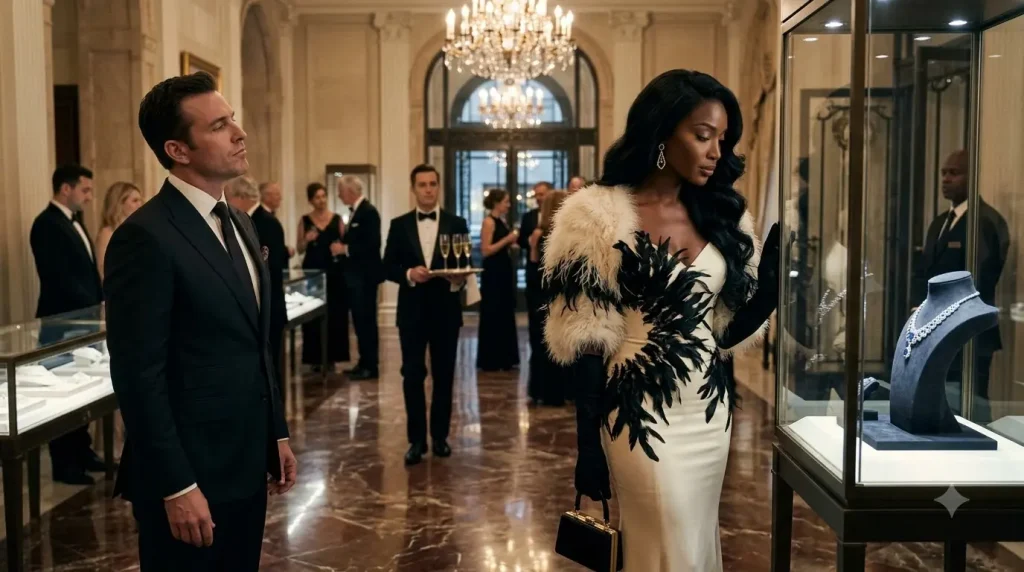
Heads turned as she crossed the sidewalk. People could not help themselves. It was partly the architecture of the gown: an ivory column of double-faced silk faille constructed around her body with surgical precision, slashed diagonally across the torso with intricate black-feather passementerie that rose from her left hip, wrapped the ribcage, and culminated in a high, sculptural collar. Over her shoulders hung a stole of vintage cream-and-black sheared wool. Long opera gloves of kidskin concealed her forearms, and from her lobes swung teardrops of polished onyx framed in brushed green gold.
Her hair, dense and obsidian-black, fell in controlled waves to the center of her spine. In her right hand she carried an envelope clutch of midnight-blue alligator—compact, devoid of metallic branding, and deceptively heavy.
Inside that clutch lay an appointment voucher stamped with a blind-embossed crest, two encrypted satellite phones, and the counter-signed closing documents that transferred fifty-four percent of Maison Bellamy’s private equity to Carter Meridian Holdings.
The acquisition was scheduled to cross the Bloomberg terminal at 9:00 a.m. on Monday. As of this damp Thursday evening, only seven people on earth knew the transaction had closed: two transaction attorneys at Sullivan & Cromwell, the primary lender in Zurich, Victor Bellamy, his lead goldsmith, Naomi, and her chief counsel.
She intended to preserve that silence until the market opened.
The boutique’s heavy bronze door swung open before her knuckles could touch the push-plate. A security guard in a charcoal uniform with silver piping stepped aside, his eyes dropping briefly to her hem before rising to her face. He did not smile; Maison Bellamy did not employ greeters who grinned. He offered a stiff, measured tilt of his head that acknowledged her physical reality without conceding its importance.
“Good evening, madam,” the doorman murmured, his voice deadened by the heavy velvet portières that muffled the roar of Fifth Avenue the moment the bronze door clicked shut.
The foyer was warm, smelling faintly of dried lavender, beeswax, and the cold, metallic ozone of heavy safes. Classical piano music—an obscure Erik Satie gymnopédie—drifted from concealed acoustic panels set into the coffered ceiling. Fluted pilasters of white Carrera marble climbed toward crystal chandeliers whose light was dimmed to a soft, candlelight amber. Across the showroom floor, glass vitrines stood isolated on pedestals of polished walnut, each piece of jewelry displayed with generous margins of empty velvet, like relics in an archaeological vault.





