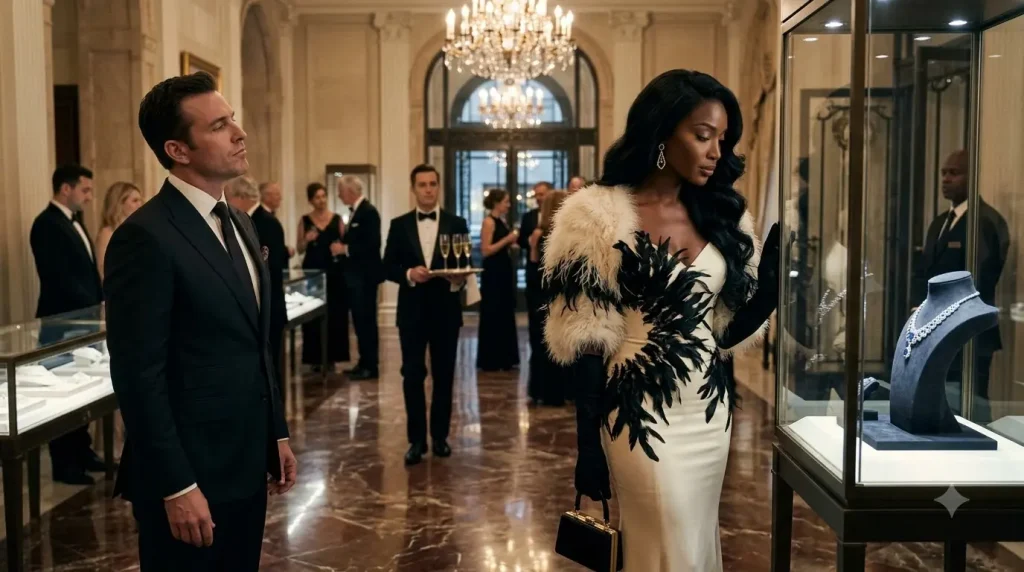
His mind raced backward through the last twelve minutes, cataloging every micro-aggression, every condescending inflection, every carefully sharpened insult he had hurled at the woman who controlled his livelihood.
Entry-level collars.
Not for casual browsing.
Thirty-Fourth Street retailers.
Wait in the vestibule.
“No,” Crane breathed, his knees visibly trembling inside his tailored trousers. “No… Mr. Bellamy… you told us the recapitalization was coming from a Swiss luxury consortium… CM Strategic Holdings—”
“Carter Meridian Strategic Holdings,” Madame Maron interjected from behind Victor, her French accent sharp as a jeweler’s saw. “Did you think the CM stood for Cartier, you fool?”
Crane’s hands flew to his mouth. A dry, choking sound tore from his throat.
Victor did not look at him again. The old man walked to the consultation table beside the central vitrine, set down the midnight-blue morocco case, and unclasped its twin brass catches with a crisp, mechanical clack-clack.
“Naomi,” Victor said, his voice softening into the gentle, reverent cadence of a true master craftsman. “Come see what we built for her.”
Naomi walked around the vitrine, leaving Elliot Crane standing like a frozen salt pillar in the center of the floor.
Victor lifted the lid of the case.
The piece inside did not belong to the commercial vocabulary of Fifth Avenue. It was not a status symbol intended to be flashed across a charity gala; it was a monument.
A wide, articulated collar of hand-hammered yellow gold and blackened steel curved across the velvet, its texture resembling the rough, layered grain of ancient oak bark. Rising from the collar, climbing upward like smoke, were dozens of individually carved feathers executed in oxidized platinum, each feather edged in single-cut micro-diamonds that caught the light with the subtle, icy shimmer of morning frost.
And nestled in the hollow of the throat, suspended within a four-prong setting of rough, unpolished gold, sat a single, untreated stone.
It was not a diamond.
It was an eleven-carat oval cabochon of raw, unheated blue lapis lazuli—deep, midnight-indigo, flecked with bright veins of golden pyrite that looked like a scattering of stars across a winter sky.
The stone was imperfect. It had an uneven surface, an asymmetrical dome, and a tiny, natural fissure running through its eastern flank. To an appraiser like Elliot Crane, it was virtually worthless—a semi-precious mineral that belonged in an artisanal market, not in a boutique where necklaces began at half a million dollars.
Yet as Naomi looked down at the blue stone, her composure—the impenetrable, aristocratic mask she had worn through boardrooms, acquisitions, and hallway ambushes—shivered.
Her breath hitched once in her throat.
She reached out with her bare hand, her index finger lightly tracing the cold, rough surface of the lapis.
Thirty-two years earlier, on an icy Sunday morning in West Baltimore, an elderly woman named Evelyn Carter had taken her nine-year-old granddaughter by the hand and walked her into an old, dusty pawnshop on Howard Street.
Evelyn had spent forty-three years working as an alterations seamstress in the basement of a department store that didn’t allow her to use the front entrance. Her hands were permanently scarred by needle punctures; her spine was bent like a willow branch from thousands of hours spent hunched over Singer sewing machines.
She had never owned an emerald. She had never worn a diamond. But every Sunday, she took Naomi to the libraries, borrowing oversized art history volumes on the Italian Renaissance, teaching the little girl the difference between cloisonné and champlevé, explaining how Benvenuto Cellini had cast gold in the sixteenth century.
In that pawnshop, in a dusty cardboard box under the counter, Evelyn had found a broken Victorian brooch: a crude piece of brass holding a cracked oval of blue lapis lazuli.
The pawnbroker had charged her twelve dollars. Evelyn had paid it in three installments of four dollars each.
On the night before Naomi left for Harvard on a full academic scholarship, her grandmother had pressed that chipped piece of blue stone into her palm.
“Never let these people tell you that beauty belongs to the person who writes the biggest check, Naomi,” the old woman had whispered, her knuckles swollen with arthritis, her voice fierce and clear. “Price is just what a merchant charges because he doesn’t know how to make anything with his hands. Value is what a thing makes you remember when you’re standing alone in the dark.”
Evelyn Carter had died during Naomi’s second year of business school. She had been buried in a municipal cemetery outside Baltimore, in a pine box, without a single piece of jewelry on her cold hands.
Naomi had kept the chipped lapis brooch in her desk drawer for fifteen years.
Ten months ago, when Victor Bellamy had confessed that his house was sixty days from bankruptcy because he refused to sell synthetic diamonds to mass-market luxury conglomerates, Naomi had placed that cheap blue stone on his workbench.
“Can you give this stone a setting worthy of the woman who held it?” she had asked.
Victor had wept when he saw the rough pyrite veins. “Cellini himself could not have found a better stone, my child,” he had answered.
Now, the piece was finished.
The feather motifs in the blackened steel were direct reproductions of the sketches Evelyn had drawn in the margins of her church hymnals. The gold was alloyed to match the tone of her grandmother’s brass thimble.
“The balance is precise, Naomi,” Victor whispered, watching her face with the anxiety of an artist awaiting judgment. “Seven hundred hours on the bench. Celeste set every feather by hand under thirty-power magnification.”
Naomi did not speak for a long time.
She lifted the necklace from the velvet. The weight was immense—nearly three hundred grams of gold, steel, and memory. She held it against her collarbone, the cold metal warming instantly against her skin, the rough blue stone resting precisely over the notch of her throat.
She turned toward the tall, gilded mirror mounted between the marble pilasters.





