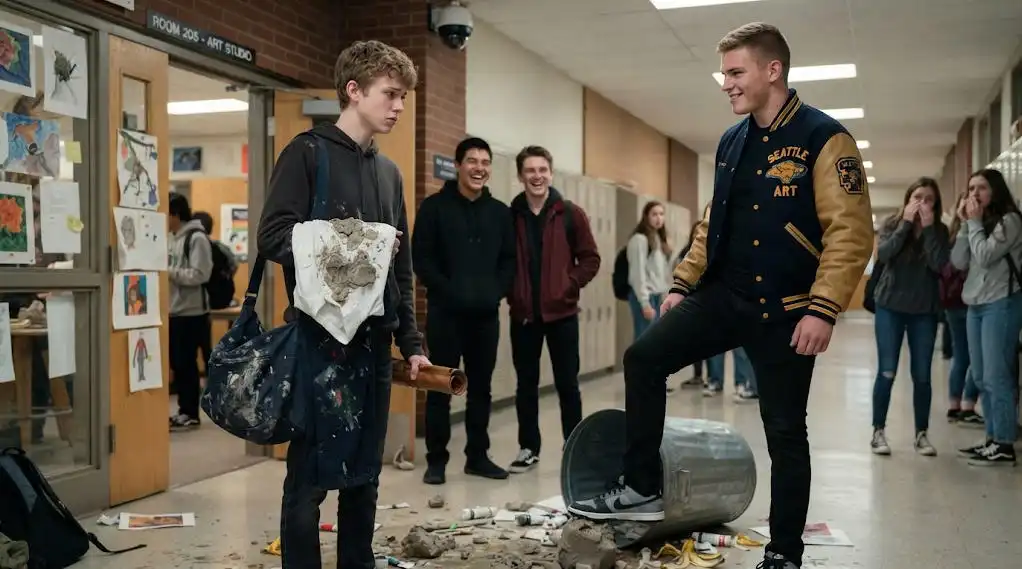
The screen flickered.
No one in the discipline room spoke.
Grant Mercer leaned back in his chair, wearing the same confident smile he had worn in the hallway.
He thought the committee was deciding whether a dirty uniform was worth all this trouble.
I kept my hands flat on the table and waited for the first frame to appear.
My name is Noah Bennett. I was seventeen, a junior at a public high school in Seattle, and I had one dream: getting into the Rhode Island School of Design.
I wasn’t born into money.
Every weekend, I helped clean the school newspaper office, sweeping floors, emptying wastebaskets, and wiping down desks. I saved almost every dollar toward my future college tuition.
Art was the one thing that made all those hours worthwhile.
I especially loved sculpture.
I could spend an entire afternoon shaping a piece of clay, adjusting one tiny detail until it finally looked the way I had imagined.
My art teacher, Ms. Alvarez, often told me that patience was my greatest talent.
Then came the school’s annual sculpture exhibition.
Students from every grade submitted their work. Teachers, parents, and local art supporters attended the event.
When the judges announced the grand prize, I could hardly believe what I heard.
My name.
Noah Bennett.
First place.
For a few seconds, I couldn’t move.
Ms. Alvarez hugged me and told me she was proud. Several students congratulated me.
But one person didn’t clap.
Grant Mercer.
Grant was the vice president of the school’s sculpture club. He was athletic, popular, and accustomed to getting whatever he wanted.
His father served on the school board.
Grant never missed an opportunity to remind people of that fact.
He had expected to win the sculpture exhibition himself.
Instead, the award went to a student who spent weekends cleaning the newspaper office to afford his education.
He didn’t take it well.
Over the following days, Grant made little comments whenever he saw me.
“Careful, everyone. The janitor’s becoming an artist.”
His friends laughed.
I ignored him.
I had no interest in fighting over a trophy. I wanted to keep improving my work and build a portfolio for college.
Unfortunately, Grant wasn’t finished.
A few afternoons later, I left the art workshop carrying my sculpture tools, my canvas bag, and the clean school uniform I had just washed.
I was looking forward to getting home.
Then Grant stepped into the doorway.
Two of his friends followed him.
They spread out across the hallway, making it difficult for me to pass.
Grant looked at the tools in my hand.
“Give me those.”
I tightened my grip.
“They’re mine.”
He laughed.
“You really think you’re special because you won one little school competition?”
I tried to walk around him.
His two friends moved with me, blocking the doorway again.
“Hand them over,” Grant repeated.
“No.”
His smile disappeared.
For a moment, nobody moved.
Then Grant turned his head toward the metal trash can standing beside the wall.
It was filled with discarded sculpting clay, leftover paint, oily residue, and fruit peels from the students’ lunches.
I saw his eyes move toward it.
Before I could react, he raised his right foot.
He kicked the metal can with tremendous force.
CRASH!
The container toppled over.
Wet clay and filthy scraps flew across the hallway.
My freshly washed white uniform was covered in dark stains.
My canvas bag was splashed from top to bottom.
Some of the wet debris slid down the fabric and fell onto the floor.
I stumbled backward, desperately trying to protect my sculpture tools.
For a moment, I couldn’t even speak.
I had spent the previous evening washing those clothes by hand.
I had carefully folded them that morning.
And now they were covered in garbage.
Two students at the far end of the hallway stopped walking.
One stared.
The other let out an uncomfortable laugh.
Grant looked at me and grinned.
“Now you look like trash.”
I could feel my face burning.
I wanted to shout at him.
I wanted to ask him why winning a school competition had made me such a target.
Instead, I looked down at my ruined uniform.
Then I looked up.
Above the art workshop doors was a high-definition wide-angle surveillance camera.
Its lens was pointed directly toward the hallway.
I knew it was there.
Grant apparently didn’t care.
I looked straight at him.
“The camera saw that.”
He followed my gaze.
Then he shrugged.
“Nobody cares.”
That was the moment I realized he genuinely believed nothing would happen to him.
Not because he hadn’t done anything wrong.
But because he thought his father’s position made him untouchable.
Just then, the door to the art workshop opened.
Ms. Alvarez stepped into the hallway.
She looked at the overturned trash can.
Then at my uniform.
Then at my canvas bag.
“What happened here?”
I tried to answer, but my voice cracked.
Grant immediately interrupted.
“He was being dramatic. The trash can just fell over.”
His friends nodded.
Ms. Alvarez didn’t argue with him.
She looked at the three boys, then turned to me.
“Noah, come inside for a moment.”
She examined the stains on my uniform and asked whether I had been hurt.
I shook my head.
She then said something I would never forget.
“Don’t wash anything yet. We need to document this properly.”
She helped me photograph the damaged clothing and canvas bag.
She also accompanied me to the school security office to request preservation of the original hallway surveillance footage.
I submitted a written incident report.
I included the date, approximate time, location, names of the students involved, and a description of what had happened.
The original recording was preserved.
The stained uniform and canvas bag were kept as physical evidence.
Ms. Alvarez also agreed to provide a written statement about what she had observed immediately after the incident.
I didn’t post anything online.
I didn’t threaten Grant.





