Principal Vance looked relieved. “Well, if Mr. Mercer is willing to provide restitution, I think we can handle this informally—”
“No,” a voice cut through the room like a whip.
Ms. Alvarez stood up from her chair by the wall. She walked over to the AV cart positioned at the end of the mahogany table, holding a small silver flash drive.
“With all due respect to the board,” Ms. Alvarez said, glaring directly at Arthur Mercer, “school policy dictates that in cases of property destruction, all available evidence must be reviewed before a ruling is made. We have the hallway surveillance footage. I insist it be played.”
Arthur Mercer’s hand stopped moving. His eyes narrowed, locking onto Ms. Alvarez with cold fury.
Principal Vance swallowed hard, looking trapped. “I… yes. The policy does state that. Please, Ms. Alvarez.”
She plugged the drive into the laptop. The large flat-screen television on the wall flickered to life.
The committee fell silent. The screen displayed the dim, empty hallway outside the art studio. The timestamp in the corner read 4:09 p.m.
There I was, walking out of the doors. There was Grant, Tyler, and Brody, stepping into my path. There was no audio, but the aggressive, coordinated blocking maneuver was undeniable. The faculty members leaned forward in their chairs.
The video showed me trying to move around them. It showed Brody stepping into my path. It showed Grant pointing at my bag.
Then came the moment.
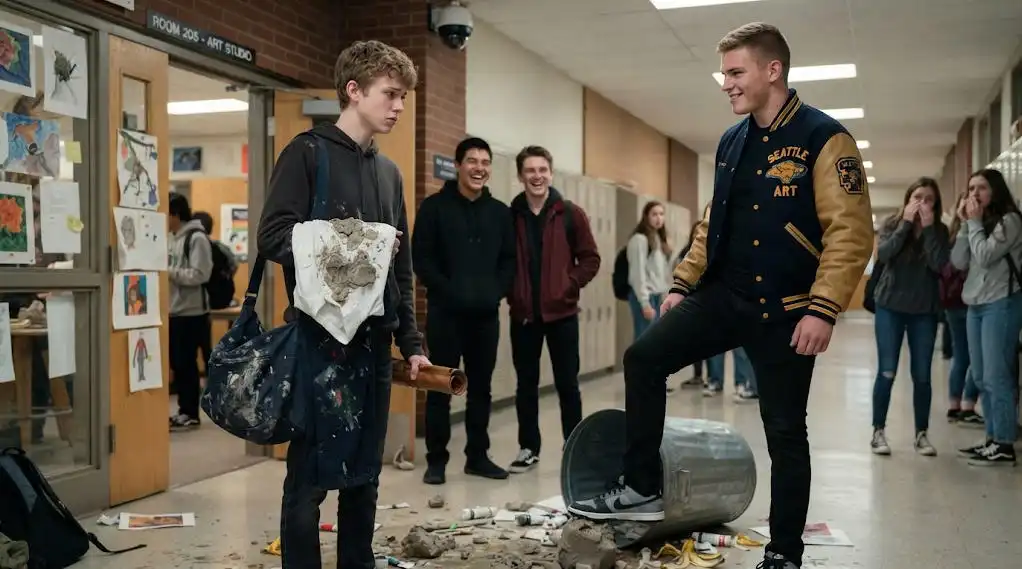
The high-definition camera captured everything with ruthless, objective clarity. It captured Grant looking at the metal trash can. It captured him stepping backward to adjust his stance. It captured the deliberate, explosive swing of his right leg, a perfect, powerful kick directly into the center of the bin.
The footage showed the metal can launching sideways. It showed the gray sludge erupting over my body. It showed me violently crashing to the floor, scrambling in the filth.
And, most damning of all, it showed Grant Mercer standing over my ruined body, a wide, sadistic smile on his face, before turning and casually strolling away.
There was no trip. There was no accident. It was an act of calculated, malicious violence.
The screen went black.
The silence in the boardroom was absolute. The air had been sucked out of the room.
I didn’t look at Grant. I looked at Arthur Mercer.
The billionaire real estate developer was staring at the blank screen, his face a mask of horrified realization. The silver pen in his hand was trembling slightly. He wasn’t horrified that his son was a bully; he was horrified that his son had been stupid enough to leave undeniable proof. His money, his influence, his power—none of it could erase what everyone in this room had just witnessed with their own eyes.
“Would you still like to describe this as a clumsy mistake, Grant?” Ms. Alvarez asked, her voice dangerously quiet.
Grant was frozen. The charming smile had vanished, replaced by the pale, wide-eyed panic of a cornered animal. He looked at Principal Vance. He looked at his father.
Arthur Mercer slowly lowered his pen to the table. He did not look at his son.
Principal Vance cleared his throat, his voice suddenly stripped of all its previous warmth. “Noah… is there anything you would like to say to the committee?”
I stood up. I placed my hands on the table. My heart was pounding, but my voice was completely steady.
“Grant hates me because I won the sculpture competition,” I said, looking directly into Grant’s terrified eyes. “He hates me because he thinks people like me are only here to clean up after people like him. I don’t care if he likes me. But I work fifty hours a week to earn the money for my education. I worked for months on that sculpture. And I spent hours cleaning the only formal clothes I own for a college interview.”
I leaned forward, the anger finally bleeding into my words.
“You don’t get to destroy my dignity just because you don’t like seeing me succeed,” I said. “You don’t get to treat people like trash just because your father’s name is on a building.”
Grant looked down at his hands. He opened his mouth, muttering something barely audible. “I’m sorry, okay? I’ll pay for the bag.”
“I don’t want your money,” I said sharply. “And I don’t want an apology you’re only giving because you got caught. I want you to face the consequences of what you actually did.”
I sat back down.
The committee deliberated for less than ten minutes. The evidence was bulletproof. The risk of a cover-up scandal was far too great for the school to ignore.
The ruling was severe. Grant Mercer was suspended for two weeks. A major disciplinary infraction for malicious destruction of property was permanently attached to his academic record—a red flag that would be sent to every Ivy League university he applied to. He was stripped of his Vice President title in the Sculpture Club and banned from all extracurricular activities for the remainder of the year.
His father’s position on the board did not save him. The truth was simply too heavy to move.
Three months later, the Seattle rain had finally given way to the crisp, clear skies of early spring.
I stood in the vast, echoing atrium of the Seattle Public Art Museum. The floors were polished marble, and the walls were bathed in warm, curated gallery lighting. Dozens of patrons were milling about, holding exhibition catalogs.
I was wearing my blue polo shirt. My hands were shoved deep into the pockets of my faded corduroy jacket.
A few days after the hearing, Ms. Alvarez had received a letter. The independent judges who had awarded me the Westlake Grand Prize were curators for this very museum. They had petitioned their board to include my piece in their annual “Emerging Voices” showcase.





