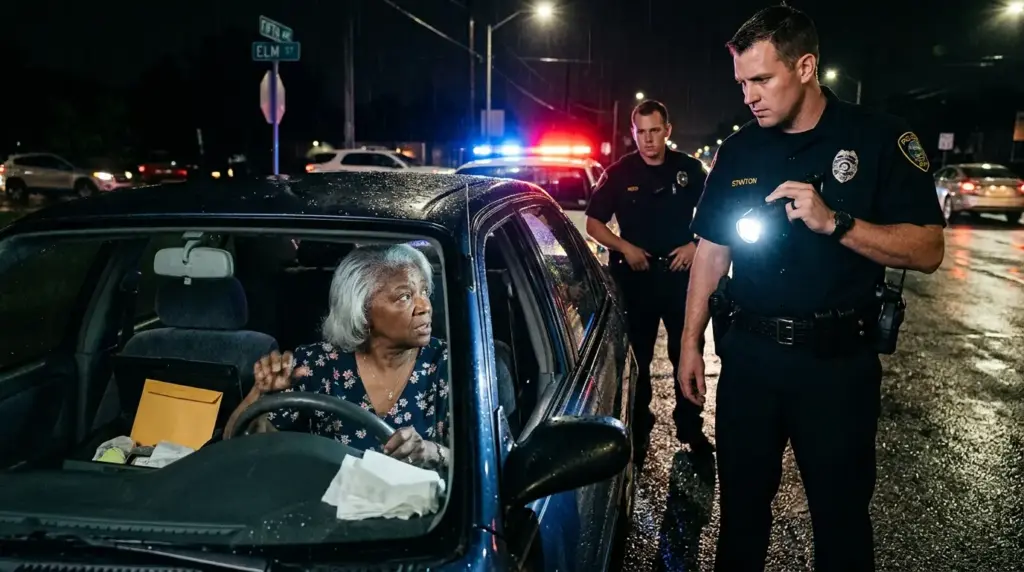
“Officer Stanton, how long have you served with the department?”
“Twelve years, sir.”
“In those 12 years, how many traffic stops would you estimate you’ve conducted?”
“Thousands, easily.”
“And during those thousands of stops, what is your primary concern?”
“Officer safety,” Stanton answered smoothly, the rehearsal paying off, his voice steady. “There is no such thing as a routine traffic stop. You never know who’s behind the wheel. You never know what’s in the glove box. It’s the most vulnerable position an officer can be in.”
“Take us to the night of August 14th. Why did you pull Mrs. Hayes over?”
“She drifted over the yellow line twice. I suspected an impaired driver.”
“When you approached the vehicle, what did you observe?”
Stanton leaned into the microphone. “The driver was uncooperative. I issued a lawful command to keep her hands on the wheel. She ignored it.”
“Did she tell you she was reaching for her registration?”
“She was speaking, but traffic was loud. I couldn’t hear her clearly. All I saw was a sudden, furtive movement toward the glove compartment. In my training, a furtive reach into a concealed area is a pre-assault indicator. People hide weapons in glove boxes.”
“So, what did you do?”
“I utilized constructive authority. I extracted the suspect from the vehicle to neutralize the potential threat.”
“You dragged a 72-year-old woman out by her hair,” a voice muttered from the gallery.
It wasn’t loud, but in the tense silence it carried. Judge Wallace’s gavel cracked down.
“Silence in the gallery, or I will clear this room!”
Bradley didn’t miss a beat. “Officer Stanton, did you intend to break Mrs. Hayes’s collarbone?”
“Absolutely not. It was an unfortunate result of a dynamic, rapidly evolving situation. The pavement was wet. She slipped during extraction. I was operating strictly within the department’s use of force continuum.”
“Thank you, Officer. Nothing further.”
Bradley sat, wiping sweat from his forehead. It was the best he could do: wrap violence in sterile bureaucratic language.
Clark stood. He didn’t bring a notepad. He walked slowly toward the center of the room. “Officer Stanton, let’s talk about this rapidly evolving situation. You’re 6’1″, 210 pounds. You bench press regularly, don’t you?”
“Objection,” Bradley called. “Relevance.”
“Goes to disparity of force, Your Honor,” Clark said.
“Overruled. Answer the question.”
“I stay in shape for the job, yes.”
“Mrs. Hayes is 5’3″. She weighs 115 pounds. She was wearing a floral dress.” Clark tilted his head. “Did she look like a tactical threat to you, Officer?”
“Size doesn’t matter when a firearm is introduced, sir. A bullet from a frail suspect kills you just as dead.”
“Ah, a firearm. The firearm she didn’t have.”
“I didn’t know that at the time.”
“Right. You just saw a furtive movement.” Clark walked to the evidence table, lifted a heavy black flashlight, and set it down again with a deliberate thud. “You blinded her with this. She told you she was reaching for her registration, and she pulled out exactly what she said she would, and your response was to rip her out of the car by her scalp.”
“I followed my training!” Stanton barked back, his temper flaring.
“She wasn’t complying. She wasn’t moving fast enough for your ego,” Clark countered. “You wanted total submission, and she had the audacity to be an old woman with a sticky glove box latch.”
“Objection! Argumentative!” Bradley was on his feet.
“Sustained. Mr. Clark, rein it in.”
Clark took a breath, smoothing his crooked tie, and looked toward the back of the gallery. Jackson was leaning forward now, elbows on his knees, hands loosely clasped, staring a hole directly through Stanton’s chest.
Stanton couldn’t help it. He followed Clark’s gaze and locked eyes with Jackson.
For 12 years, Stanton had worn a badge and been the apex predator in every room he entered. He was used to fear, compliance, respect. But looking into the eyes of the man in the back row, Stanton felt a cold, primitive terror scrape down his spine. It was the sudden, horrifying understanding that the uniform didn’t matter here. The badge didn’t matter. If this man decided to cross the wooden railing, no bailiff, no judge would stop him.
“Officer Stanton,” Clark said quietly, drawing his attention back. “When you broke her bone, when you heard it snap, did you call for an ambulance?”
Stanton’s mouth had gone dry. “No.”
“Why not?”
“She was under arrest. Protocol dictates we secure the suspect first.”
“You handcuffed a broken arm behind her back. You dragged her up by the chain. Then you put her in the back of your cruiser.” Clark leaned on the podium. “Tell me, Officer Stanton, in all your thousands of traffic stops, is that how you protect and serve?”
Stanton opened his mouth, but the prepared defense caught in his throat. He looked at Bradley, silently begging for an objection, but Bradley was staring at his notepad.
“I did my job,” Stanton whispered.
“No,” Clark said, turning his back on the witness stand in disgust. “You didn’t. No further questions.”
Stanton stepped down, his confident swagger gone, replaced by the stiff, mechanical gait of a man walking through a minefield. He sat without looking at his lawyer or his partner.
Bradley stood, buttoning his jacket with trembling fingers. “Your Honor, the defense rests.”
Judge Wallace nodded, noting it on his legal pad. “Mr. Clark, any rebuttal witnesses?”
Clark rose slowly, smoothed his tie one final time, looked across the aisle at the two officers, then toward the back of the room, where a man in a charcoal suit sat with the stillness of a predator waiting in tall grass.
“Yes, Your Honor,” Clark said, his voice ringing clear. “The state calls Officer David Reed.”
The courtroom exhaled a confused, collective breath. Bradley’s head snapped up.
“Objection! Officer Reed is a co-defendant! He has invoked his Fifth Amendment right. The state cannot compel him to testify!”
“The state isn’t compelling him, Your Honor,” Clark replied evenly.





