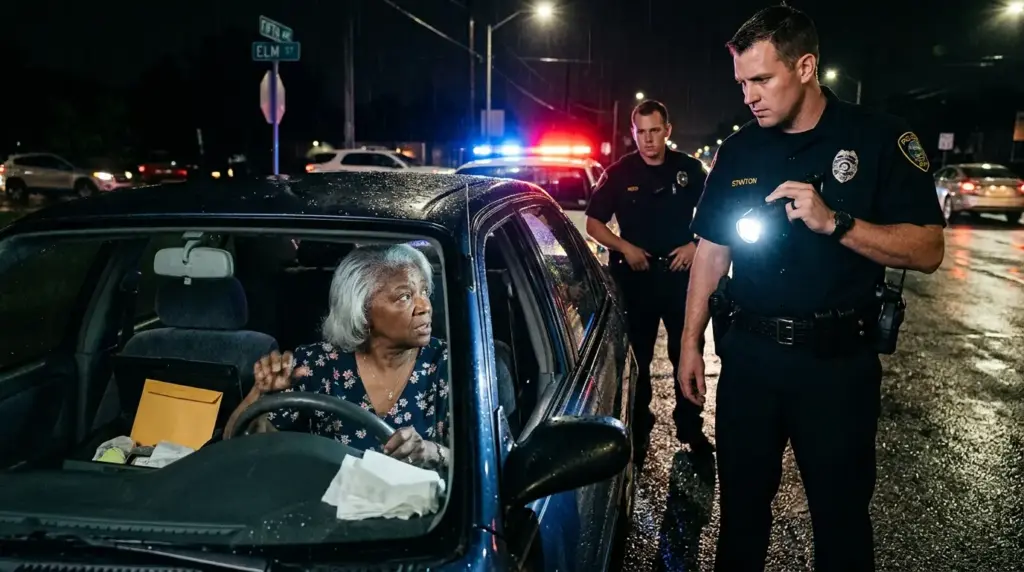
He gestured toward the oak doors. A man in a cheap gray suit walked in—a union-appointed attorney named O’Connor.
“During the lunch recess, Officer Reed, through independent counsel, reached a proffer agreement with the district attorney’s office. He has waived his Fifth Amendment rights. He intends to change his plea to guilty on the charge of official misconduct in exchange for truthful testimony regarding the assault charges against Officer Stanton.”
Stanton turned to Reed, the color drained from his face, replaced instantly by a flush of murderous rage. “You rat piece of garbage,” he hissed.
“Control your client, Mr. Bradley!” Judge Wallace barked, slamming his gavel. “Officer Reed, you’re still under oath. Take the stand.”
Reed stood. His legs wobbled as he climbed into the witness box like a man walking to the gallows, refusing to look at Stanton, whose eyes bored into the side of his head, and refusing, more importantly, to look toward the back row of the gallery.
“Officer Reed,” Clark began, leaning against the prosecution table. “Let’s be clear for the jury. You’re testifying today because you accepted a plea deal. You’re going to lose your badge. You’re going to serve probation. Correct?”
“Yes, sir,” Reed whispered.
“Speak up, please.”
“Yes, sir.”
“Why did you take the deal, David?” Clark stripped him of his title deliberately.
Reed gripped the wooden railing, knuckles bone-white, his Adam’s apple bobbing. “Because I can’t carry this anymore. Because we lied.”
The silence in the courtroom was absolute. You could hear the fluorescent tubes buzzing overhead.
“Tell the jury about the lie,” Clark said softly.
Reed took a shuddering breath. “When we pulled Mrs. Hayes over, Stanton was already agitated. We’d had a bad call earlier in the shift. A guy spit in his face. He’d been looking for something to hit all night.”
“Objection! Speculation as to my client’s state of mind!”
“Sustained. Stick to the facts, Officer Reed.”
“The facts,” Reed said, his voice gaining a fraction of strength, “are that Mrs. Hayes didn’t make a furtive movement. She told us exactly what she was doing. She was reaching for her registration. Stanton knew it. I knew it. But the glove box was jammed. She pulled on it, and it made a loud popping noise when it opened, and Stanton just snapped.”
He looked up directly at the jury box, tears finally welling in his eyes, spilling onto his cheeks.
“He grabbed her by the hair. I yelled, ‘Gun!’ because… because that’s what you do. It’s the magic word. You yell ‘gun’ and it covers whatever happens next. But I never saw a weapon. There was no threat. He threw a 72-year-old woman onto the asphalt because he was having a bad night and he wanted someone to bleed for it.”
A collective gasp rippled through the gallery.
“What happened after she was handcuffed?” Clark asked.
“She was crying. She said her arm was broken. Stanton told her to shut up. He picked her up by the cuffs. I heard her shoulder pop. It sounded like tearing wet canvas.” Reed closed his eyes, the memory physically repulsing him. “We put her in the cruiser. We drove to the precinct. In the parking lot, Stanton turned off his body cam. He told me to turn mine off. He said, ‘We write the same report. She resisted. She reached into the dark. We feared for our lives. The union will back us. The brass will rubber-stamp it. She’s nobody. Just another file in the drawer.'”
Clark let the words hang in the air. She’s nobody.
He looked at Beatrice Hayes, sitting perfectly still, chin raised, her dignity an impenetrable armor. Then he looked toward the back row. Jackson Hayes hadn’t moved a muscle. He was simply watching the geometry of the room, recording the collapse of his mother’s attackers.
“Did she look like nobody to you, David?” Clark asked quietly.
“No,” Reed choked out. “She looked like my grandmother.”
“Thank you. Pass the witness.”
Bradley stood for cross, still bound by duty to a rapidly sinking client. “Officer Reed, you’re a coward, aren’t you?”
“Objection,” Clark called.
“I’ll allow it,” Judge Wallace said grimly.
“I am,” Reed answered, voice devoid of pride. “I was a coward that night for not stopping my partner. And I’m a coward today, testifying against him to save myself from prison.”
“You’d say anything to stay out of a cell?”
“I would,” Reed admitted, finally looking at Stanton. “But I’m not lying now. I lied to cover for you, Tommy. I’m done covering.”
Bradley had nothing left. “No further questions.”
“Closing arguments in 15 minutes,” Judge Wallace said.
In the hallway, Beatrice sat on a hard bench, her arm in a black sling, the painkillers wearing thin. Jackson brought her water.
“Thank you, baby,” she murmured, her hand shaking.
He sat beside her. Up close, the toll of his life showed: faint scars across his knuckles, exhaustion settled deep in his eyes. “Are you in pain?” he asked, his voice low now, the ice gone.
“Just tired, Jackson. Deep down tired.” She studied his face. “That boy Reed looked terrified. You didn’t threaten him, did you?”
“No, Mama. I didn’t threaten him.”
It was the truth. Soldiers like Jackson didn’t make threats; they stated facts.
“Good,” she said, resting her head on his shoulder. “We don’t need more violence. I just want this over.”
The courtroom doors swung open. “Jury’s back,” the bailiff called.
Only three hours. Short deliberations rarely favor the defense. Jackson offered his arm, and together they walked back in.
The air had changed. The tension was no longer anticipation; it was certainty waiting to be spoken aloud. Stanton stood at the defense table, his arrogance finally collapsed, shoulders rounded, looking small.
The jury filed in. They didn’t look at Stanton. They didn’t look at the judge. They looked at Beatrice.
“Have you reached a verdict?” Judge Wallace asked.
The jury foreman stood, holding a slip of paper. “We have, Your Honor. On the charge of aggravated assault, we find the defendant guilty.”





