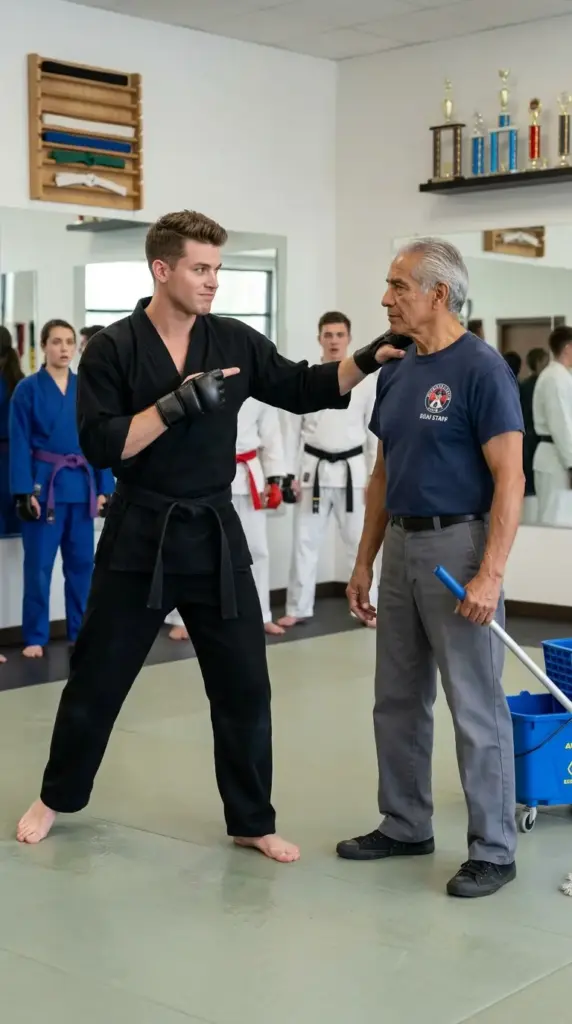
“When I was thirteen, I was angry, arrogant, and stupid. My father had left. My mother worked nights. I got into fights because I wanted the world to know I was hurt. Every dojo in my neighborhood kicked me out.”
He turned toward Mr. Alvarez.
“Except his.”
The old man looked down.
Adrian continued.
“Master Alvarez ran a small martial arts school above a grocery store in Queens. No fancy equipment. No mirrors. No trophies in the window. Just cracked mats, old fans, and discipline.”
A few students looked around at the polished dojo, suddenly aware of how much shine surrounded them.
“He never taught me to win first,” Adrian said. “He taught me to bow. To sweep the floor. To breathe. To apologize. To walk away.”
Brandon swallowed.
His students were staring at him now.
Adrian’s voice grew softer.
“I hated him for it. I wanted power. He gave me patience. I wanted to beat people. He taught me not to need to. And when I finally learned that, I started winning.”
Mr. Alvarez looked at him.
“You did the work.”
“You showed me how.”
Adrian turned to the room again.
“Every major victory of my career began in his school. Every medal I won belongs partly to him.”
The cameras had turned toward Mr. Alvarez.
He shifted uncomfortably.
For years, he had worked in silence.
Cleaned floors.
Emptied trash.
Listened to young fighters speak loudly about discipline while showing very little of it.
He had not hidden because he was ashamed.
He had hidden because the life he had once known had ended painfully.
Fifteen years earlier, his dojo burned down.
An electrical fire, they said.
No one was hurt, but the building was lost. Insurance denied the claim because of a technicality in the lease. Rent had already been overdue. Medical bills from his wife Elena’s cancer treatments had drained every account.
Carlos Alvarez sold what was left.
The heavy bags.
The old mats.
The framed photographs.
Even the sign.
Then Elena died six months later.
After that, he stopped teaching.
Not because he stopped loving martial arts.
Because the room had become too empty without her sitting by the front desk, collecting tuition envelopes and pretending not to cry when a student won a tournament.
He moved to Boston to live near a cousin.
Took janitorial work.
Quiet work.
Honest work.
Work that asked nothing from his broken heart except that he show up and keep moving.
The dojo hired him because he was reliable.
No one there knew that he had once trained champions.
No one asked.
And Mr. Alvarez had learned that the world rarely sees what it is not trained to recognize.
Brandon stepped forward, forcing a laugh.
“Okay, this is touching and all, but with respect, that was a long time ago.”
The room turned toward him.
He should have stopped there.
But arrogance, once wounded, often chooses ruin over humility.
“I’m sure Mr. Alvarez was something back in the day,” Brandon continued. “But martial arts evolve. Sport evolves. Competition evolves. With all due respect, cleaning floors in a dojo doesn’t make you relevant now.”
A silence fell that felt colder than the air-conditioning.
Adrian’s face hardened.
Mr. Franklin whispered, “Brandon.”
But Brandon was committed.
He looked at Adrian.
“You came here to teach modern champions, right? Then teach. Don’t turn this into a retirement-home tribute.”
Several parents gasped.
Mr. Alvarez closed his eyes.
Adrian stared at Brandon for a long moment.
Then asked, “What rank are you?”
“Third-degree black belt.”
“Who promoted you?”
“Master Franklin.”
Adrian turned slightly.
Mr. Franklin looked mortified.
Adrian nodded slowly.
“Rank means responsibility.”
“I understand that.”
“No,” Adrian said. “You wear it. That is different from understanding it.”
Brandon’s face reddened.
“I’ve won twenty-two regional medals.”
“And yet you have not learned how to speak to the man who cleaned the mat you trained on.”
Brandon looked around.
The cameras were still recording.
Students were watching.
The room that had once fed his ego now threatened to witness his humiliation.
His pride panicked.
“Fine,” he said. “If he’s such a master, let him show us.”
Mr. Alvarez opened his eyes.
“No.”
Brandon smiled.
“There it is.”
Adrian stepped between them.
“Do not mistake restraint for inability.”
Brandon ignored him.
“Come on, Master. One round. Light contact. Show the students all that old wisdom.”
Mr. Alvarez looked at him with sadness.
“You are asking for the wrong lesson.”
“Sounds like an excuse.”
Adrian’s voice cut through the room.
“Enough.”
But Mr. Alvarez raised one hand.
Not to Brandon.
To Adrian.
“It’s all right.”
Adrian turned.
“Master, you do not have to.”
“I know.”
Mr. Alvarez stepped onto the mat.
A murmur swept through the dojo.
Parents lifted phones higher.
Students moved back.
Brandon smiled like he had won.
He bounced lightly on his toes, rolling his shoulders, shaking out his arms.
Mr. Alvarez stood still.
He did not remove his work shirt.
Did not change shoes.
Did not stretch.
He only placed his hands at his sides and waited.
Mr. Franklin moved forward.
“This is not a sanctioned match.”
“It won’t be a match,” Mr. Alvarez said.
The sentence made Brandon laugh.
“You hear that? He’s already giving up.”
Adrian stood near the edge of the mat, face unreadable.
But his eyes never left his old teacher.
Brandon raised his guard.
“Ready, old man?”
Mr. Alvarez bowed.
Brandon did not.
That told the room everything, though not everyone understood it yet.
Brandon attacked first.
A fast jab.
Sharp.
Clean.
Technically sound.
Mr. Alvarez shifted half a step.
The punch missed by less than an inch.
Brandon fired a low kick.
Mr. Alvarez lifted his foot just enough for the kick to pass under his balance point, then set it down at a slight angle.
Brandon’s stance broke.
Not badly.
Just enough.
He recovered quickly and came forward with a combination.
Jab.
Cross.
Hook.
Round kick.
To most students, Brandon looked fast.
To Mr. Alvarez, he looked early.





