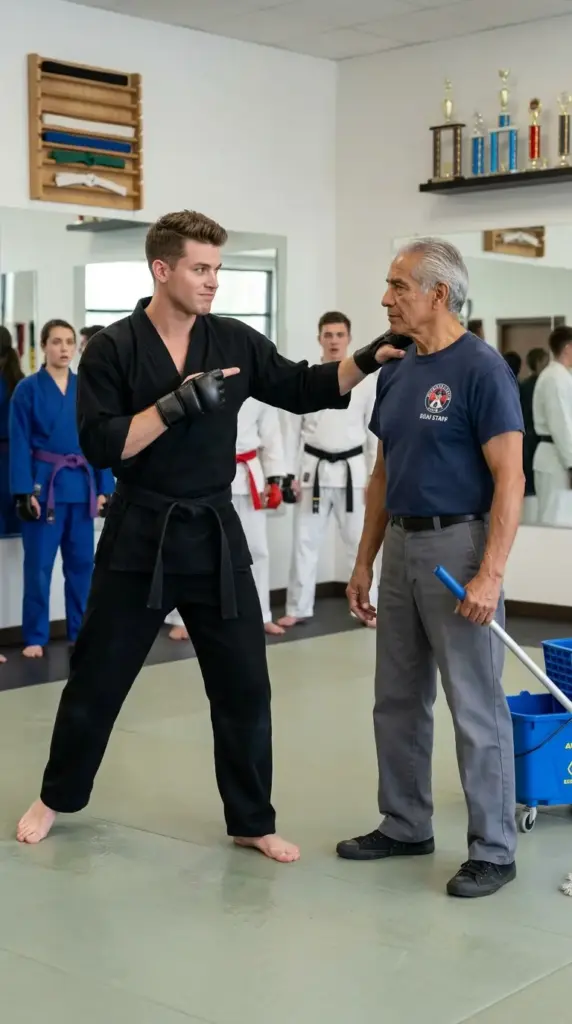
How to bow like it meant something.
How to clean a mat properly.
That last lesson confused some students until Adrian joined him.
The world champion took a mop from the storage closet, filled a bucket, and stood beside Mr. Alvarez.
“Before I was allowed to spar,” Adrian said, “I cleaned for six months.”
A few students looked shocked.
Brandon looked down.
Adrian continued.
“Not as punishment. As education. If you are too proud to clean the place where you train, you are not ready to fight on it.”
Then the students cleaned.
All of them.
White belts.
Black belts.
Adults.
Children.
Even parents helped stack chairs.
For the first time since Mr. Alvarez had taken the janitorial job, he did not clean alone.
At the end of the seminar, students lined up for autographs from Adrian.
But many also lined up to speak with Mr. Alvarez.
“Thank you, sir.”
“I’m sorry I never introduced myself.”
“Will you teach again?”
“My son wants to learn from you.”
“My daughter too.”
Mr. Alvarez answered each politely, still uncomfortable with attention.
Brandon waited until the room had thinned.
His senior students had left.
The cameras were packing up.
Adrian stood near the office speaking with Mr. Franklin.
Mr. Alvarez was folding towels when Brandon approached.
For a moment, neither man spoke.
Then Brandon untied his black belt.
He held it in both hands.
His voice was low.
“I don’t deserve this.”
Mr. Alvarez looked at the belt.
“That is not mine to decide.”
“I embarrassed myself.”
“Yes.”
Brandon flinched.
The honesty landed clean.
“I disrespected you.”
“Yes.”
“I thought the belt made me better than people.”
Mr. Alvarez waited.
Brandon swallowed.
“I was wrong.”
The old man studied him.
This was the important moment.
Not the throw.
Not the applause.
Not the world champion’s bow.
This.
A proud man standing at the edge of change, deciding whether humiliation would harden him or open him.
Mr. Alvarez took the belt from Brandon’s hands.
For one terrible second, Brandon thought the old man might keep it.
Instead, Mr. Alvarez folded it carefully and handed it back.
“A belt is not proof that you have arrived,” he said. “It is a reminder of what you still owe.”
Brandon looked down at it.
“What do I do?”
Mr. Alvarez pointed toward the storage closet.
“Start with the mop.”
Brandon blinked.
Then nodded.
He went to the closet, filled the bucket badly, spilled water on his own shoes, and spent the next hour cleaning the mats under Mr. Alvarez’s supervision.
No one laughed.
Not because it was not funny.
It was a little funny.
But because everyone understood they were watching the beginning of a different kind of training.
Over the next weeks, the dojo changed.
At first, people came because of the video.
Someone had posted the clip online with the title:
World Champion Calls Janitor “Master.”
It spread everywhere.
Millions of views.
Comments from martial artists around the world.
Some mocked Brandon.
Some praised Mr. Alvarez.
Some argued about technique.
But the ones who understood the deepest lesson wrote the same thing again and again.
This is what martial arts is supposed to be.
Reporters came.
Podcasts called.
A sports network wanted a feature.
Mr. Alvarez declined most interviews.
He agreed to one only because Adrian asked him to.
When the interviewer asked why he had hidden his past, Mr. Alvarez looked at his hands.
“I was not hiding,” he said. “I was grieving.”
The room went quiet.
He continued.
“After my wife died, the sound of a dojo hurt too much. But cleaning one was close enough to remember and far enough to survive.”
The clip touched people even more than the throw.
Students began showing up not for tricks, but for something rarer.
Humility.
Mr. Franklin asked Mr. Alvarez to teach a weekly fundamentals class.
Then two.
Then a special Saturday morning session called Foundations.
The name was Adrian’s idea.
No one advanced in rank at the dojo anymore without completing six weeks of mat cleaning and service duty.
Parents loved it.
Students complained at first.
Then they changed.
The dojo became quieter.
Not less joyful.
Just less arrogant.
Brandon changed slowly.
Not magically.
Humility did not arrive in one dramatic moment and stay forever.
Some days he still spoke too sharply.
Some days he wanted to impress people.
Some days he felt anger rise when newer students corrected him.
But now he noticed it.
That was the beginning.
He cleaned mats every Friday night with Mr. Alvarez.
At first, it was punishment.
Then routine.
Then practice.
One night, after everyone had left, Brandon pushed the mop in slow lines across the mat.
Mr. Alvarez watched from the bench.
“You are rushing.”
“I’m mopping.”
“You are rushing while mopping.”
Brandon exhaled.
“Is there a correct way to mop now?”
“There is a correct way to do everything.”
Brandon rolled his eyes, but gently now.
Then he slowed down.
Long strokes.
Even pressure.
Edges first.
Center last.
After a while, he said, “I used to think people respected me.”
Mr. Alvarez looked up.
“They feared your temper.”
Brandon nodded.
“I know that now.”
“That is not the same thing.”
“No.”
He stopped mopping.
“Did you ever have a student you couldn’t fix?”
Mr. Alvarez smiled faintly.
“Many.”
“What happened to them?”
“Some left. Some returned years later. Some did not.”
“Did that hurt?”
“Yes.”
“Then why keep teaching?”
Mr. Alvarez looked across the clean mat.
“Because the ones who return make the waiting worth it.”
Brandon lowered his eyes.
“I’m trying to return.”
“I know.”
That was all Mr. Alvarez said.
It was enough.
Adrian visited again three months later.
This time, there were no cameras.
No seminar.
No crowd.
He came on a quiet Tuesday afternoon with a duffel bag and two cups of coffee.
Mr. Alvarez was teaching a children’s class.
Twenty kids stood in uneven rows, trying to balance on one foot without falling into each other.





