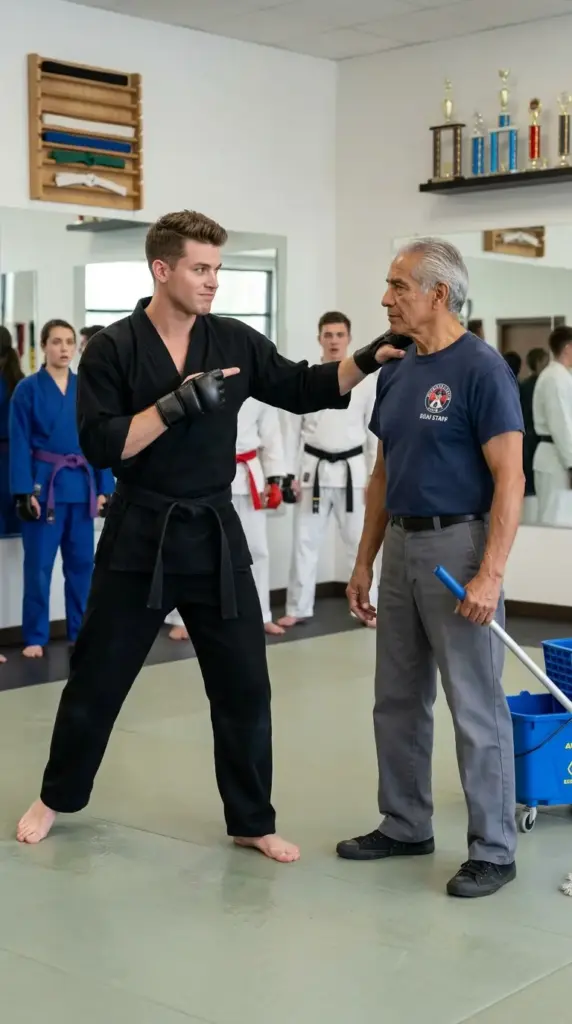
Adrian stood at the door and watched.
Mr. Alvarez noticed him and smiled.
“Class,” he said, “we have a guest.”
One child gasped.
“You’re on YouTube!”
Adrian laughed.
“So are you, probably.”
The children surrounded him after class, asking questions all at once.
Can you kick over your head?
Did you ever lose?
Do medals feel heavy?
Are you stronger than Mr. Alvarez?
Adrian looked at his old teacher.
“No,” he said.
The children went quiet.
“Really?”
Adrian nodded.
“Really. Because strength is not only what your body can do. It is what your character can carry.”
Later, after the children left, Adrian and Mr. Alvarez sat together on the edge of the mat.
For a while, neither spoke.
Then Adrian said, “I bought the building.”
Mr. Alvarez turned.
“What building?”
“The old one in Queens.”
The old dojo.
The grocery store below had closed years ago. The upper floor had been used for storage, then abandoned.
Mr. Alvarez looked away.
“Why would you do that?”
“Because it should not become luxury apartments.”
The old man’s throat moved.
Adrian continued.
“I want to restore it. Not as a commercial school. As a foundation. Free training for kids who need structure. Scholarships. Mentorship. Food after class. The things you gave me.”
Mr. Alvarez stared at the mat.
“Elena would have liked that.”
“I was hoping,” Adrian said carefully, “we could name it after her.”
For a moment, Mr. Alvarez could not speak.
Then he bowed his head.
“The Elena Alvarez Foundation,” Adrian said. “If you approve.”
The old man closed his eyes.
When he opened them, they were wet.
“She always wanted the children fed first,” he said.
“Then we feed them first.”
Six months later, the Elena Alvarez Foundation opened in Queens.
The sign was simple.
White letters on dark wood.
Inside, the mats were new, but one wall remained exposed brick from the original school. Mr. Alvarez insisted on that. Some old things should not be covered.
At the opening ceremony, Adrian spoke first.
Then Mr. Franklin.
Then one of Mr. Alvarez’s former students, now a school principal, talked about how the old dojo had kept him out of jail.
Then Brandon spoke.
That surprised people.
He stood at the microphone in a plain white uniform, no medals, no dramatic introduction.
“My name is Brandon Cole,” he said. “And the first lesson Master Alvarez taught me was that I did not yet deserve the belt I wore.”
A soft murmur moved through the room.
Brandon continued.
“I thought martial arts was about being stronger than the person in front of me. I thought respect was something people owed me because I could beat them. I was wrong.”
He looked toward Mr. Alvarez.
“Respect is service. Rank is responsibility. Strength is restraint. And sometimes the person cleaning the floor has more to teach you than the person standing at the front of the room.”
Mr. Alvarez lowered his eyes, but he was smiling.
Brandon bowed deeply.
“Thank you, Master.”
The applause was quiet at first.
Then full.
Adrian stood beside Mr. Alvarez.
“You changed him.”
Mr. Alvarez shook his head.
“No. He decided to change. I only held up the mirror.”
Years passed.
The story became part of martial arts folklore.
The arrogant black belt.
The janitor.
The world champion’s bow.
People told it in different ways, as stories often change with time.
Some made the throw bigger.
Some made Brandon crueler.
Some made Mr. Alvarez into a mysterious legend who had chosen poverty for wisdom.
The truth was simpler.
And better.
He was a man who had loved a dojo.
Loved a wife.
Lost both.
Then spent years cleaning floors because grief had made teaching too painful.
But the art had never left him.
It was in his posture.
His breath.
His hands.
His patience.
His ability to stand in front of insult and not let it choose his actions.
That was mastery.
Not a belt.
Not a medal.
Not applause.
Mastery was the quiet discipline of carrying power without needing to show it.
Years later, when students at the Elena Alvarez Foundation asked Mr. Alvarez what made someone a true martial artist, he never mentioned trophies.
He never mentioned rank.
He pointed to the floor.
“Leave the mat cleaner than you found it,” he said.
The children always thought he meant the rubber beneath their feet.
And he did.
But he meant more.
Leave the room better.
Leave the people safer.
Leave your anger smaller than when you entered.
Leave your pride at the door.
Leave proof that your strength served something beyond yourself.
Brandon eventually became an instructor at the foundation.
Not the loudest one.
Not the flashiest.
But patient.
Careful.
Whenever a new student showed arrogance, Brandon did not mock him.
He handed him a mop.
And if the student complained, Brandon smiled and said, “Good. That means the first lesson is working.”
On the wall near the entrance hung a photograph taken the day everything changed.
Adrian Vale bowing deeply to a man in a janitor’s uniform.
Beside it was a smaller photograph taken six months later.
Brandon, holding a mop, standing beside Mr. Alvarez on a clean mat.
Under both photographs was a simple inscription:
A belt can be tied in a moment.
A master is made over a lifetime.
And every evening, after class, when the students finished bowing and the parents gathered their children and the lights dimmed across the mat, Mr. Alvarez still checked the floor.
Not because anyone made him.
Not because he was still the janitor.
Because he knew something most people forget.
The mat remembers everything.
The footsteps.
The falls.
The sweat.
The pride.
The apology.
The first bow of a child who does not yet understand respect.
The last bow of a champion who finally does.
And sometimes, if the room is quiet enough, you can hear the lesson beneath it all.
Never mock the hands that clean the ground you stand on.





