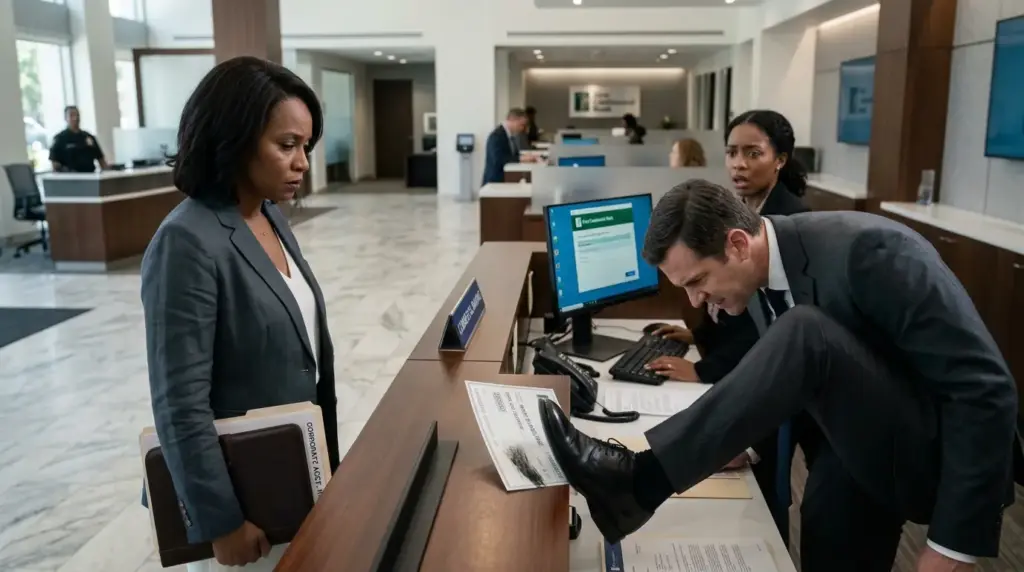
Martin’s employment was terminated after the bank completed its personnel process. The finding against him cited the racial abuse, misuse of fraud review authority, inaccurate description of Marion’s conduct, and his attempt to have Alicia record the transaction as a customer refusal.
Alicia’s case was handled separately. She had not approved the deposit; she had not challenged Martin’s managerial authority at the counter. She had simply refused to enter a fact she had not observed. Her customer-facing access was restored, and Heritage paid the wages she had lost during the internal suspension. There was no promotion attached to it; her original teller entry remained in the file. That mattered more.
The regional problem produced a different consequence: Heritage withdrew “client presentation” from its fraud selection guidance. Future manual referrals required a documented transaction, identity, account, or instrument condition that another reviewer could actually identify. The bank also accepted independent monitoring of comparable referral outcomes under the regulatory resolution.
That change was not added because one manager had behaved badly; it was required because the bank had already been warned that an undefined, appearance-based factor was producing unequal scrutiny and had allowed the rule to remain active.
Several older complaints tied to the same mechanism were reopened. Rachel did not tell us that every complaint would be sustained; she said they would be reviewed under the standard that should have existed when they were filed.
Marion’s own record was corrected first: the manual fraud referral was removed. The final disposition stated that Southline Community Capital had presented a valid certified instrument and withdrew the proposed placement after improper branch handling. It did not say Marion refused verification; it did not say the check failed review. Those facts were now separate from Martin’s version.
Heritage later paid a regulatory penalty and entered a formal remediation agreement covering the referral process and complaint handling.
Marion did not return with the check. By then, Southline had completed due diligence on three community banks with existing small business and neighborhood development programs. The $10 million placement was divided among them. The broader community trust moved forward under Ruth Caldwell’s name.
A few months later, I was reviewing the first construction draw for one of the projects the fund had been created to support. An old pharmacy storefront was being converted into a neighborhood clinic. The contractor had finished the electrical work and was installing examination room cabinets when Marion arrived for the site review. She checked the milestone sheet, asked one question about the completion date, and signed the release authorization.
Nobody there knew what had happened at Heritage National. They did not need to. The money had finally reached the work it was supposed to fund.
Shadows Over Heritage and the Light in the Dust
The dust from the drywall hung in the air like a fine grey mist, illuminated by bare bulbs hanging from temporary cords in the ceiling. The drill stopping and the sound of a hammer meeting wood were the only noises inside the old pharmacy, which was now slowly taking the shape of a clinic. Marion stood in the middle of the room with a clipboard in hand. Her fingers were steady as she signed the authorization for the first disbursement. There was no hesitation in her movements, none of the tremors that Heritage National Bank had spent months trying to plant in her self-confidence.
She handed the papers back to the construction foreman with a muted but unwavering nod.
“Everything is in order,” she said softly. “Proceed as planned.”
The foreman took the paperwork without any idea of the battle fought behind every single cent paying for the medical cabinets and new electrical wiring. To him, she was simply a representative from Southline Community Capital—an efficient, calm woman doing her job thoroughly. He didn’t know that these ten million dollars were once frozen in a web of prejudice, bureaucracy, and silent arrogance at Heritage National. Nor did he need to. The money had finally reached the work it was always meant to fund.
Yet, even as the work on the construction site forged ahead, the story of Heritage National Bank was far from over. An institution does not change so easily, and the wounds created by its arbitrary procedures required more than a mere fine to heal.
The Chapter of Cleanup
In the weeks following the site review, a slow, suffocating aftermath unfolded. Heritage National Bank was forced to make its regulatory agreement public. The public report was a cold, legal enumeration of failures: “Undocumented and subjective assessment criteria regarding suspected fraud,” “deficient complaint handling,” and “disparate scrutiny of minority-owned and smaller organizations.”
To the general public, it was just another financial story in the business section. But for those of us who had sat in those cold meeting rooms, it was a total vindication.
At the bank’s downtown headquarters, the atmosphere had shifted drastically. Martin, the manager who had once signed the manual fraud referral against Marion and Southline, was no longer at his desk. His workspace was cleared out on a Friday afternoon without a farewell reception or explanation. His superiors tried to frame it as a “restructuring,” but everyone in the building knew that his personal interpretation of bank policy had become a direct liability under the new, independent monitoring.
Rachel, the bank’s counsel, kept her promise. Every single complaint from the past three years involving that same undefined, appearance-based referral rule was pulled out of the archives. It was painstaking work. Many of those affected had given up on their projects, some had lost their businesses, and others had simply carried the shame of being treated like criminals at a bank counter.
When Rachel’s final review was submitted, it revealed that over eighty percent of the manual referrals lacked any objective basis. The bank was ordered to send written apologies and financial restitution to the impacted parties. Not everyone accepted the apology. Many returned the letters unopened. But the system had been forced to look its own actions in the eye.
A New Balance
Back at Southline Community Capital’s modest offices on the edge of town, the mood had transformed. The massive ten-million-dollar placement, which was originally supposed to sit in a single large vault at Heritage, was now divided among three smaller community banks.
This division turned out to be a blessing in disguise. The three smaller banks knew exactly what the local area needed. They knew the names of the business owners, understood the neighborhood’s social challenges, and didn’t demand grand facades or polished surfaces to extend trust.
Ruth Caldwell, whose name the fund now bore, often sat in the office in the afternoon. She was an elderly woman with a gaze that had seen fifty years of the city’s rises and falls. She rarely asked for reports or charts; she simply wanted to know if the roofs on the new homes were holding up and whether the doctors at the new clinic had started seeing patients.
One Tuesday afternoon, Marion sat down beside Ruth. On the table between them lay the newspaper clipping detailing Heritage National’s fine and public apology.
“Does it feel any better?” Ruth asked softly, pointing at the headline.
Marion looked at the text for a moment. Her face was serene, but there was a depth in her eyes that only those who have fought an invisible battle possess.
“It doesn’t change what happened at the counter that day,” Marion said. “It doesn’t change the way the teller looked at me, or how they assumed a check from a community fund had to be fraudulent. But… it means the next girl who walks in with a check won’t be met with that same rule.”
Ruth nodded slowly and laid her hand over Marion’s.
“It was never the bank’s money, Marion. It was the community’s trust. The bank was just a holding place that forgot its role. Now, the money is at work.”
The Dedication of the Clinic
Six months later, the old pharmacy building was completely finished. The lingering smell of old paint and dampness was replaced by the clean scents of antiseptic, fresh wooden furniture, and coffee. The large front windows facing the street, which had been covered in plywood for years, were now clear and bright, letting the autumn sunlight stream into the waiting room.
There were no prominent bank executives present at the dedication. No one from Heritage National had been invited, and no high-ranking officials from City Hall showed up to cut ribbons. Instead, it was the neighborhood residents, the local tradespeople, the nurses, and families from the block who gathered.