Not the friendly kind that belonged in hallways after school or in living rooms when families told old jokes over dinner. This laughter was thin, polished, and sharp enough to cut. It came from the registration table, where a woman in a cream-colored blazer looked at Noah’s scuffed shoes as if they had left mud on the marble floor just by existing.
“You’re here for the delivery entrance,” she said without standing up.
Noah tightened his grip on the envelope in his hand. It was wrinkled from the rain and from the way he had held it against his chest all the way across town. “No, ma’am. I’m here to register for the Young Stars Talent Showcase.”
The woman finally lifted her eyes. Her name tag read Marla Whitcomb, Program Chair. Her smile did not reach the rest of her face. “You?”
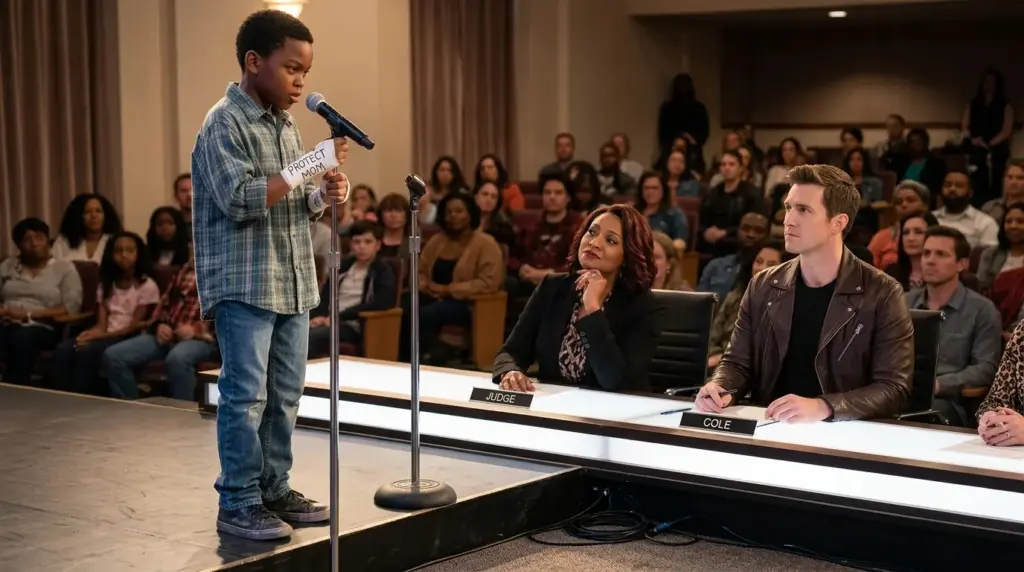
Noah swallowed. He was eleven years old, skinny from growing too fast and eating too little, with a church jacket two sizes too big folded over his arm. His hair was still damp. His jeans had been washed so many times the knees had gone pale. “Yes, ma’am.”
Marla leaned back in her chair. Behind her, glossy posters showed smiling children in tuxedos, sequined dresses, ballet slippers, and expensive stage makeup. The words GRAND PRIZE: $80,000 EDUCATION AND PERFORMANCE GRANT shone in gold letters across the largest poster.
Noah knew that number by heart. Eighty thousand dollars. Enough to pay the overdue hospital balance. Enough to keep the collection agency from calling. Enough to move his mother out of the apartment with the mold crawling behind the bathroom wall. Enough to make one impossible thing possible.
Marla picked up his application with two fingers. “Noah Bell. No parent email. No instructor listed. No performance academy. No résumé.” She glanced up. “Do you understand what this showcase is?”
“A talent competition.”
“It is a showcase for refined young performers.” She said refined slowly, like she was teaching him a new word. “Our finalists train for years. They come from proper programs. They have vocal coaches, accompanists, stage preparation, wardrobe consultants.”
“I can sing,” Noah said.
A teenage girl in a silver dance jacket, waiting beside her mother, turned and smirked. Marla gave a small laugh. “Every child thinks they can sing.”
Noah felt his ears go hot. “I’m not every child.”
Marla’s smile sharpened. “Confidence is charming when it is earned. On a child like you, it can become embarrassing.”
The envelope in Noah’s hand bent under his fingers. Inside was $260. Registration fee. He had earned it over eleven months: carrying groceries to cars outside the discount market, sweeping hair at Mr. Lewis’s barbershop, washing windows for Mrs. Alvarez on Saturdays, collecting cans from the park after baseball games. Some of the bills smelled like rain. Some of the quarters were sticky from vending machines. It was money built from work nobody clapped for.
“I have the fee,” he said.
Marla looked at the envelope and then back at him. “I’m sure you do. But money isn’t the only requirement.”
“The flyer says any child between ten and sixteen can enter if they pay the fee before registration closes.”
For the first time, annoyance broke through her polished expression. “The flyer also assumes families understand the spirit of the event.”
Noah knew what she meant. He did not have the right mother standing behind him. He did not have a father adjusting his tie. He did not have a private teacher telling him to breathe from his diaphragm. He had a bus transfer in his pocket and a mother sleeping in a reclining chair at St. Mercy Hospital because lying flat hurt too much.
“My mom signed the form,” he said.
Marla looked down at the signature. “Lena Bell.” Her eyes paused for half a second, as if the name touched something in the back of her memory, then she dismissed it. “And where is Mrs. Bell today?”
“In the hospital.”
The girl in the silver jacket stopped smirking. Her mother looked away.
Marla sighed, not with sympathy, but irritation. “Then perhaps your family’s priorities should be reconsidered. Competitions are expensive. Dreams are expensive. Illness is expensive. A sensible child would know where to put his money.”
Noah’s chest tightened so hard he could barely breathe. “That’s why I’m here.”
Marla tilted her head. “Excuse me?”
“The prize is eighty thousand dollars.”
For a moment, the whole lobby seemed to pause. Then Marla laughed again, louder this time. “Oh, sweetheart.”
The word felt worse than an insult.
Noah stepped forward and placed the envelope on the table. “I want to register.”
Marla looked at the envelope as if it were something unpleasant left on a sidewalk. “You are going to stand on that stage in front of donors, judges, cameras, children with real training, and embarrass yourself.”
“I still want to register.”
“You’ll dirty up the whole evening.”
Noah went still.
His mother had warned him about people like Marla. People who didn’t shout because they didn’t have to. People who could crush you with a smile and still call themselves polite. Lena Bell had worked hotel laundry for fourteen years and had taught Noah three rules: stand straight, speak clearly, and never let someone else decide your worth before you’ve opened your mouth.
Noah reached for the form. Marla lifted it before he could touch it. “This application is incomplete.”
“What’s missing?”
“Professional sponsor.”
“That isn’t on the flyer.”
“It is in the supplemental guidelines.”
“I never got those.”
“Then perhaps that tells you something.”
She let the paper slip from her fingers. It drifted down, landed in the wet footprint Noah had left on the floor, and soaked through.
Noah stared at his own handwriting blurring into gray streaks.
The teenage girl whispered, “Mom, that was mean.”
Marla’s head snapped toward her. “Isabelle.”