“I should have done it before he ever had to sing for your life,” Adrian said, his voice breaking. “I should have been there before there was a hospital bill. I should have been there before he learned to count coins like a grown man. I can’t fix that. I know I can’t. But I can stop pretending I didn’t fail you both.”
Noah wiped his face with his sleeve. “Thank you for paying for her surgery.”
Adrian nodded, tears falling freely now.
“But money doesn’t make you my father.”
“No,” Adrian whispered. “It doesn’t.”
“My father would have shown up when nobody was clapping.”
Adrian closed his eyes as if the words had struck him physically.
Noah took the receipt and handed it to his mother. Then he picked up the oversized check. “I’m going home.”
At the door, he stopped.
“If you want to help,” he said without turning around, “help from over there. Don’t push. Don’t explain. Don’t try to buy a family. Just prove you can stay.”
Adrian’s voice was barely audible. “I will.”
Noah did not answer.
Three months later, Lena Bell had surgery.
Six months later, she was walking without a cane.
Nine months later, Noah stood in a real studio for the first time, headphones over his ears, singing into a microphone that cost more than their old car.
Adrian sat behind the glass, not as a father, not yet, but as a producer. He kept his promises carefully. He asked before showing up. He paid for voice lessons without demanding gratitude. He helped Lena find a better apartment and put the lease in her name. He showed up to Noah’s small performances and stood in the back, never waving, never stealing attention.
Some days Noah hated him.
Some days Noah needed him.
Most days, they were simply learning how to stand in the same room without the past swallowing all the air.
A year after the showcase, the Lakeside Youth Arts Center held a new competition under new leadership. Marla Whitcomb was gone. An investigation had uncovered years of favoritism, missing scholarship funds, and complaints from families who had been quietly pushed out because they did not look rich enough to belong.
Noah returned as a guest performer.
Backstage, he found a small boy sitting alone with a grocery bag full of coins.
The boy looked up, eyes wide. “Are you Noah Bell?”
“Yeah.” Noah sat beside him. “You competing?”
The boy nodded. “They said I could pay in change. Is that embarrassing?”
Noah remembered the Nike box. The wet form. Marla’s laugh. Adrian’s face when he heard the name Bell.
“No,” Noah said. “That’s proof.”
“Proof of what?”
“That you worked for it.”
The boy smiled a little.
Noah walked onto the stage that night to a standing ovation. His mother sat in the front row, healthy, glowing, alive. Adrian sat three seats away, close enough to be present, far enough to respect the line. When Noah looked at him, Adrian gave one small nod.
Noah nodded back.
It was not forgiveness. Not exactly.
But it was no longer nothing.
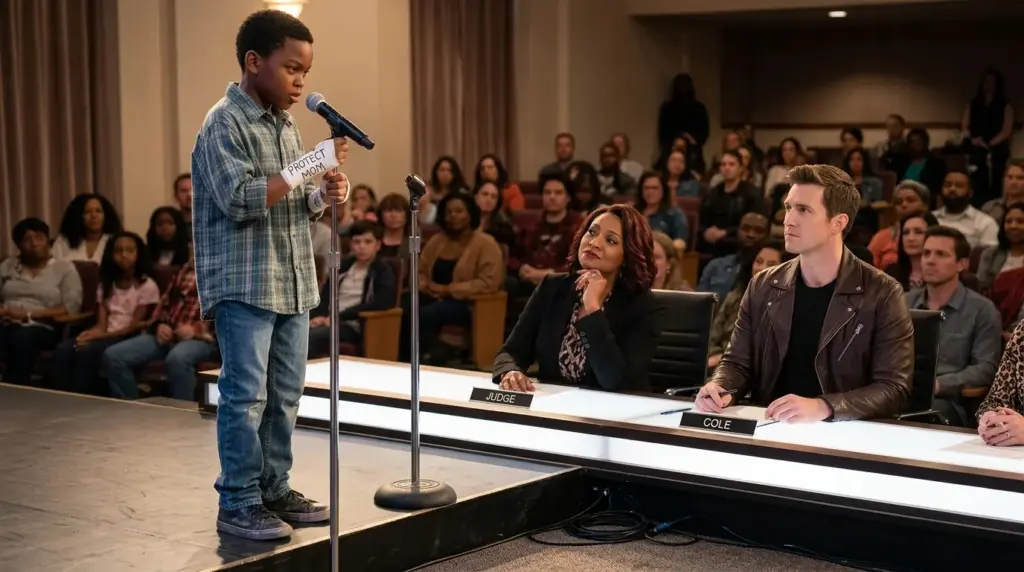
Noah took the microphone and looked out at the room full of children waiting for permission to believe they belonged.
“My name is Noah Bell,” he said. “A year ago, someone told me I would dirty up this stage.”
A low murmur moved through the crowd.
Noah smiled.
“So tonight,” he continued, “I’m dedicating this song to every kid who has ever been told they don’t belong in a room they worked hard to enter.”
He looked at his mother.
Then at Adrian.
Then at the little boy with the grocery bag full of coins.
“Sing anyway,” Noah said.
And then he did.
His voice rose through the auditorium, no longer the sound of a desperate child trying to save his mother alone, but of a boy who had survived humiliation, fear, betrayal, and impossible pressure without losing the truth inside him. The song carried pain, but it also carried space. Space for healing. Space for boundaries. Space for love that did not arrive perfectly, but arrived late and kept trying.
People cried again, but this time Noah did not sing to make them cry.
He sang because he was free.
Afterward, when the applause settled and the lights softened, Lena hugged him so tightly he laughed.
“My strong boy,” she whispered.
“No,” Noah said, smiling through tears. “Your free boy.”
Across the room, Adrian Cross stood alone near the wall, clapping with everyone else. He did not approach. He did not call out. He simply stayed.
And for that night, staying was enough.