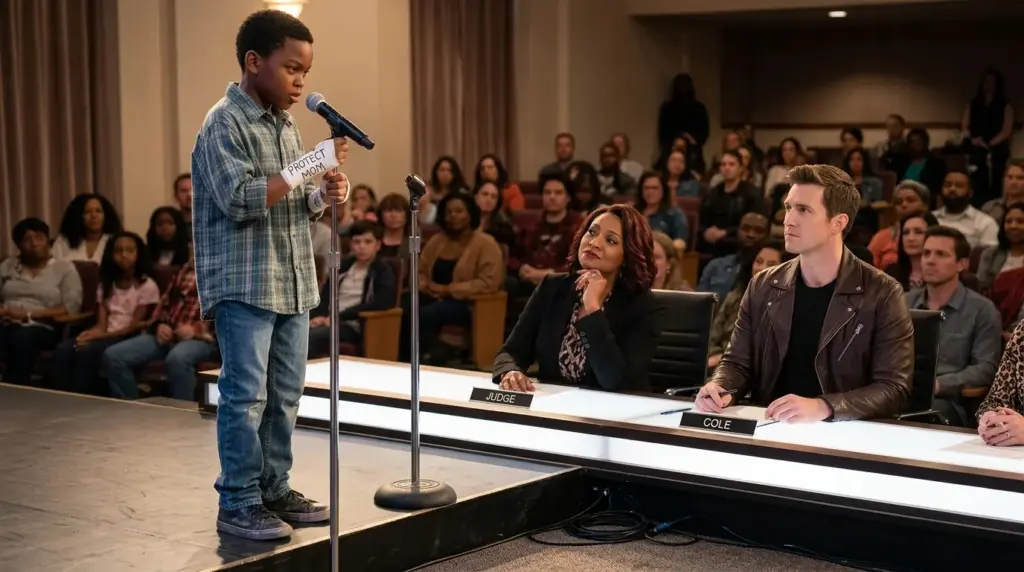
The arts center auditorium was packed with parents, donors, teachers, local reporters, and children who looked as if they had stepped out of magazines. Noah wore the church jacket, now brushed clean, and a white shirt Mrs. Alvarez had ironed for him. She had also slipped a folded note into his pocket before he left: The whole block is with you.
Backstage, children warmed up in perfect scales. A boy in a navy suit practiced piano runs on a silent keyboard. A girl stretched beside her violin case. Isabelle, the girl from registration, waved at Noah when she saw him.
“You came,” she said.
“I said I would.”
“My mom thinks you’re going to make people cry.”
“Is that good?”
“In this room?” Isabelle smiled. “Very.”
Marla’s son, Preston Whitcomb, performed third. He was thirteen, blond, polished, and trained until every movement seemed calculated. He sang a Broadway song with perfect timing and a bright smile that never wavered. The audience loved him. Marla, sitting at the judge’s table, looked proud enough to burst.
Noah was fifth.
When his name was called, he walked into the spotlight and felt the whole room judge him before he sang a note. He saw Marla’s pen already poised. He saw Adrian at the far end of the judge’s table, leaning forward, elbows on his knees.
Noah held the microphone.
He had planned to sing a popular song because everyone knew it. Instead, at the last second, he changed his mind.
He sang the song his mother used to hum while folding towels at midnight. The one she said her grandmother sang in a small church in Mississippi. It was called “Carry Me Home,” and there was no backing track, no piano, no band. Just Noah’s voice.
The first line came out soft, almost too soft.
Then the room changed.
His voice was not perfect. It carried a rasp from years of singing in bathrooms and stairwells. It bent around certain notes like it had learned pain before it learned music. But there was truth in it. There was a boy standing under stage lights asking heaven not for fame, not for applause, but for more time with the person he loved most.
By the second verse, a woman in the front row was crying.
By the final chorus, the room was silent in the kind of way that feels like prayer.
Noah opened his eyes on the last note and saw Adrian Cross standing.
The applause came a second later, thunderous and startled, as if the audience had forgotten its own hands and suddenly remembered them. Noah stepped back from the microphone, breath shaking.
Scores appeared.
9.6. 9.7. 9.5.
Marla raised a 7.8.
The crowd booed before they could stop themselves.
“Lack of polish,” Marla said into her microphone. “Emotional, certainly. But this is a competition, not a charity fundraiser.”
Adrian looked at her with open disgust. Then he raised his card.
10.
The applause returned, louder than before.
Noah advanced to the finals.
By morning, the video had gone viral.
Someone had filmed it from the balcony and posted it with the caption: Poor kid sings for sick mom and silences entire room. By breakfast, the clip had two million views. By lunch, local news was outside St. Mercy Hospital. By dinner, strangers were sending donations to a fundraising page Noah had not created.
The money rose fast. Five thousand. Twelve thousand. Thirty-one thousand.
Noah watched the number climb from the hospital chair beside his mother’s bed.
Lena cried quietly. “People are good,” she whispered.
Noah wanted to believe that. But he had seen Marla’s face when she gave him the 7.8. He had seen the way she looked at him afterward, not like he was a child, but like he was a threat.
Two days before the finals, the threat came.
An email arrived from the arts center at 6:14 a.m.
Dear Mr. Bell,
It has come to our attention that your preliminary performance included a traditional song without verified arrangement rights. Under Showcase Rule 9C, all finalists must submit documentation proving legal authorization for all performed material. Failure to do so by noon today will result in disqualification.
Noah read it three times before his hands started shaking.
The song was older than anyone in that building. His mother learned it from her grandmother. No one owned it, not in the way Marla was pretending. But Noah did not know how to prove that. He did not have lawyers. He had a prepaid phone and a library card.
His mother tried to sit up too quickly and winced. “Call Adrian.”
“I don’t have his number.”
Twenty minutes later, as if the universe had heard her, Noah’s phone rang from an unknown number.
“This is Adrian Cross,” the voice said. “Did Marla send you an email?”
“Yes.”
“Come to the arts center. Now.”
When Noah arrived, Adrian was waiting in the lobby with a woman in a navy suit and two folders under her arm.
“This is Elise Grant,” Adrian said. “Entertainment attorney.”
Elise smiled at Noah. “I reviewed the song. It’s public domain. Marla knows it.”
They walked into Marla’s office without knocking.
Marla looked up from her computer, startled. Preston sat in the corner scrolling on his phone.
Adrian placed one folder on her desk. “Withdraw the disqualification notice.”
Marla’s eyes narrowed. “The rules apply to everyone.”
“Good,” Elise said. She opened the second folder. “Then we can discuss your son’s use of a copyrighted Broadway arrangement in the preliminary round without licensing clearance. We can also discuss the fact that you requested Noah’s documentation after approving the program list, while applying no similar review to any other finalist.”
Preston looked up. “Mom?”
Marla’s lips tightened. “This is intimidation.”
“No,” Adrian said. “This is what accountability feels like when you’re not used to it.”