Daniel’s gaze cooled by a fraction of a degree. He pushed the final letter across the walnut. It was from Harborview Credit Partners, a private debt fund that had financed Cole’s newest, most aggressive acquisition—a sprawling cold-storage warehouse complex near the interstate.
“Harborview isn’t asking about an existing guarantee,” Daniel said. “They’re asking for clarification regarding the financing presentation Cole’s firm circulated in October for the Westbridge warehouse expansion. According to their managing director, the project was marketed to their credit committee as—and I am quoting directly here—fully backstopped by Bennett family assets.”
Lauren frowned, her fingers resting flat against the cool tabletop. “Is that language accurate?”
Daniel shook his head. “Not according to a single document in the trust vaults. The trustees never reviewed the Westbridge expansion. We never issued a commitment letter, a comfort letter, or a conditional guarantee for that parcel.”
Silence settled over the dining room, broken only by the sleet ticking against the glass.
“Who wrote the lender package?” Lauren asked quietly.
“Cole’s internal finance team, working alongside an outside capital adviser they hired two years ago.”
“Did the trust approve the wording?”
“No.”
Lauren glanced down at the edge of her grey sleeve, where the faint purple shadow of Cole’s thumbprint peeked out above her palm. One crisis at a time. If she let the financial recklessness bleed into the memory of two nights ago, her chest would tighten until she couldn’t think clearly.
“Are we calling regulators?” she asked, testing the boundaries of what she had set in motion.
“No,” Daniel said firmly. “We are not accusing anyone of fraud, and we are not making phone calls to compliance officers. That would be irresponsible without a complete record. The trustees have issued a neutral, standard request to all three lenders asking them to transmit the exact offering materials and schedules they relied upon, so we can compare them line by line against our executed guarantee agreements.”
Good, Lauren thought. Process.
Her phone lit up again on the kitchen island. COLE. She did not get up to silence it; she let the screen glow until it went dark on its own.
From the bedroom down the hall, Noah let out a thin, sleepy cry. Lauren rose immediately, smoothing her cardigan. Yesterday morning, while Cole’s phone had gone straight to voicemail from a boutique hotel downtown, she had bundled both children into a cab in the freezing rain and sat for two hours in a crowded pediatric urgent care clinic. The doctor had listened to Noah’s chest with a warm stethoscope and told her the fever was consistent with a garden-variety viral infection—manageable at home as long as his breathing stayed unlabored, his fluids stayed up, and specific warning signs did not appear. Lily’s cough, the doctor had reassured her, sounded far more dramatic than the clear lungs beneath it. Lauren had written every dosage time, every temperature threshold, and every red flag in neat blue ink on a yellow legal pad now resting beside the sink.
“Lauren,” Daniel said softly as she reached the archway to the hall. He glanced toward the living room sofa, then back to the faint bruise showing at her cuff. “Before we go any further with the bank correspondence—do you want an emergency protective order?”
She paused, her hand resting on the doorframe.
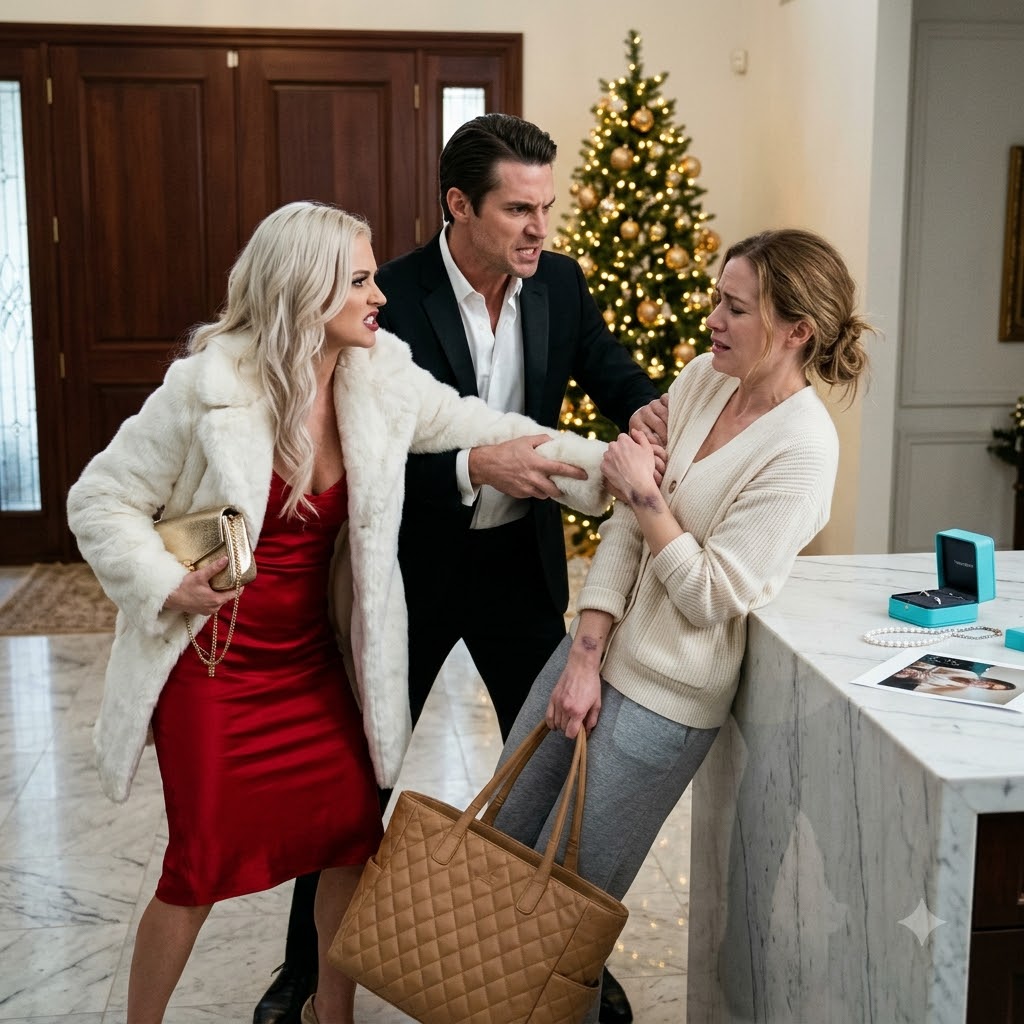
Two nights earlier, on Christmas Eve, she had noticed a four-thousand-eight-hundred-dollar charge from a jeweler on Michigan Avenue sitting on the joint household credit card—a card funded by automatic monthly sweeps from her own Bennett Trust distribution account. When she asked Cole about it in the kitchen after the children were asleep, he hadn’t lied smoothly the way he usually did. He had been tired, irritable from two glasses of scotch, and careless. He had told her she was paranoid, that she had no idea how client gifts worked in commercial real estate. When she reached for the printed statement on the counter, his hand had shot out and clamped around her left wrist with a sudden, terrifying torque that lifted her heel half an inch off the tile.
He had let go three seconds later, his face draining of color. He had apologized immediately, his voice thick and trembling, pulling her against his chest while she stood rigid as timber. And then, five minutes later, pouring himself a glass of water at the sink, he had muttered, “You know how stressed I am with the Westbridge close, Lauren. Why do you always have to push me until I lose my temper?”
That sentence had frightened her infinitely more than the bruise. A bruise faded in ten days. A man who believed your questions caused his hands to close around your bones was a man who would never stop finding reasons to blame you.
The next morning—Christmas Day—Cole had left at eight o’clock after a sharp, cold silence, claiming an emergency walk-through with a concrete contractor. By noon, a receipt for room service at the Langham had pinged her email—an old shared travel profile Cole had forgotten to unlink—alongside a photograph a friend of a friend had awkwardly forwarded from a hotel lobby bar: Cole’s hand resting possessively on the small of Sierra Vance’s back, a slim diamond tennis bracelet catching the chandelier light on Sierra’s wrist.
That afternoon, while Noah’s fever climbed to 102.4, Lauren had called Daniel Harris—not to ask for revenge, and not to burn down her husband’s company, but to trigger the emergency safety and financial-protection review Eleanor Bennett had written into Section 14 of the trust.
“I want to speak to a family-law attorney first,” Lauren told Daniel now, her voice steady. “I want to know what the law actually requires before I sign anything.”
“Good,” Daniel said, reaching for his phone. “I’ll call Rachel Kim.”





