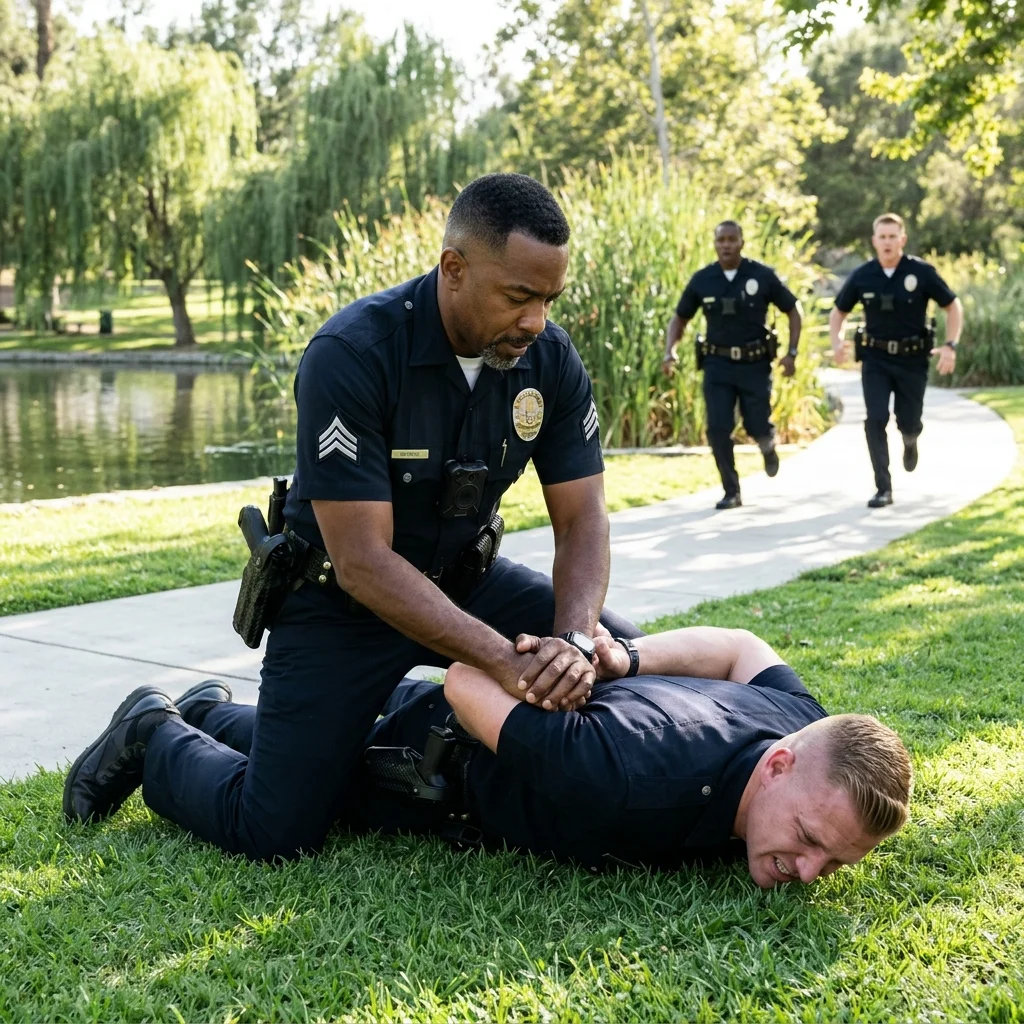
The moment Daniel Briggs recognized his mother at the microphone, the confident officer who had attacked Marcus Reed disappeared.
In his place stood a frightened man confronting a truth he had spent most of his life refusing to examine.
“Mom, sit down.”
His voice echoed through the council chamber.
Helen didn’t move.
“Daniel, please.”
Briggs stepped into the aisle.
“You don’t understand what you’re doing.”
Helen looked at her son.
“I understand exactly what I’m doing.”
He glanced toward Deputy Chief Sloane.
The older officer remained motionless near the front row.
Then Briggs turned toward Marcus.
“This is your fault.”
Marcus said nothing.
“You dragged her into this!”
Helen’s voice rose.
“No, Daniel, I walked into this room because I was tired of being afraid.”
The council chair struck her gavel.
“Mr. Briggs, you will take your seat or leave the chamber.”
Briggs stopped.
For a moment, Marcus thought he might continue arguing.
Instead, he slowly sat down.
Helen returned her attention to the council.
She explained how the forged transfer had been prepared.
She described the altered meeting minutes.
She acknowledged that she had falsely certified documents after being pressured by senior officials.
And she admitted that Samuel Reed had been blamed for financial irregularities he had tried to expose.
Several journalists recorded every word.
Marcus stood perfectly still.
He had imagined this moment countless times.
He had imagined demanding explanations.
He had imagined confronting the people who destroyed his father’s good name.
But now that the truth was finally emerging, he felt no satisfaction in watching Helen suffer.
He felt grief.
Grief for the years his father had lost.
Grief for the conversations they never had.
Grief for the simple fact that Samuel was not alive to hear someone publicly admit he had been innocent.
Helen turned toward Marcus.
“Your father was an honest man.”
Her voice broke.
“And I helped make the world believe he wasn’t.”
Marcus lowered his head.
For several seconds, the chamber remained silent.
Then the council chair spoke.
“Mrs. Grant, do you possess evidence supporting your testimony?”
Helen nodded.
“Yes.”
She reached inside her handbag.
Briggs suddenly stood again.
“Mom, don’t!”
But Helen had already removed her phone.
She opened a message and handed it to the council clerk.
It was a conversation between Helen and Briggs from earlier that morning.
The first message was from Daniel.
Stay away from the park today.
Helen’s reply asked why.
His next message read:
There will be an incident involving Marcus Reed.
Then came the sentence that changed the atmosphere in the entire room.
It has to happen before 10:17.
Leah stared at the screen.
Marcus looked toward Briggs.
The officer’s face had gone pale.
Helen spoke quietly.
“I begged my son not to participate.”
She paused.
“He told me the deputy chief had promised that if Marcus was discredited, nobody would investigate the old records.”
The council chair turned toward Sloane.
“Deputy Chief, is that true?”
Sloane stood.
“These are serious allegations based on an emotionally distressed witness.”
Helen’s expression changed.
She was no longer crying.
“I may have spent 23 years being frightened, Owen, but that doesn’t mean I’ve forgotten what happened.”
A voice came from the rear of the chamber.
“Neither has the county recorder.”
A woman in a gray suit rose from the visitors’ section.
She identified herself as attorney Vivian Cross, representing an independent state public-integrity investigation that had recently begun reviewing irregular municipal land transactions.
Her team had received information concerning Harlow Park before that day’s confrontation.
They had also received the historical society’s request for verification.
She held a certified document packet.
“With the council’s permission, I would like the verified county record entered into the hearing materials.”
The chair agreed.
Vivian placed the documents before the municipal clerk.
Then she addressed the room.
“The instrument recorded in 1986 confirms the existence of a charitable trust governing the eastern grounds of Harlow Park.”
The Hartwell attorney stood.
“We dispute any suggestion that this prevents redevelopment.”
Vivian nodded.
“That is a matter for judicial determination.”
She turned a page.
“But the document establishes something important that has not been accurately represented in the city’s current property summary.”
The chamber became completely silent.
“The city was never given unrestricted ownership of that land.”
The words seemed to hang above the crowded room.
Vivian continued.
“The original donors transferred the land into a charitable trust for permanent community use.”
She explained that the city had been assigned maintenance responsibilities and limited administrative authority.
The public trust retained its own legal interests.
The municipality could not simply treat the protected property as an ordinary asset available for commercial sale.
Any claim that the restrictions had been extinguished required legally valid supporting documents.
And the purported transfer from 23 years earlier was now under serious investigation.
The Hartwell representative stared at his attorney.
The attorney looked toward Sloane.
Sloane looked toward the exit.
Marcus felt his pulse quicken.
For decades, the city had behaved as though Harlow Park belonged to the people sitting in government offices.
But the original donors had written a different promise.
The park belonged to the community it served.
And his father had spent the final years of his career trying to defend that promise.
Vivian continued.
“Given these unresolved ownership and fraud concerns, we have requested immediate preservation of the relevant public records and are seeking appropriate court orders.”
The council chair conferred with the city attorney.
Then she addressed the audience.
“The proposed redevelopment vote will not proceed tonight.”
Applause erupted.
People stood.
Some shouted with relief.
Others began embracing the people beside them.
Leah looked at Marcus.
“Dad, they stopped it.”
Marcus nodded slowly.
But he wasn’t celebrating yet.
He was watching Briggs.
The younger officer sat motionless.
His head was lowered.
His hands rested loosely on his knees.
For the first time that day, he looked small.





