She took a folded slip of paper from her coat pocket and pressed it into his hand.
“Ask what happened at 10:17.”
“Why?”
“Because that was when they needed everyone looking at you.”
Marcus unfolded the paper.
Written in careful blue handwriting were 7 words.
THEY ARE NOT AFTER YOUR BADGE.
He looked up.
The woman’s eyes filled with tears.
“They’re after something your father left behind.”
Before Marcus could question her, she turned and hurried toward the park entrance.
He started to follow.
Then his phone rang.
It was Leah.
“Dad, where are you?”
“Harlow Park.”
Her voice was urgent.
“Don’t go back to the station.”
“Leah—”
“I found something in the video.”
Marcus stopped.
“What did you find?”
“The woman filming from across the path caught something behind Briggs.”
Marcus looked toward the park.
“What?”
Leah hesitated.
“Dad, while everyone was watching you fight, 2 men were opening the old maintenance building beside the fountain.”
Marcus slowly turned around.
Beyond the trees, the building stood near the edge of the eastern gardens.
Its windows had been boarded for years.
No one was supposed to have access.
Leah spoke again.
“And Dad?”
“Yes?”
“One of those men was Deputy Chief Sloane.”
Marcus stared at the distant building.
The confrontation had never been the real event.
It had been the distraction.
And whatever was happening behind those locked doors had begun long before Briggs ever touched him.
By noon, Marcus Reed had become the most controversial police officer in Bellhaven.
His photograph appeared on local news websites, social media pages, and television broadcasts.
Some people defended him.
Others demanded his immediate dismissal.
The police department issued a statement describing the confrontation as an altercation involving 2 officers.
The statement mentioned an ongoing investigation.
It did not mention that Briggs had initiated the physical confrontation.
It did not mention the civilian witnesses.
And it certainly did not mention the 2 men who had entered the old maintenance building while Marcus was being attacked.
Marcus sat inside a small coffee shop 4 blocks from the park, staring at his phone.
Across from him, his daughter Leah opened her laptop.
At 24, Leah had inherited her father’s dark eyes and stubborn determination, although she wore her curly hair in a loose ponytail and preferred sneakers to anything resembling a uniform.
She worked as a producer for a local investigative journalism program.
Marcus had once hoped she would become an attorney.
Instead, she had chosen a career that frequently brought her into conflict with institutions like his own.
Today, however, they were working toward the same goal.
“Show me everything,” Marcus said.
Leah connected her headphones and opened a folder containing several videos.
“I found 4 recordings from different witnesses.”
She played the first.
It showed the confrontation from a distance.
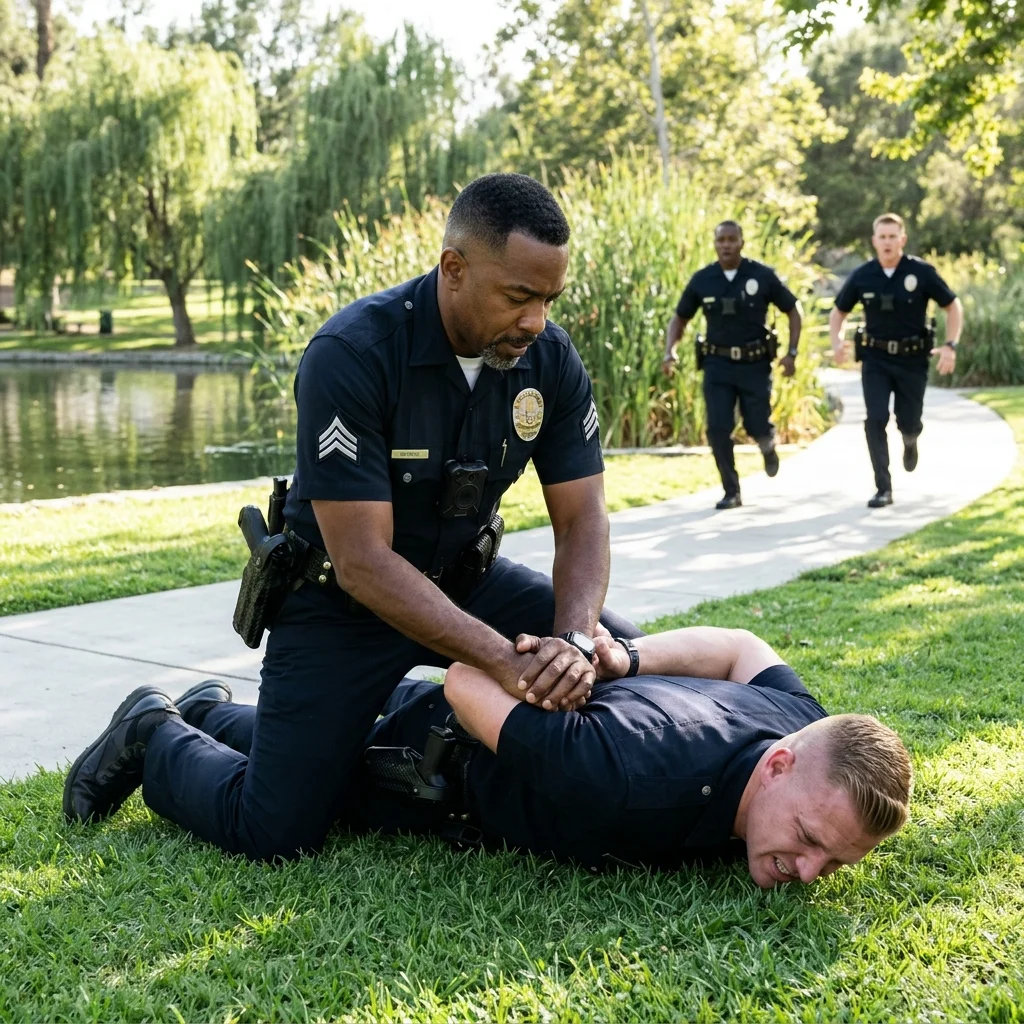
Briggs approached Marcus, collided with him, and immediately began shouting.
The camera shook when the person filming moved closer.
Then came the shove.
Then the attempted punch.
Marcus watched without speaking.
Leah paused the footage.
“That’s enough to prove the online video is misleading.”
“Only if people are willing to watch the whole thing.”
She looked at him.
“You’re not going to defend yourself publicly?”
“I will, but I want the facts established first.”
“Dad, they’re already deciding what happened.”
Marcus rubbed his forehead.
He knew she was right.
For years, he had believed that patience and professional conduct would eventually overcome dishonesty.
But patience did not always protect people from deliberate manipulation.
Leah opened another recording.
“This one came from a woman walking her dog.”
The video was blurry.
Marcus and Briggs were visible near the center.
Beyond them stood the old maintenance building.
A dark sedan pulled onto the narrow service road.
Two men got out.
One carried a rectangular equipment case.
The other wore a gray jacket.
Leah enlarged the image.
Marcus leaned forward.
“That’s Sloane.”
“Exactly.”
“But he arrived at the confrontation afterward.”
“Watch the timestamp.”
10:17:08.
The man in the gray jacket opened the maintenance building.
His companion entered first.
Sloane followed.
At 10:19:31, both men emerged.
The equipment case appeared heavier than before.
They placed it in the trunk.
Then Sloane walked toward the waiting police SUV.
Marcus sat back.
“He wasn’t responding to a disturbance.”
Leah nodded.
“He was waiting for one.”
For a moment, neither spoke.
Rain clouds gathered beyond the coffee shop windows, darkening the afternoon.
Marcus remembered his father’s hands.
Samuel Reed had been a quiet man with a deep voice, rough fingers, and an almost unreasonable devotion to Harlow Park.
He worked for the city’s maintenance department until a financial scandal ended his career.
City auditors claimed that money intended for park improvements had disappeared.
Samuel was accused of falsifying documents.
He denied it.
No criminal conviction followed, but the public accusation destroyed his reputation.
Marcus had been 20 when it happened.
He remembered his father sitting at the kitchen table with a newspaper folded beside him.
The headline had used the word disgraced.
Samuel had stared at that word for a long time.
Then he quietly pushed the newspaper away.
“Sometimes people don’t need to prove you did something wrong, Marcus.”
His voice had been barely audible.
“They only need to convince enough people not to listen when you say you didn’t.”
Marcus had never forgotten that evening.
Now, 23 years later, he was watching the same machinery turn against him.
Leah noticed his expression.
“You’re thinking about Grandpa.”
Marcus nodded.
“He tried to tell me something before he died.”
“What?”
Marcus looked down.
“He said the park wasn’t what people thought it was.”
Leah waited.
“I thought he was talking about the accusation.”
“And now?”
“Now I’m not sure.”
Leah closed the video.
“Then we find out.”
The coffee shop door opened.
Officer Elena Ruiz entered wearing civilian clothes.
She spotted Marcus and crossed the room.
“Thanks for coming,” Marcus said.
Elena sat down without ordering anything.
Her face looked exhausted.





