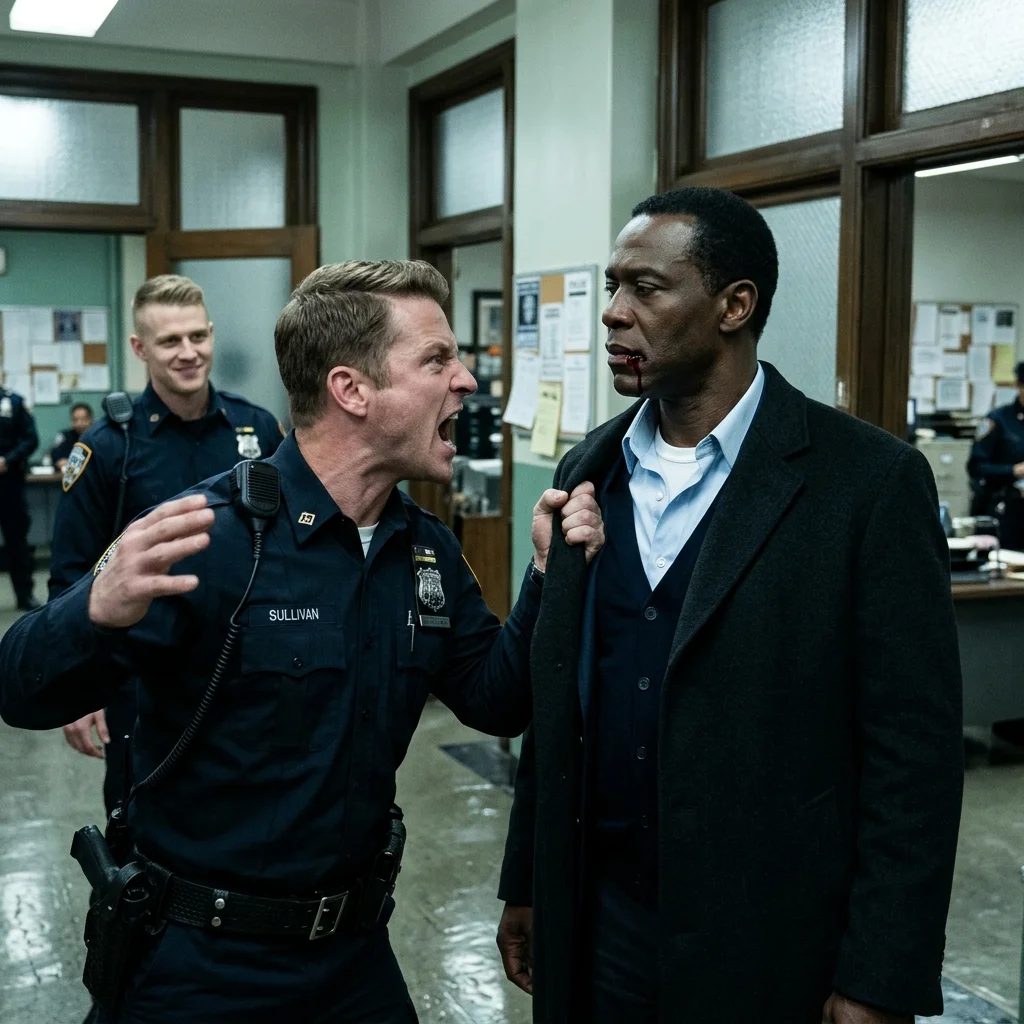
By 9:40 a.m., Precinct 54 had become a very different place.
The usual conversations had stopped.
Officers stood in small groups, whispering.
Several employees were suddenly discovering urgent reasons to visit the restroom.
Others stared at their computer screens, hoping nobody would ask them questions.
Isaiah Carter stood in the commander’s office.
He had removed his wet coat and placed it over the back of a chair.
A fresh cut remained visible near his mouth.
Across from him stood Deputy Superintendent Helen Ward, Sergeant Tessa Monroe, and two investigators from the department’s independent oversight unit.
The first investigator, Marcus Reed, opened a folder.
“Commander, we’ve reviewed the initial arrest report.”
Isaiah nodded.
“What did you find?”
“It was entered at 8:31.
The incident description says the suspect struck Officer Sullivan before attempting to flee.”
“Was there a medical report?”
“No.”
“Was there a witness statement?”
“Only Officer Hayes’s.”
Isaiah looked at Monroe.
“Did you witness the incident?”
“Yes, sir.”
“Then why isn’t your statement included?”
Monroe lowered her eyes.
“Officer Sullivan told me to stay out of it.”
“And you obeyed?”
The sergeant swallowed.
“Yes, sir.”
Isaiah waited.
Monroe finally looked up.
“I was wrong.”
He nodded.
“That’s a beginning.”
She seemed surprised.
Isaiah continued.
“People make mistakes.
What matters now is whether you’re willing to tell the truth even when it becomes uncomfortable.”
Monroe straightened.
“I am, sir.”
The investigators placed several documents on the desk.
One showed the complaint history for Precinct 54 over the previous eighteen months.
Another listed body-camera malfunctions.
A third contained property discrepancies.
Isaiah examined them.
The numbers were disturbing.
Twenty-three complaints had been marked resolved without documented interviews.
Eleven body-camera recordings had been reported missing.
Fourteen items listed as evidence had been transferred without complete signatures.
And seven arrests involved individuals whose property receipts did not match the original inventory.
“Who supervises evidence management?” Isaiah asked.
Monroe answered carefully.
“Lieutenant Warren Pike.”
“Where is he?”
“Upstairs.”
“Bring him here.”
A few minutes later, Lieutenant Pike entered.
He was fifty-six years old, tall, silver-haired, and impeccably dressed.
He had served in the department for thirty years.
He also had a reputation for surviving every scandal that touched his precinct.
“Commander Carter,” he said pleasantly.
“Congratulations on your appointment.”
Isaiah did not offer his hand.
“Lieutenant Pike, how long have you supervised evidence management?”
“Six years.”
“Have you ever discovered discrepancies?”
“Not that I’m aware of.”
Isaiah slid the property report across the desk.
“Then you haven’t been looking.”
Pike glanced at the document.
His expression remained neutral.
“Administrative errors happen.”
“Fourteen missing items?”
“Transfer mistakes.”
“Eleven missing camera recordings?”
“Equipment failures.”
“Twenty-three unresolved complaints?”
“Staff shortages.”
Isaiah leaned back.
“That’s a remarkable collection of excuses.”
Pike smiled faintly.
“With respect, Commander, you’ve been here less than two hours.”
“True.”
“And you’re already making accusations.”
Isaiah looked at him.
“No, Lieutenant.
I’m asking questions.”
Pike’s smile disappeared.
“Perhaps you should learn how this precinct operates before making changes.”
Isaiah slowly stood.
“I came here precisely because I know how this precinct operates.”
He walked around the desk.
“Now, tell me why Officer Sullivan was allowed to write an arrest report claiming I attacked him when three witnesses say otherwise.”
Pike’s eyes flickered.
“I haven’t reviewed the incident.”
“Then review it.”
Isaiah turned toward the investigators.
“Until further notice, Lieutenant Pike is relieved of evidence-management access.
All records will be preserved.”
Pike’s face hardened.
“You don’t have the authority to…”
Helen Ward interrupted.
“He does.”
Pike looked at her.
For the first time, he appeared genuinely concerned.
The investigators escorted him outside.
Isaiah turned toward Monroe.
“Take me to the evidence room.”
She hesitated.
“Sir, the main evidence room is downstairs.”
“Then let’s go downstairs.”
They walked through a narrow corridor behind the processing area.
A heavy security door stood at the end.
Monroe entered her access code.
The door opened.
Inside were shelves containing boxes, sealed bags, electronic devices, and hundreds of labeled containers.
Everything appeared orderly.
Too orderly.
Isaiah examined the inventory records.
“Where are the transferred items?”
Monroe pointed toward a set of shelves.
“Those are supposed to be here.”
He checked the labels.
Several numbers were missing.
“Where are they?”
“I don’t know, sir.”
Isaiah looked at the shelves again.
Then he noticed something unusual.
A small section of the rear wall had recently been repainted.
The color was slightly different from the surrounding surface.
He approached it.
“What’s behind this?”
Monroe looked uncomfortable.
“Nothing, sir.
Just a maintenance area.”
Isaiah knocked against the wall.
The sound was hollow.
He turned toward the investigators.
“Get maintenance.”
A technician arrived with a toolbox.
After several minutes, they discovered a narrow panel concealed behind a storage cabinet.
The panel opened.
Behind it was a small room.
Inside were dozens of unregistered evidence boxes, confiscated phones, envelopes containing cash, and several body-camera memory cards.
Nobody spoke.
Isaiah stepped inside.
He found a handwritten ledger on a metal shelf.
The pages contained dates, badge numbers, property descriptions, and amounts of money.
Some entries were marked with the initials DS.
Others carried the initials BH.
Derek Sullivan.
Bradley Hayes.
Isaiah slowly turned the pages.
A pattern emerged.
People were arrested.
Their belongings were recorded.
Certain items disappeared.
Then false transfer receipts were created.
The officers involved received payments.
“Photograph everything,” Isaiah ordered.
Marcus Reed nodded.
“We’ll secure the room.”
Isaiah noticed a phone inside a clear plastic evidence bag.
The label read JAMAL BELL.
He picked up the inventory sheet.
“That’s Ruth Bell’s grandson.”
Monroe looked at him.
“Sir, Jamal was arrested yesterday.”
“Why is his phone here?”
She examined the paperwork.
“According to the system, it was transferred to an external storage facility.”
Isaiah looked around the hidden room.
“Apparently, the system has been lying.”
A voice came from the doorway.
“Commander?”
It was Bradley Hayes.
He stood with his hands visible.
Sullivan was no longer beside him.
Isaiah looked at the former officer.
“What do you want?”





