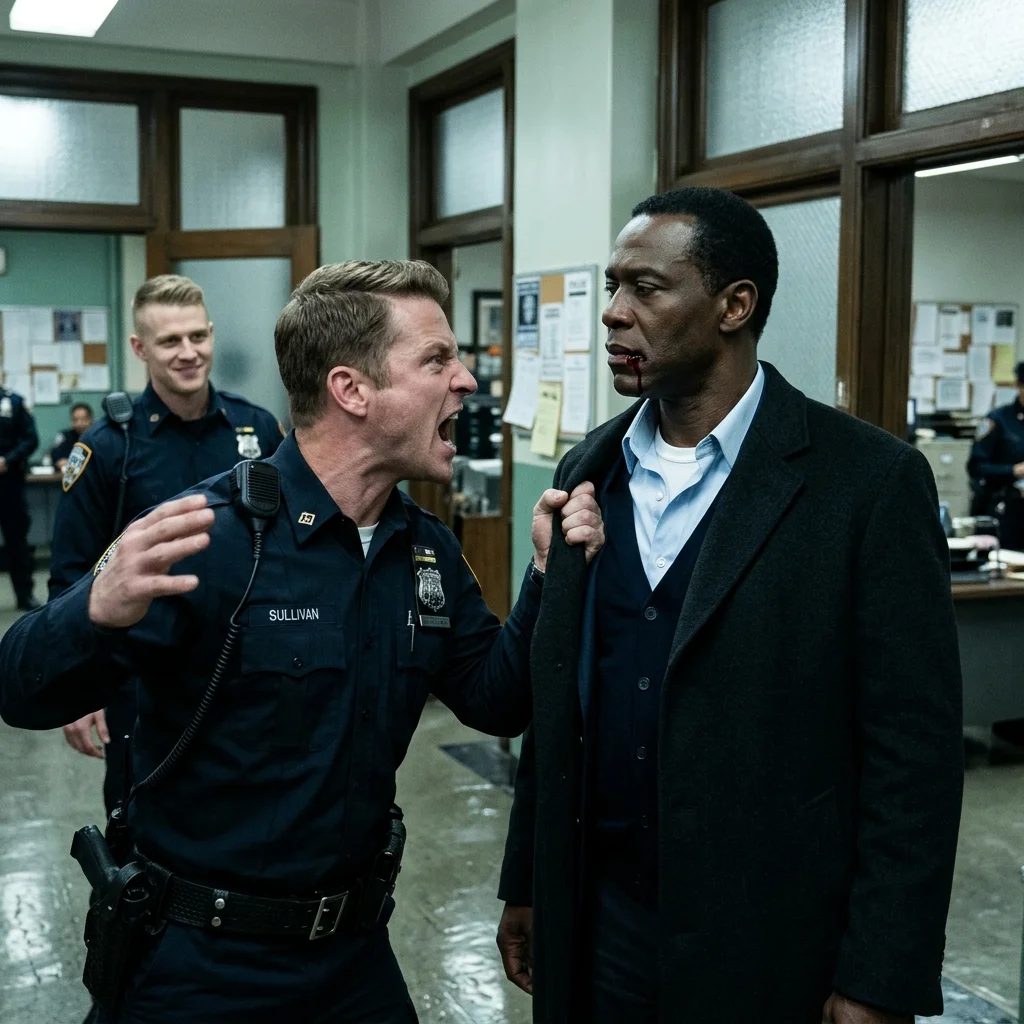
Derek Sullivan was formally charged with assaulting a civilian, filing a false arrest report, and intimidating witnesses.
Bradley Hayes agreed to provide a full statement and surrender all copies of the records he had concealed.
His cooperation did not erase his involvement.
Isaiah made that clear.
“You will answer for what you did,” he told Hayes.
“But telling the truth now may prevent someone else from suffering because of your silence.”
Hayes nodded.
“I understand.”
Sullivan was escorted through the lobby shortly afterward.
The same lobby where he had slapped Isaiah that morning.
His hands were cuffed.
His uniform jacket had been removed.
He stopped when he saw Ruth Bell.
For a moment, he looked as though he wanted to say something.
Then he lowered his head.
Isaiah stood near the complaint desk.
“Officer Sullivan.”
Sullivan looked up.
Isaiah continued.
“Do you remember what you said to Mrs. Bell this morning?”
Sullivan didn’t answer.
“You told her to come back when somebody asked her to.”
Isaiah glanced toward the empty waiting chairs.
“She came here because her grandson needed help.
You treated her like she didn’t matter.”
Sullivan swallowed.
“Commander, I…”
Isaiah interrupted.
“Don’t apologize to me.”
He looked toward Ruth.
“If you have something to say, say it to the people you harmed.”
Sullivan lowered his eyes.
The investigators escorted him outside.
For the first time in years, Precinct 54 felt quiet for a different reason.
Not because civilians were afraid to speak.
But because the people who had spent years silencing them were finally being held accountable.
At 2:15 p.m., Isaiah returned to his office.
Helen Ward stood near the window.
“Your first day hasn’t gone as planned,” she said.
Isaiah gave a tired smile.
“No.
But I suppose it could have been worse.”
Helen looked at the cut on his mouth.
“Are you sure you’re ready to take command here?”
Isaiah turned toward the window.
Outside, the rain had stopped.
A weak November sun was beginning to break through the clouds.
He thought about his father.
He thought about Ruth.
He thought about the frightened civilians who had entered the building that morning believing nobody would listen.
Then he answered.
“More than ever.”
That afternoon, Isaiah ordered several changes.
Every complaint would receive a documented tracking number.
Every evidence transfer would require independent verification.
Body-camera failures would automatically trigger supervisory review.
Civilian complaints involving officers would be handled by an independent unit.
And every employee would receive a written notice that retaliation against witnesses would result in immediate investigation.
But his most important decision involved the people who had spent years waiting for someone to hear them.
He reopened every unresolved complaint connected to Precinct 54.
Not one would be dismissed simply because the person filing it lacked money, influence, or a familiar name.
At 4:30, Ruth returned to the commander’s office.
She carried the old metal box.
“I think this belongs to you.”
Isaiah opened it.
Inside was a folded letter.
His father’s handwriting was unmistakable.
He unfolded the paper carefully.
The letter had been written several weeks before the fire.
It contained only a few paragraphs.
Isaiah,
If you ever find this, I hope you understand something I learned too late.
People will tell you that wearing a badge makes you powerful.
It doesn’t.
Power comes from what people trust you to do when they cannot defend themselves.
Never confuse obedience with loyalty.
Never confuse silence with peace.
And never let someone convince you that protecting the department is more important than protecting the people it serves.
Love,
Dad.
Isaiah read the letter twice.
Then he lowered it.
For several moments, he couldn’t speak.
Ruth gently touched his shoulder.
“Your father would be proud.”
Isaiah looked at her.
“Thank you for finally telling the truth.”
She began crying.
“I should have done it years ago.”
“Yes,” he answered honestly.
Then he added something she had not expected.
“But you did it today.”
Ruth nodded.
It was not forgiveness for everything.
It was the beginning of something.
A little later, Luis entered the office.
He was holding the photograph of Samuel Carter.
“I’d like to keep a copy,” he said.
Isaiah smiled.
“Of course.”
Luis looked at the picture.
“I used to think I survived that night because I was lucky.”
He paused.
“Now I know somebody made sure I survived.”
Isaiah stood beside him.
“That’s what my father believed being an officer meant.”
Luis looked toward the precinct lobby.
“Do you think things will actually change?”
Isaiah considered the question.
He knew that one arrest would not erase decades of corruption.
He knew that other officers might resist.
He knew that changing a department would require more than speeches and new policies.
But he also knew that change had to begin somewhere.
“Not because I say they will,” he answered.
“Because the people who work here will have to prove it.”
At 5:00 p.m., Isaiah walked into the lobby for the final time that day.
The elderly woman who had waited so long was preparing to leave.
Her grandson Jamal had been released into his family’s care after receiving medical treatment.
The young mother, Nia, had received confirmation that her brother Devon was safe and would be interviewed by independent investigators.
Luis was standing near the entrance.
Sergeant Monroe was helping another civilian complete a complaint form.
Nobody was being ignored.
Nobody was being laughed at.
Isaiah paused beneath the large clock.
It was the same clock that had watched him being dragged into custody that morning.
He looked up at it.
Then he glanced toward the front desk.
The place where Sullivan had once sat like a king was now occupied by a young officer who was carefully listening to an elderly man explain why he needed help.
Isaiah smiled faintly.
Then his phone rang.
It was Helen Ward.
“Commander, there’s one more thing.”
“What is it?”
“The independent investigators found something inside the old dispatch archive.”
Isaiah stopped walking.
“What?”





