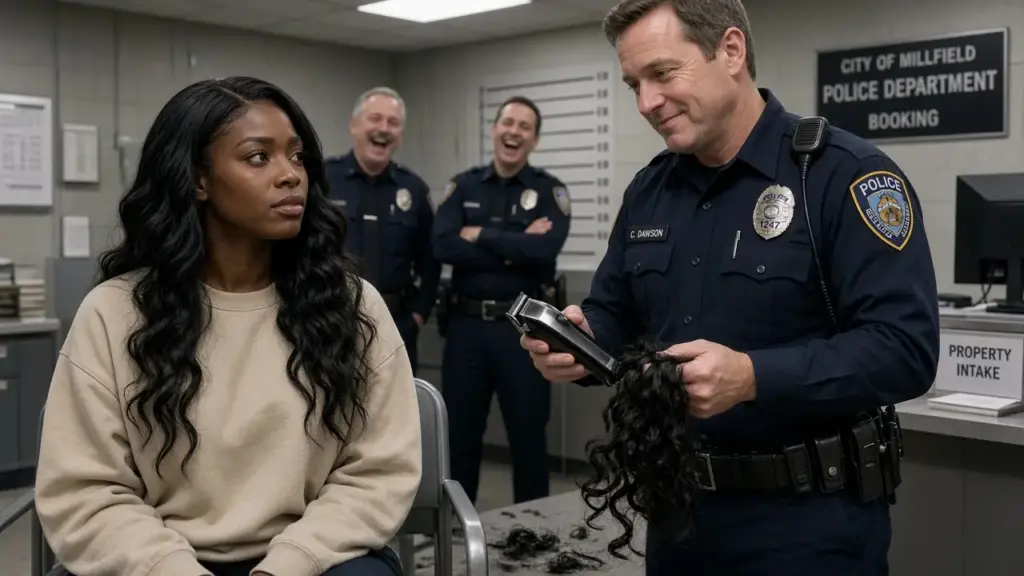
“Sergeant Teller was informed and approved the search protocol.”
That sentence would matter later. Remember it.
Loomis then spent several minutes building a wall around Dawson: more commendations, training records, a statement from a local pastor praising his community involvement. Brick by brick, he was constructing the image of a dedicated public servant caught in an unfortunate misunderstanding.
Finally, Dawson delivered his closing line from the stand. He looked at the jury, made eye contact with as many of them as he could, and said, “I treated her the same as I’d treat anyone. This isn’t about race. It’s about safety. I did my job.”
The courtroom was quiet for a moment.
At the plaintiff’s table, Reginald Owens hadn’t objected once during the entire testimony. Not once. He didn’t take notes. He didn’t whisper to his client. He just sat there with one hand resting on a thick folder in front of him, like a man who already knew every card in the deck and was waiting for the right moment to flip the table.
Belle Hammond sat beside him, face completely still. If Dawson’s testimony made her angry, she didn’t show it. If his lies made her want to stand up and scream, she swallowed it whole. She just watched him the same way she had watched him in that booking room: quiet, focused, recording everything behind those dark, steady eyes.
And here’s what nobody in that courtroom understood yet—not the judge, not the jury, not Gerald Loomis, and certainly not Craig Dawson: the silence at that plaintiff’s table wasn’t weakness. It wasn’t defeat. It wasn’t a woman too overwhelmed to respond.
It was a trap. And Dawson had just walked straight into it.
The next morning, the courtroom felt different. Same fluorescent lights, same stiff flag in the corner, but the energy had shifted. Maybe it was the jury; a few of them had barely slept, still hearing Dawson’s voice saying “that type of hair” on a loop in their heads. Maybe it was the gallery, fuller now, word spreading the way it does when a case starts to feel like something bigger than a lawsuit.
Or maybe it was her.
Belle Hammond walked into the courtroom in the same navy dress, same silk headwrap, same small gold earrings, no makeup trying to hide anything. If you looked closely—and the jury did—you could still see faint razor nicks near her temples, thin lines where the clippers had caught skin. She didn’t cover them. She didn’t look away when people stared. She sat down next to Reginald Owens, placed her hands flat on the table, and waited.
Owens stood. “Your Honor, the plaintiff calls Belle Hammond.”
She rose, walked to the witness stand, and took the oath. Her voice was low and clear—not loud, not dramatic, just precise. Every word landed exactly where she put it.
Owens began. “Ms. Hammond, take us back to the evening of June 14th. Where were you coming from?”
“I was driving home from a work trip, returning on Route 9 into Granton.”
“Were you speeding, running a light? Anything unusual about your driving?”
“No. I was doing the speed limit, both hands on the wheel.”
“And what happened?”
“I saw flashing lights behind me. I pulled over immediately. I turned off the engine, put my hands on the steering wheel where they could be seen, and waited.”
She described it the way someone describes a fire drill: practiced, methodical, precise. This was not a woman who panicked during a traffic stop. This was a woman who had a routine for it.
“Officer Dawson approached the driver’s side. I rolled down the window. He asked for license and registration. I told him I was reaching into the glove compartment, and I did so slowly.”
“Did he tell you why he pulled you over?”
“He said my left taillight was broken.”
“Was it?”
“No. I had my car serviced two days before. Full inspection. All lights were functional. I have the receipt and the mechanic’s report.”
Owens made a small note, but didn’t press further. Not yet. He was saving that.
“What happened next?”
Belle’s voice stayed level, but something behind her eyes shifted, like a door opening to a room she’d kept locked. “He told me to step out of the vehicle. I asked if I was being detained. He said, ‘You are now.’ Two more officers arrived. I was handcuffed and placed in the back of a cruiser. He never told me what I was being charged with, because there was nothing to charge me with.”
“Where were you taken?”
“Granton County Booking Facility. They brought me to a room in the back, Room B4.”
“Describe that room.”
She paused. Not for drama—to be accurate. “Small, concrete walls, a steel table bolted to the floor, one chair, fluorescent light overhead, and a camera bracket on the wall. Empty. No camera, just a bracket with loose wires hanging from it.”
She said that detail—the empty bracket, the loose wires—like a scientist recording an observation. No emotion attached, just fact. But the jury heard it. You could see it register on their faces.
“What happened in that room?”
“Officer Dawson entered wearing latex gloves. He told me my hair presented a concealment risk and that he needed to search it. I told him I would consent to a search by a female officer. He refused.”
“What were his exact words?”
“He said, ‘You don’t get to make demands.’ Then he said, ‘We can do this easy or hard.'”
“What did you do?”
“I asked again for a female officer. I stated clearly that I did not consent to a male officer touching my hair or my body.”
“And then?”
She didn’t look away from the jury. Not for a second. “He pushed my head down onto the table. I felt the clippers at the top of my skull. The vibration went through my teeth, into my jaw. He started at the crown and moved forward.”





