And she had been building this case the way she built every federal case: quietly, methodically, with the kind of documentation that doesn’t leave room for doubt.
She closed the folder. On the front tab, written in neat black ink, were two words and one initial: Dawson, C. Pattern File.
Pattern. Not incident, not complaint—pattern. That word would come back to haunt Craig Dawson in ways he couldn’t imagine.
Belle stood and walked to the bathroom. She looked at herself in the mirror: the short, uneven stubble growing back in patches where the clippers had been careless. She ran her hand over it slowly. Her expression wasn’t anger; it wasn’t sadness. It was something harder, something quieter: resolve.
She whispered two words to her own reflection: “Every single one of them.”
Then she turned off the light and went back to the kitchen table. She had work to do. And Craig Dawson, out there somewhere tonight, sleeping soundly, badge on his nightstand, absolutely certain this lawsuit was going nowhere, had no idea that the woman he had called an animal was about to dismantle his entire career with a manila folder and a federal seal.
Day two, afternoon session. The courtroom was fuller than the morning. Reporters filled the back rows. A few local activists sat near the door. The jury—twelve people who had spent the morning listening to Belle describe the sound of her own hair hitting concrete—sat with a tension in their shoulders that hadn’t been there yesterday.
Judge Whitfield called the session to order. “Mr. Owens, you may continue.”
Reginald Owens stood slowly. He buttoned one button on his gray suit jacket and carried a single folder to the center of the courtroom. Not the thick one, a thinner one—the kind that holds just enough to change the direction of a trial.
“Your Honor, the plaintiff wishes to introduce four pieces of independent evidence.”
Loomis shifted in his seat. Dawson didn’t move; he still had his legs crossed, still had that look, the one that said this was a waste of his time. That look was about to disappear.
“Exhibit A: maintenance log from the Granton County Booking Facility.” Owens placed the document on the evidence table, handed copies to the judge and jury, and explained it plainly. “Room B4 was equipped with a ceiling-mounted security camera. According to the log, that camera was removed for repair at 3:15 on the afternoon of June 14th. Belle was brought into that room at 8:40 that evening. The camera was reinstalled the following morning at 7:00 a.m. The maintenance request was signed by one person.” He looked at Dawson. “Officer Craig Dawson.”
A murmur rippled through the gallery.
Loomis stood. “Objection! The timing is coincidental. Officers regularly submit maintenance requests.”
Whitfield looked at him over her glasses. “Overruled. Continue.”
“Exhibit B: dashcam footage from the plaintiff’s vehicle.”
A screen was set up facing the jury. The footage played: clear, steady, timestamped. Belle’s car on Route 9, June 14th. A gas station sign visible on the right: Morrison’s Fuel Stop, Granton. And both taillights glowing bright red, fully functional.
Owens paused the footage. “Officer Dawson testified he pulled Ms. Hammond over for a broken left taillight. This footage, with GPS coordinates and timestamp in the metadata, shows both lights working at the exact time and location of the stop. The stated reason for the traffic stop was false.”
Loomis tried, “The dashcam could be from a different date.”
Owens placed the metadata analysis on the table. “Certified forensic lab. GPS match, timestamp match, the gas station confirmed at that location. Counselor Loomis is welcome to hire his own expert to dispute it.”
Loomis sat down. He didn’t dispute it.
Dawson uncrossed his legs—first time in two days.
“Exhibit C: Officer Dawson’s body cam footage.”
The room tightened. Owens addressed the court. “The department responded to our discovery request by stating that Officer Dawson’s body cam malfunctioned on June 14th and no footage was available.” He paused. “That statement was not accurate. A federal records request filed through specific channels had recovered the footage from a cloud backup server. The footage had always existed; it had simply never been pulled.”
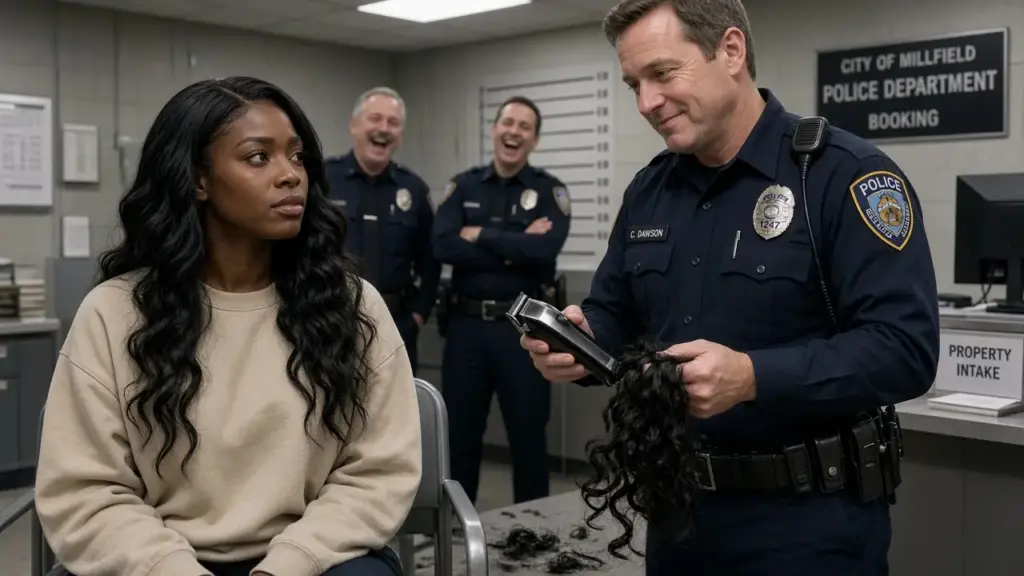
The screen lit up. Shaky at first: Dawson walking through the booking hallway, then Room B4, the empty camera bracket on the wall, Belle in the chair, handcuffed.
Dawson’s voice came through the speaker. He was laughing—not nervous, casual. He snapped on latex gloves; the sound echoed off concrete walls.
Belle’s voice, calm: “I want a female officer present.”
He didn’t look at her. He picked up the clippers. Then, the line that split the courtroom open: as the clippers touched her scalp, Dawson turned to the officer behind him and said, “Bet she wishes she’d just straightened it, huh?”
Sharp inhales across the room. A juror covered her mouth. Another removed her glasses and pressed her hand to her forehead. A young male juror closed his eyes and shook his head.
Whitfield struck her gavel once; order held. But that sentence—casual, smiling, spoken while shaving a restrained woman’s head—had burned itself into every person in that room.
Owens stopped the footage. “Exhibit D: three additional complaints.”
Three files on the evidence table. Three Black women, four years. All described forced or coerced hair searches during booking. All had natural hairstyles. All complaints investigated internally; all classified as unfounded.
He opened one. “Filed in 2022. The account mirrors Ms. Hammond’s word for word: same Room B4, same language—’concealment risk’—same clippers without consent. And the same detail.” He looked up. “Camera removed for maintenance on the day of her booking.”
He closed the file. “Your Honor, how many coincidences does it take before we call it a pattern?”
The question hung in the air like smoke.
At the defense table, Dawson’s posture had collapsed: legs uncrossed, shoulders forward, jaw locked. Loomis whispered something urgent; Dawson didn’t respond. He stared at the three files like they were loaded guns.





