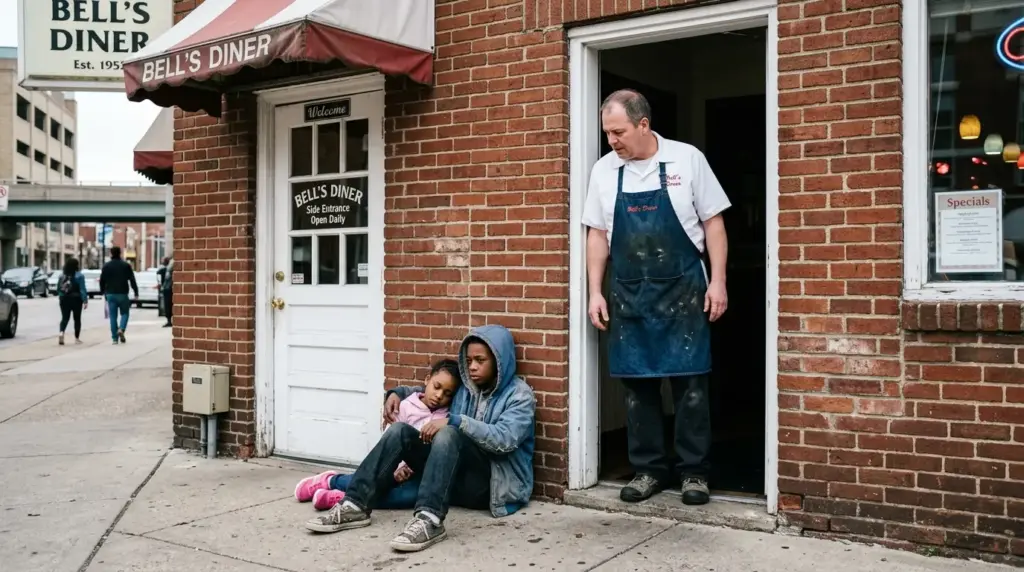
The tallest man pushed a purchase agreement across the counter and tapped the number printed near the signature line. It was more money than Arthur had ever held at one time, enough to pay his debts and rent a small apartment somewhere far from the noise of downtown Cleveland, but it was still less than the land beneath Bell’s Diner was worth to Sterling Crest Development. Arthur knew that because he had watched them buy almost every property on the block, one by one, for a project advertised as Riverside Crown Residences. Twenty-four floors of glass apartments, private parking, a rooftop pool, and ground-floor shops where a cup of coffee would probably cost more than Arthur’s breakfast special.
“You are the last holdout,” the man said. His name was Victor Dane, and he spoke with the tired irritation of someone who believed the world should move faster when money was involved. “Everybody else understood the opportunity.” Arthur folded the agreement in half without signing it. “Everybody else can make their own decisions.”
Victor smiled without warmth. “This is not sentiment, Mr. Bell. This is development.”
“Then develop around me.” The two men behind him laughed, but Victor did not. He leaned closer and lowered his voice. “The demolition schedule starts next month. Permits are in motion. Contractors are booked. You can leave with a check, or you can leave after attorneys finish billing you into the ground. Either way, this diner disappears.”
Arthur had heard versions of that speech for six months. He had also heard the refrigerator compressor groan every night, the bank warn him about a missed equipment payment, and his accountant explain that stubbornness was not a financial strategy. Still, he looked at the green vinyl booth beside the front window, the one closest to the old radiator, and remembered two children sitting there with bowls of beef stew warming their hands. The boy had been ten. His little sister had been seven. Neither had eaten in three days.
Twenty-five years earlier, Arthur Bell had been forty-six and strong enough to unload fifty-pound flour sacks without thinking about his back. Bell’s Diner sat at the edge of a working neighborhood where factory workers ate before dawn, school bus drivers stopped for coffee, and city crews came in muddy at lunch. Arthur owned the narrow brick building outright because his father had bought it in 1968, and the diner was as much a part of him as the burn scar on his left wrist from a fryer accident when he was nineteen. His wife, Susan, had died five years earlier, and the diner had become the place where he kept moving because stopping meant thinking too much.
It was a cold November afternoon when he first saw the children. The lunch rush had ended, the sky was the color of dirty snow, and Arthur was carrying a trash bag toward the dumpster when he noticed two small figures sitting on the concrete beside the diner’s side entrance. The older child was a Black boy in a thin blue jacket with a broken zipper, and the younger was a Black girl wearing pink sneakers with no socks. She had her head resting against his shoulder, and he had both arms wrapped around her as if his body could make up for the coat she did not have.
Arthur stopped a few feet away. “You two waiting for somebody?” The boy stood so quickly that the girl almost tipped sideways. “No, sir. We’re leaving.”
Arthur looked at the girl’s face. Her lips were dry, and there was a dullness in her eyes that he had learned to recognize after years of feeding people who came into the diner pretending they were not hungry. “I did not tell you to leave.” The boy hesitated. “We are not bothering anybody.”
“Didn’t say you were.” The girl pressed one hand against her stomach. The boy noticed and turned slightly, blocking Arthur’s view as though hunger were something he needed to protect her from. That movement decided the conversation. “Come inside,” Arthur said.
The boy shook his head immediately. “We don’t have money.” “I didn’t ask if you had money.” The boy looked toward the front windows, where two customers still sat drinking coffee. “Can I just ask you something?”
Arthur waited. The boy swallowed. “Do you have anything you were going to throw away? Bread ends. Fries. Anything. Just for my sister. She hasn’t eaten in a while.”
Arthur felt the words land like something heavy. He glanced at the girl again. “How long is a while?” The boy looked down. “How long?”
“Three days.” Arthur’s face hardened, but not at the children. “And you?” “I’m okay.” “That means three days for you too.”
The boy did not answer. Arthur opened the side door and pointed inside. “Both of you. Now.”





