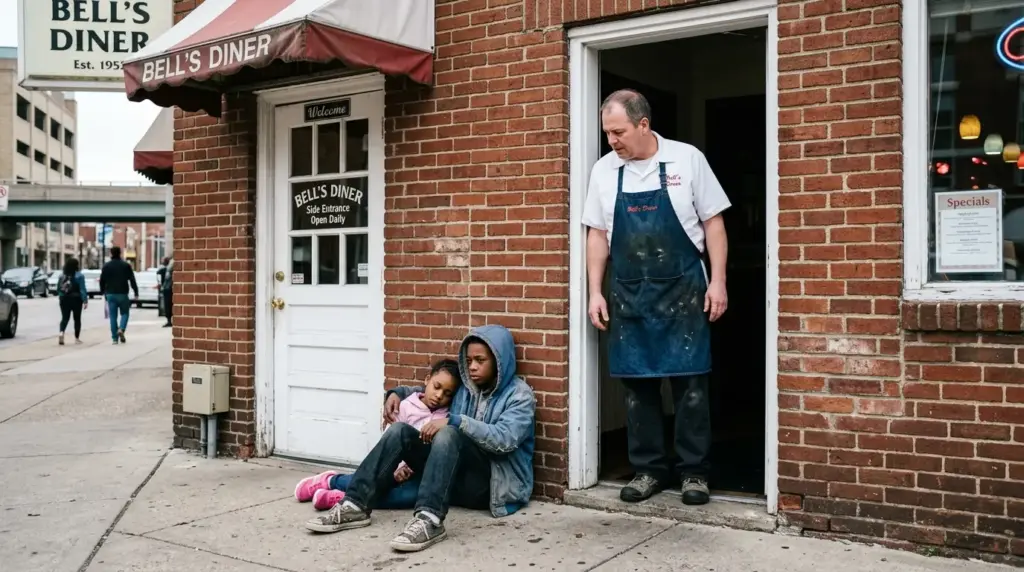
They followed cautiously, like children entering a place they expected to be removed from. Arthur guided them to the booth beside the radiator and told them to sit while he went behind the counter. The girl kept her hands tucked under her thighs, and the boy sat on the outer edge of the seat as if staying ready to run. Arthur filled two glasses with water first, then thought better of it and warmed milk in a saucepan with a little honey because both children looked chilled through.
“What’s your name?” he asked when he carried the mugs over. “Isaiah Brooks.” The girl looked at her brother before answering. “Mia.”
“How old?” “I’m ten,” Isaiah said. “She’s seven.” Arthur set the milk down. “Drink slowly.”
Mia wrapped both hands around the mug but did not drink until Isaiah nodded. Arthur pretended not to notice. He went back to the kitchen, ladled beef stew into two bowls, added mashed potatoes, green beans, and two thick slices of buttered bread to each plate. Then he stood there for a second looking at the food and wondered what kind of world trained a ten-year-old to ask for trash before asking for a meal.
When he carried the plates out, Isaiah stood. “Sir, we can’t pay for that.” “Good thing I’m not charging you.” “We only asked for leftovers.”
“These will be leftovers if nobody eats them. Sit down.” Mia stared at the steam rising from the stew. Her eyes filled before she took the first spoonful, and Arthur turned away to give her privacy. Isaiah ate more slowly at first, watching Arthur after every few bites, but hunger eventually won and the caution disappeared. He used the bread to clean every drop from his bowl.
While they ate dessert, Arthur filled two brown paper bags in the kitchen. He packed a loaf of white bread, a loaf of wheat, a jar of peanut butter, six apples, cheese, canned soup, crackers, and two cartons of milk from the refrigerator case. He added a small package of sliced turkey, then hesitated and placed a third bag on the counter with two wrapped cinnamon rolls and a note that said FOR TOMORROW MORNING.
Isaiah saw the bags when Arthur returned and pushed back from the booth. “No, sir. That’s too much.” “Too much for what?” “For us.”
“That is not an answer.” Isaiah’s jaw tightened. Pride looked strange and painful on a hungry child’s face. “We don’t want charity.”
Arthur pulled out the opposite seat and sat down. “Then don’t call it charity. Call it me having too much bread. Call it you doing me a favor. Call it Tuesday. I don’t care.”
“We’ll pay you back.” “You can pay me back by getting your sister somewhere warm tonight.” Something in Isaiah’s expression shifted. He looked toward Mia, then at the window, then back at Arthur. “We have somewhere.”
Arthur knew that answer was incomplete, but he also knew frightened children did not become less frightened because adults demanded everything at once. “All right. Then take the food there.”
Isaiah stood and lifted the first bag. It was heavy enough that Arthur took half the weight and divided the groceries again. Mia hugged the bread to her chest like a pillow. At the door, Isaiah stopped beneath the old brass bell and turned around.
“Mr. Bell?” “Yeah?” Isaiah looked him directly in the eye. “One Day I’ll Come Back.”
Arthur smiled. “You don’t owe me anything.” “I’m not saying I owe you. I’m saying I’ll come back. When I’m grown.”
“Fine. Bring your sister.” Mia raised the bread bag. “Can I bring this back?”
Arthur laughed. “Eat that one first.” They disappeared down the sidewalk just as the first snow began to fall. Arthur stood at the window until he could no longer see them. He expected the children to return the next day, maybe with a parent, a teacher, or a social worker. Instead, three days passed with no sign of Isaiah or Mia.
On the fourth afternoon, a black sedan stopped in front of Bell’s Diner. Three white men stepped out wearing black suits under long dark coats, expensive shoes, and expressions that did not belong to people looking for lost children. They came inside without taking off their gloves. The man in front placed a photograph on the counter showing Isaiah and Mia beside an older Black woman Arthur assumed was their mother.
“You seen these two kids?” he asked. Arthur looked at the photograph longer than necessary. “Who wants to know?” “Family matter.”
“You family?” The man smiled. “Close enough.” Arthur did not like the answer. “Then you should know where they are.”
The second man moved along the counter, looking toward the kitchen. “We were told the boy comes around here.” “Told by who?” “Doesn’t concern you.”
Arthur picked up the photograph and studied the woman. “Their mother?” The first man’s smile disappeared. “Mr. Bell, this goes easier if you answer the question.”
Arthur looked up slowly. “You know my name, but I don’t know yours. That makes me less interested in helping.”
The third man, younger and heavier than the others, leaned both hands on the counter. “The mother owes money. A lot of it. She ran with something that belongs to our employer. The kids may know where she went.”
Arthur thought about Isaiah sitting at the booth with his body angled protectively toward Mia. He thought about the way both children watched the door even while eating. Suddenly their caution made more sense. “I haven’t seen them,” Arthur said. It was the first deliberate lie he had told in years.
The men stayed ten minutes. They asked about alleys, shelters, churches, bus routes, and whether anyone had come asking for leftover food. Arthur denied everything. The younger man finally picked up the sugar dispenser from the counter, turned it in his hand, and set it down hard enough to crack the glass base.





