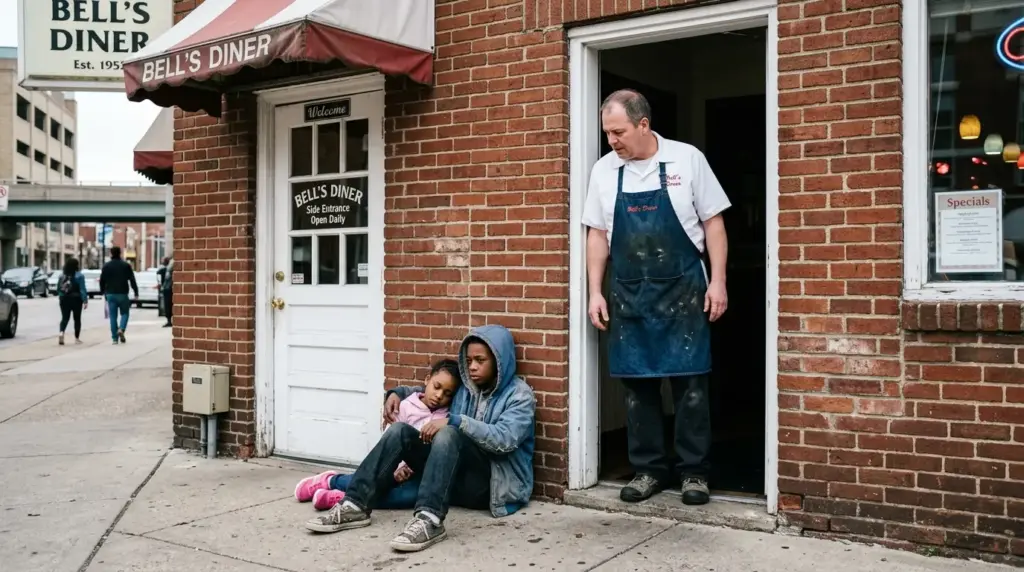
Victor exhaled slowly. “Why?” Arthur glanced toward the booth by the radiator. “Because somebody told me he would come back.”
Victor stared at him, then laughed. The men behind him laughed too. “That is your reason? A promise?” “Part of it.”
“From who?” Arthur smiled. “None of your business.”
Victor leaned closer. “Do you understand what happens when the bank takes this property? You will not get to choose who buys it. You will lose the leverage you have now.”
“Then maybe the boy better hurry.” Victor shook his head like Arthur had finally confirmed he was senile. “There is no boy coming back, Mr. Bell. There is only a deadline.”
They left the contract behind. Arthur stayed at the counter long after closing. At midnight he turned off the front lights, leaving only the yellow bulb above the grill. The diner looked old in that light. Not charmingly old. Tired old.
He walked to the booth beside the radiator and sat where Isaiah had sat twenty-five years earlier. For the first time, Arthur admitted something he had never said aloud: maybe Raymond had been right. Maybe Isaiah had meant the promise only in the fierce, temporary way children mean things before life carries them somewhere else. Arthur rested his forehead against the cool window. “You got about three weeks, kid.”
The next morning, a woman named Leah Grant walked in and ordered black coffee. She was around thirty-five, carried a leather briefcase, and asked Arthur strange questions about the history of the block. Arthur assumed she worked for Sterling Crest until she showed him credentials from a nonprofit legal clinic specializing in property fraud and displacement. “Why are you interested in my diner?” he asked.
Leah opened her briefcase and removed a photocopy of an old payroll ledger. “Because of Rochelle Brooks.” Arthur almost dropped his coffee pot. Leah watched him carefully. “You knew her children.”
It was not a question. Arthur’s voice became guarded. “Why?”
“Because twenty-five years ago Rochelle copied financial records from Dane & Weller before disappearing. Those records showed the company using debt agreements and forged liens to pressure low-income homeowners into selling properties below value. Some of those properties eventually became part of Sterling Crest’s land portfolio.” Arthur sat down opposite her. “Where are Isaiah and Mia?”
Leah paused. “Alive.” Arthur gripped the edge of the table. “Where?” “I cannot tell you yet.”
Old anger flashed through him. “I have waited twenty-five years.” “They know.” That answer hurt almost as much as it relieved him.
Leah explained that Rochelle had tried to report the scheme. Before she could, people connected to Dane & Weller began searching for her. The men who came to Bell’s Diner had not been police or legitimate debt collectors. They were private recovery agents hired to retrieve documents and frighten Rochelle into silence.
“She thought the safest thing was to move the children separately for a short time,” Leah said. “But then the situation escalated.” Arthur’s stomach tightened. “What happened to her?”
Leah looked down. “She died nine months later in a car crash outside Pittsburgh. The official finding was accidental. Her sister raised the children under a different surname.”
Arthur closed his eyes. “They lost their mother because of this?” “They lost a great deal.” “And now Sterling Crest wants my diner.”
Leah nodded. “That is why I am here. The current project may depend on property interests that trace back to the same records Rochelle tried to expose.” Arthur looked toward the old booth. “Why now?”
“Because somebody found the rest of her files.” “Who?” Leah smiled faintly. “The boy who said he would come back.” Arthur stood so fast the table moved.
“Where is he?” “On his way.” For the rest of the afternoon Arthur could barely function. He burned toast, forgot an order, poured decaf into the regular pot, and accused the cash register of conspiring against him. At four-thirty, a dark blue sedan pulled into the lot.
A tall Black man stepped out wearing a dark overcoat. He was thirty-five, broad-shouldered, clean-shaven, and carried himself with the quiet confidence of someone who had learned how to enter difficult rooms without asking permission. Arthur stared through the window, trying to find the ten-year-old boy inside the man’s face. Then the passenger door opened.
A Black woman stepped out, smaller than the man, wearing a burgundy coat and carrying a flat cardboard bakery box. She was thirty-two. When she looked toward the diner, her hand rose to her mouth. Arthur stopped breathing. Mia had her mother’s eyes.
The bell above the door rang. Nobody spoke at first. Isaiah walked three steps into the diner and looked at the booth beside the radiator. Mia did the same. Their expressions changed together, as though both had been pulled backward through time.
Arthur came around the counter slowly. “You took your time.” Isaiah laughed once, but it broke halfway through. “I know.”
Arthur looked at Mia. “You still argue with him?” She began crying. “Every day.” That ended any possibility of dignity.
Arthur hugged them both. For several minutes there was no developer, no bank, no twenty-five years. There was only an old man holding two adults and remembering the weight of paper grocery bags in small hands. When they finally separated, Mia opened the bakery box she had carried inside. It contained a flattened brown paper bag.
Arthur recognized the old Bell’s Diner stamp near the bottom. “We kept one,” she said. Inside the bag was a note written in childish block letters on the back of an old diner receipt. ONE DAY I’LL COME BACK.
ISAIAH
MIA TOO
Arthur looked up. “You made her sign?” Isaiah smiled. “She insisted.”





