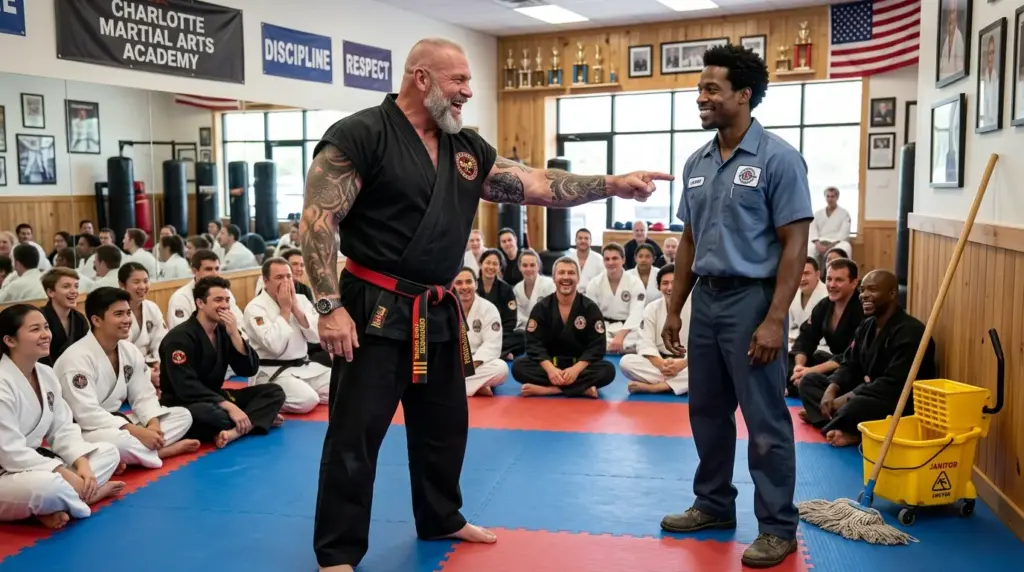
Conrad Hartwell’s voice cut across the training room like a blade.
Jasper Townsend stopped mopping.
The academy was supposed to be closed to outsiders for the evening seminar, but the mats were still wet in patches, and someone had spilled sports drink near the heavy bags. Jasper had been trying to finish the hallway before the next class started.
Conrad stood in the doorway, enormous and impatient.
Six-foot-seven.
Skull shaved.
Tattoos running down both arms like armor.
A black tank top stretched across his chest, making him look less like an instructor and more like a man hired to break doors.
He ripped the mop from Jasper’s hands.
“I need a body,” Conrad said. “You’ve got the honor of being chosen.”
Jasper kept his voice level.
“I never agreed to this.”
Conrad’s eyes narrowed.
The room behind him went quiet.
Students turned.
Parents looked up from folding chairs.
Someone laughed nervously, then stopped.
Conrad stepped closer until his shadow covered Jasper’s face.
“Who gave you permission to talk back to me?”
Before Jasper could move, Conrad grabbed him by the collar and hair, dragging him across the edge of the mat like he was nothing more than equipment.
A demonstration dummy.
A thing.
Jasper stumbled, caught his footing, and kept his hands open.
He could feel the room watching.
Conrad pulled him to the center of the training mat and locked an arm around his neck.
“Class,” Conrad said, voice loud now, theatrical, “today we talk about control. When a man has no training, no discipline, no foundation, the body becomes useless. Soft. Easy to move.”
Then he lifted Jasper into the air and slammed him hard onto the mat.
The impact shook the floor.
Parents gasped.
Students leaned forward.
Conrad planted one boot on Jasper’s chest and looked down at him.
“First warning.”
Jasper lay on the wet mat, breathing slowly.
The smell of rubber, sweat, and cheap disinfectant filled his nose.
Conrad leaned down.
“Get up. I’m not done yet.”
Jasper opened his eyes.
Then he smiled.
A calm, cold smile that did not belong to a helpless man.
“Are you sure?”
Conrad did not understand what that meant.
Not yet.
But soon he would.
Hartwell Academy of Martial Arts sat between a laundromat and a nail salon in a strip mall outside Charlotte, North Carolina.
The sign out front read:
HOME OF THE HARTWELL COMBAT SYSTEM
Founded by Grandmaster Conrad Hartwell
Gold letters on black.
Inside, trophy cases lined the walls. Regional championships. Framed magazine clippings. Photos of Conrad standing over defeated opponents, arms raised, veins bulging, mouth open in victory.
This was Conrad’s kingdom.
Everyone inside it lived by his rules.
Students bowed when he entered.
Parents lowered their voices.
Assistant instructors laughed at his jokes whether they were funny or not.
Conrad had built an image out of muscle, volume, and fear. He called himself a grandmaster. He claimed to have developed his combat system through decades of study, competition, and street-tested experience. He told students he had taken techniques from all over the world and forged them into something new.
Most believed him.
Why wouldn’t they?
He had the building.
The sign.
The trophies.
The confidence of a man who never expected to be questioned.
Jasper Townsend had been the night janitor at Hartwell Academy for three years.
Five nights a week, from nine at night to four in the morning, he mopped the mats, scrubbed the locker rooms, emptied trash, refilled paper towels, cleaned mirrors, and made sure the academy looked spotless before the next morning’s classes.
His paycheck was eight hundred dollars every two weeks.
Most of it went to rent and his grandmother’s medication.
Jasper was thirty-four years old and looked like he had not eaten a full meal in months, because many times he had not. Dinner was usually white rice and canned beans. Some nights, just water and sleep.
His body told that story at first glance.
Narrow shoulders.
Sharp collarbones.
Ribs visible through every thin shirt he owned.
But if a person looked closer, something did not match.
His forearms carried flat, dense muscle that clung to bone like rope wrapped around a post. His wrists moved with a speed that had nothing to do with cleaning. His hands, rough from bleach and mop handles, had a precision too quiet to draw attention and too old to be accidental.
Jasper Townsend had been training since he was six years old.
His grandfather, Master Sergeant Clarence Townsend, had served as a Black Marine in Okinawa during the early 1960s. While stationed there, Clarence studied Shotokan karate and judo under local masters. He trained alongside another young Marine, a white man named Ellis Monroe.
Together, Clarence and Ellis spent four years shaping a combat system built not for trophies, but for survival.
No belts.
No sales pitch.
No school logo.
No grandmaster titles.
Just application.
Balance.
Distance.
Breakfall.
Control.
Survive the first attack.
End the second.
Walk away if you can.
Clarence came home to North Carolina and never opened a school. He never charged a student. He never advertised. He taught one person: his grandson.
Every morning before school.
Every evening after homework.
For thirteen years, Jasper trained on an old wooden porch until the boards knew his footwork.
Clarence taught him how to fall without breaking.
How to redirect force without meeting it head-on.
How to control a wrist, a collar, a shoulder.
How to stop a larger man without becoming cruel.
And above all, he taught him what the art was for.
“If you must fight,” Clarence would say, “fight clean. If you must fall, fall quiet. If you must rise, rise for someone other than yourself.”
Jasper was nineteen when his grandfather died.
He never stopped training.