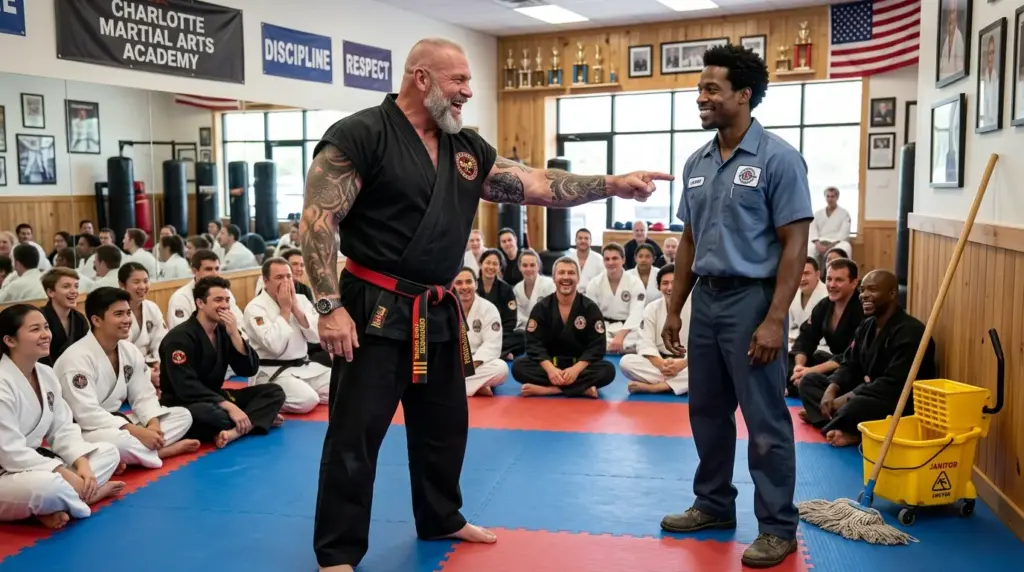
The gold letters on the sign were taken down by the landlord on a Tuesday afternoon.
Nobody photographed it.
Nobody marked the occasion.
Some empires do not fall with a bang.
They just go quiet, the way they should have stayed from the beginning.
Six months after the first class, the Townsend Community Defense Program had a waiting list.
Three community centers in North Carolina, two in Virginia, and one in Georgia began running the same curriculum.
No franchise fees.
No belt tests.
No trophies.
Just technique passed from one person to the next, the way Clarence believed it should be.
Jasper turned down interviews.
Two podcasts.
One TV appearance.
A documentary request from New York.
Ruth told him he should do at least one.
He told her he was not the story.
She told him he was exactly the story.
He smiled and kept mopping.
Because that was what people missed about Jasper Townsend.
He did not stop being a janitor.
Three nights a week, after the last class left, he still cleaned the community center gymnasium.
He mopped the same floor he taught on.
He emptied the same trash cans.
The only difference was that now, when he practiced alone at midnight, he did not have to hide.
Ellis Monroe passed away in April, four months after the hearing.
He was eighty-eight.
His obituary mentioned his Marine service, his Okinawa posting, and his role in developing a combat system that was never sold but never forgotten.
Jasper drove nine hours to attend the funeral.
He brought Clarence’s leather journal with him.
At the service, he placed it on Ellis’s casket for five minutes.
Then he picked it back up.
Ruth stood beside him in the rain.
Neither spoke during the drive home.
The journal now sits in a glass case at the Charlotte Community Center.
Page forty-three is open.
On that page is a hand-drawn diagram of the same throw Jasper used to put Blake Emerson on his back.
Below the diagram, in Clarence Townsend’s handwriting, are the words:
If you must fight, fight clean.
If you must fall, fall quiet.
If you must rise, rise for someone other than yourself.
Denise Caldwell earned her instructor certification through the Townsend program.
She teaches the Tuesday evening women’s self-defense class. She still records every session, but now the footage goes into a training archive, not a locked folder.
Blake Emerson enrolled in a judo school in Raleigh.
He started over as a white belt.
He told a friend he wanted to learn the art the way it was supposed to be learned from the beginning.
With respect.
Conrad Hartwell was later seen working at an auto parts store off Highway 74. He grew his hair out. He covered his tattoos with long sleeves. No one in the store knew he had once run a martial arts academy.
No one asked.
The old academy space is now a tax preparation office.
The trophy cases were sold at auction.
The framed television segment ended up in a dumpster behind the nail salon next door.
But two miles east, in a gymnasium that smells like floor wax and clean sweat, a thin Black man in a white T-shirt stands barefoot on a polished mat every Saturday morning and teaches forty people how to protect themselves without throwing the first punch.
His grandmother watches from the front row.
His grandfather’s journal sits in a glass case by the door.
And on the wall behind him, framed and lit, hangs the photograph from 1964.
Two Marines.
One dirt floor.
One system built honestly.
Passed down with love.
Finally home.
People often misunderstand legacy.
They think legacy is a sign in gold letters.
A building with your name on it.
A trophy case.
A wall of photographs.
A title like grandmaster, founder, champion.
Conrad Hartwell had all of those things.
And none of them were real.
Clarence Townsend had no sign.
No school.
No marketing budget.
No spotlight.
But he had truth.
He had discipline.
He had a grandson who carried what he taught without twisting it into cruelty.
The real thing is often quieter than the copy.
It does not need to shout.
It does not need to humiliate anyone.
It does not need to make sure you never meet the original.
Because the moment people see the original, the copy begins to fall apart.
That was the lesson Jasper carried onto the mat.
Not that he could defeat larger men.
Not that he could embarrass Conrad.
Not that the world finally noticed the janitor.
The lesson was that truth does not need a banner.
It needs one person willing to carry it.
Even unseen.
Even hungry.
Even mopping the floors of a building somebody else built from stolen plans.
For years, Jasper Townsend carried his grandfather’s art in silence.
He carried it through poverty.
Through humiliation.
Through bruises.
Through nights when no one watched but the security cameras and the ghosts of men who had taught him how to stand.
Then, when the moment came, he did not use that art to punish.
He used it to reveal.
And that is why the story did not end with a fight.
It ended with a class.
With an old woman in the front row.
With children learning how to fall safely.
With women learning how to break grips and walk home taller.
With men learning that strength without respect is only another form of weakness.
With a folded janitor uniform sitting beside the mat, not as shame, but as proof.
Proof that dignity can survive humiliation.
Proof that truth can outlast theft.
Proof that a legacy does not belong to the loudest man in the room.
It belongs to the one who carries it cleanly.
And Jasper Townsend, the quiet janitor everyone mistook for nothing, had been carrying the real thing all along.





