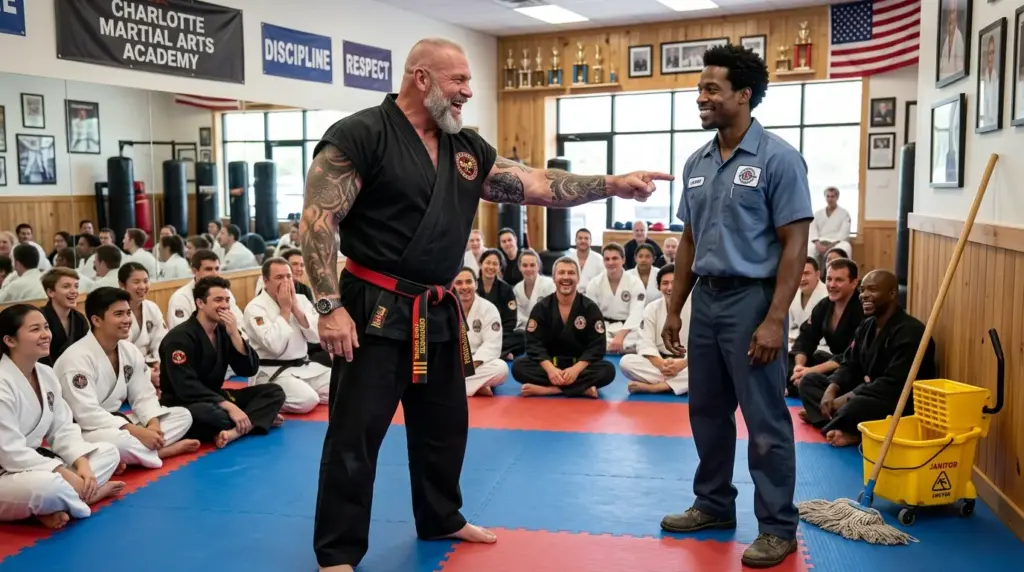
The caption that spread fastest read:
THE MOP GUY JUST ENDED THREE BLACK BELTS.
By midnight, #MopMaster was trending in North Carolina.
By Sunday morning, it had crossed state lines.
Denise Caldwell watched the numbers climb from her apartment. Her own footage—months of Conrad’s abuse, the slaps, kicks, insults, and forced demonstrations—sat in a locked folder on her desktop.
She did not upload it.
Not yet.
She was waiting for the right moment.
And she knew it was coming.
Conrad filed the police report on Monday morning.
Assault and battery.
He sat across from Officer Brenda Wallace at the Charlotte-Mecklenburg precinct with his arms folded and jaw set. Blake Emerson sat beside him wearing a foam cervical collar.
“My student sustained a serious neck injury during what was supposed to be a friendly exhibition,” Conrad said. “The janitor used excessive force. Reckless. Dangerous. He could have paralyzed this young man.”
Blake stared at the floor.
Officer Wallace took the statement.
Then she looked at Blake.
“Can you describe the incident in your own words?”
Blake glanced at Conrad.
Conrad gave a single nod, barely visible.
Wallace caught it.
“He, um… he threw me hard. My neck’s been hurting since Saturday night. I can barely turn my head.”
Wallace wrote it down.
She did not say what she was thinking, but she circled two words in her notes.
Barely.
And Saturday.
The report was being filed on Monday.
If the injury was that severe, why wait forty-eight hours?
By Tuesday, local news picked up Conrad’s version.
The county paper ran the first headline:
JANITOR INJURES STUDENT AT MARTIAL ARTS EXHIBITION.
The evening news framed it exactly how Conrad wanted: a reckless employee who attacked a young student during a supervised event.
Jasper’s phone buzzed Wednesday morning at six.
A text from the academy office manager.
Don’t come in tonight. You’re suspended pending investigation.
No hearing.
No conversation.
Just a text.
Jasper sat at the kitchen table and did the math.
Eight hundred dollars every two weeks.
Rent due in six days.
Ruth’s blood pressure pills: one hundred forty dollars.
No refills left.
Groceries already gone.
The canned beans in the cabinet might last four days.
After that, nothing.
Ruth came from her bedroom and saw his face.
She sat down across from him, placed her hand over his, and said, “We’ve been broke before. We’ve never been broken.”
Conrad moved fast.
By Thursday, he had hired Gail Prescott, a local PR consultant who specialized in reputation management for small businesses. Together, they built a story.
Conrad Hartwell was not a bully.
He was a protector.
A mentor.
A man who had dedicated his life to teaching young people discipline.
And the janitor, untrained and unqualified, had endangered one of his students.
Gail coached Conrad for a five-minute local news interview.
He wore a navy suit instead of a tank top.
He spoke slowly.
He shook his head at exactly the right moments.
“I feel responsible,” he told the camera. “I should never have let an untrained staff member onto the mat. That was my mistake. But the violence he used? That was his choice.”
The internet did the rest.
The same platforms that celebrated #MopMaster three days earlier turned on Jasper overnight.
He could have killed that kid.
Lock him up.
Typical thug behavior.
A counter-hashtag appeared.
#MopMenace.
By Friday, it was trending locally.
Jasper did not respond.
He did not post.
He did not defend himself.
He sat in the small house with Ruth and read the comments on a cracked phone until she took it from his hands and set it face down on the table.
“Stop reading poison,” she said.
But behind the cameras and hashtags, cracks were forming.
Wednesday night, Conrad called Blake into the office.
The door was closed.
The foam collar sat on the desk between them.
Blake had taken it off the moment he left the precinct.
“Keep wearing it,” Conrad said. “Every time you leave this building, that collar goes on.”
Blake rubbed his neck.
“Conrad, my neck is fine. The doctor said mild strain. I’ve had worse sparring.”
“I don’t care what the doctor said. You wear it.”
Silence.
Then Blake said something Conrad did not expect.
“He helped me up.”
Conrad stared.
“What?”
“After the throw. He helped me up. He didn’t have to.”
Conrad’s jaw locked.
“Four years I trained here,” Blake continued, “and not once have I seen you help someone up after a demo.”
“Are you comparing me to a janitor?”
“I’m telling you what happened.”
“What happened is what I say happened. You understand that?”
Blake looked at the collar.
Then picked it up.
Then put it on.
But his eyes said something his mouth was not ready to say.
Not yet.
Thursday night, alone in his office, Conrad pulled up slow-motion clips of Jasper’s final throw from six different angles.
He watched the footage fourteen times.
Frame by frame.
The collar grip.
The hip load.
The forty-five-degree foot placement.
The rotation.
Then he opened his desk drawer and pulled out a notebook he had not touched in years. Training notes scribbled three decades earlier in the back of a van after sessions with a man whose name he had spent thirty years trying to forget.
Master Sergeant Clarence Townsend.
Conrad flipped to a page near the middle.
A rough sketch of a throw.
Same grip.
Same hip angle.
Same foot position.
He stared at the sketch.
Then at the frozen frame on his screen.
Then back at the sketch.
His mouth went dry.
He did not know Jasper’s last name.
In three years, he had never once cared enough to look at the employee file. Jasper was the janitor. Mop man. The body.
Now Conrad pulled up the personnel record.
He scrolled to the name field.
Jasper Townsend.
His chair creaked as he leaned back.
Townsend.
The room felt smaller.
The tattoos on his arms suddenly looked like exactly what they were.





