Another was a pedestrian bridge designed for a creek near my old neighborhood, where people had to walk almost a mile out of their way to reach the nearest crossing.

I knew every line in that book.
I knew where I had made mistakes, where I had started over, and where a drawing had finally begun to look the way I imagined it.
Trent held the sketchbook high above his head.
“What’s this supposed to be?”
He flipped through several pages with exaggerated curiosity.
“Little houses?”
His friend laughed.
I took a step forward.
“Give me the book.”
Trent moved it farther away.
“Wait, everybody needs to see this.”
He turned the open sketchbook toward the students gathered behind him.
Several leaned forward to look, although I doubted any of them could see much beyond lines and measurements from where they stood.
“Look at this,” he announced.
“Our new kid thinks he’s some kind of genius.”
I could feel heat rising into my face.
“Trent.”
He glanced at me.
“What?”
“Please.”
The word left my mouth before I could stop it.
For a fraction of a second, his expression changed.
I thought he might finally understand that the book mattered.
Instead, he smiled.
“Please what?”
I swallowed.
“Don’t damage it.”
That was when he grabbed the opposite sides of the sketchbook and pulled.
The first sound was a sharp crack from the binding.
Then the paper began to tear.
I moved instinctively, reaching toward him, but he had already pulled the two halves apart.
Pages slipped from the damaged spine and fluttered to the floor, turning slowly in the stale hallway air.
A carefully drawn section of my pedestrian bridge landed near his shoe.
Another page slid beneath the feet of the students watching.
Someone gasped.
Then someone laughed.
I stood there staring at the two pieces in his hands, unable to understand how something that had taken so long to create could be destroyed in less than three seconds.
Trent dropped the remains.
“Guess you’ll have to draw some more houses.”
My hands closed into fists inside my pockets.
I could feel my fingernails pressing into my palms.
My shoulders tightened, and for one terrible moment, every lesson I had learned at the gym seemed to rise from memory at once.
I knew how to move my feet.
I knew what to do when someone much larger came too close.
I knew how quickly a person could lose balance when they weren’t prepared.
Trent was standing directly in front of me, still smiling.
I imagined what would happen if I let myself react.
The crowd would have something much more exciting to film.
Trent’s teammates would join in.
Teachers would rush out of nearby classrooms, and by the time everyone finished telling their versions of the story, the quiet transfer student would become the person who had started a fight with the school’s favorite athlete.
My uncle’s voice returned to me.
Don’t let somebody else decide who you become.
I slowly opened my hands.
Across the hallway, near the outer edge of the crowd, a girl held her phone vertically.
She wasn’t trying to hide it.
Her camera was pointed directly at Trent, and there was a small smile on her face as she recorded.

At that moment, I assumed she was hoping for something embarrassing enough to share with her friends.
Then my attention shifted beyond her shoulder.
Principal Evans had stepped out of the administrative office.
He was a tall man in his mid-fifties with carefully combed gray hair, a charcoal jacket, and a dark tie.
A white ceramic coffee mug rested in one hand.
Steam drifted above it as he stopped near the entrance to the staff corridor.
He had a clear view of everything.
I watched his eyes move from Trent to the torn sketchbook on the floor.
He saw the students surrounding us.
He saw my backpack hanging open.
And he saw me standing against the lockers with my hands clenched at my sides.
For a brief moment, I thought he was coming toward us.
Our eyes met.
Then he turned away.
Not hurriedly.
Not as if someone had called him.
He simply looked down at his coffee and continued into the staff hallway.
He had seen what happened and decided that it wasn’t worth stopping.
The realization hurt more than I expected.
Trent noticed where I was looking and glanced over his shoulder.
When he saw that the principal had disappeared, his grin widened.
“See?” he said, turning back to me.
“Nobody cares.”
Then he stepped forward and drove his broad shoulder into my chest.
My back struck the lockers, and I lost my footing.
I slid down the cold metal until my knees touched the floor.
Loose drawings surrounded me.
Trent stood over me for another moment.
“I’ll find you after seventh period,” he said.
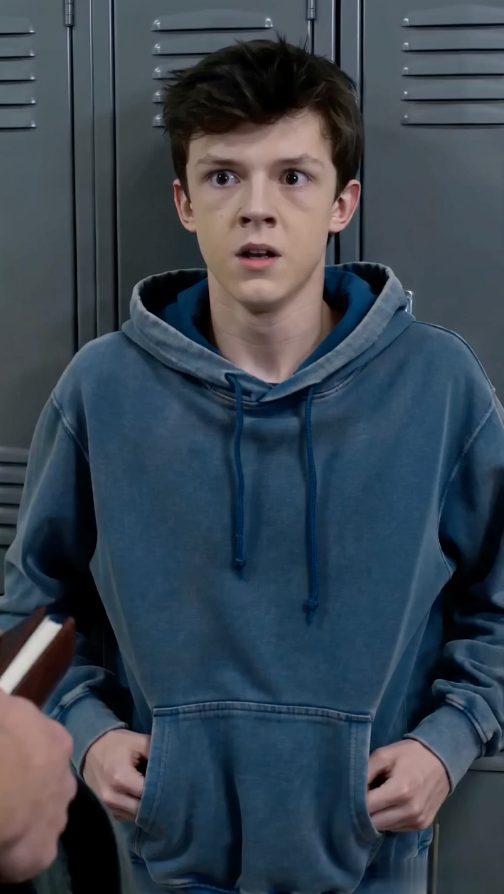
“And if you’re wearing that dumb blue hoodie again, I’m taking it right off you.”
He moved his shoe across the floor and pushed one of my crumpled drawings into my lap.
His teammates laughed.
The morning bell rang.
It was strange how quickly everything returned to normal after that.
Students who had been watching only seconds earlier suddenly remembered that they had classes to attend.
The circle broke apart, backpacks swung over shoulders, and shoes squeaked against the floor as people hurried away.
A few stepped around me.
Others stepped directly across the scattered pages.
Someone muttered something that sounded like an apology, but nobody stopped long enough for me to see who it was.
Trent walked away with his friends, talking loudly about football practice.
Within a minute, the hallway was almost empty.
I remained on my knees.
A torn drawing lay across my lap.
It showed the front entrance of the recreation center, including a ramp I had redesigned four times after realizing the first version was too steep.
The paper had been ripped directly through the entrance.





