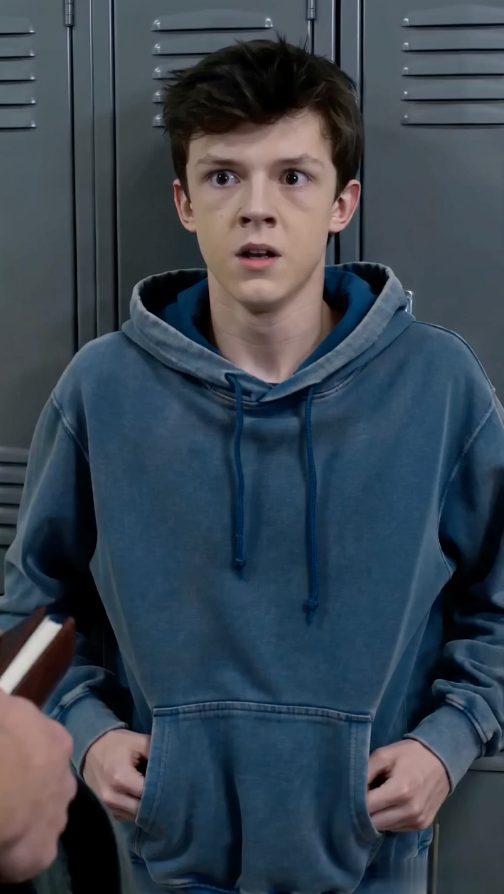
The interruption lasted only a moment, but it was enough.
I moved past him and continued toward the exit.
Behind me, he called out, “This isn’t over!”
I didn’t turn around.
My hands were shaking when I reached the main doors.
But I had made it outside.
And for the second time that day, I had chosen not to let him decide what happened next.
My uncle was waiting beside his old pickup truck.
He stood with his arms folded, wearing a gray work shirt and dark jeans.
His hair was beginning to turn silver near the temples, and the deep lines around his eyes made him look stern until he smiled.
He wasn’t smiling when he saw me.
His eyes moved to the torn backpack, then to the papers I was holding against my chest.
“What happened?”
I tried to answer.
Nothing came out.
He took one step toward me.
“Are you hurt?”
I shook my head.
“Did somebody put their hands on you?”
I looked away.
He waited.
I had spent the entire day trying to remain calm, trying to convince myself that I could handle everything without making a scene.
But standing beside the person who had taught me how to protect myself, I suddenly felt very young.
“Yeah,” I said.
My uncle’s jaw tightened.
“Get in the truck.”
He didn’t raise his voice.
That frightened me more than if he had shouted.
We drove away from the school without speaking.
I watched the athletic fields pass through the passenger window.
Students in football gear were already running across the grass beneath the stadium lights, and I wondered whether Trent was among them.
My uncle kept both hands on the steering wheel.
After several minutes, he said, “Tell me.”
So I did.
I told him about the lockers, the backpack, the sketchbook, and the students watching.
I told him that Trent had torn apart my scholarship drawings.
When I reached the part about the principal walking away, my uncle glanced toward me.
“You’re sure he saw?”
“Yes.”
“You’re absolutely sure?”
“He looked right at us.”
My uncle returned his attention to the road.
I continued, explaining the threat about seventh period and the encounter after the final bell.
When I finished, he didn’t speak for a long time.
I stared at my hands.
“Are you mad?”
He looked at me.
“At you?”
I nodded.
“Why would I be mad at you?”
“Because I didn’t do anything.”
He pulled into the parking lot outside the gym and switched off the engine.
Then he turned toward me.
“Listen carefully.”
I looked up.
“Did you hurt that boy?”
“No.”
“Did you threaten him?”
“No.”
“Did you do what you could to leave safely?”
“Yeah.”
My uncle nodded.
“Then don’t ever confuse refusing to fight with refusing to stand up for yourself.”
I looked down.
“He destroyed my work.”
“I know.”
“Months of it.”
“I know.”
My voice broke.
“And everybody laughed.”
My uncle reached across the center console and rested his hand on my shoulder.
For the first time all day, I stopped trying to hide how much it hurt.
I covered my face with both hands.
I didn’t cry loudly.
There was no dramatic breakdown, no angry outburst.
I simply sat in the passenger seat while tears slipped between my fingers.
My uncle stayed beside me.
When I finally lowered my hands, he gave my shoulder a gentle squeeze.
“Now,” he said, “tell me what we can still save.”
The gym smelled of old leather, cleaning solution, and the faint metallic scent of exercise equipment.
A few familiar members were finishing their workouts when we arrived.
My uncle greeted them briefly and led me into the small office at the back.
He cleared a space on the desk.
“Show me.”
I opened the sketchbook.
The damaged pages spread across the surface like pieces of a puzzle.
My uncle examined them without speaking.
He picked up a drawing of the pedestrian bridge and carefully unfolded the corner.
“You remember when you showed me this?”
I nodded.
“You said the supports weren’t right.”
“Because they weren’t.”
He turned the page.
“And then you figured it out.”
“Yeah.”
He placed the drawing down.
“So you can figure out how to fix this too.”
I shook my head.
“Some of the pages are missing.”
“Then we start with what you have.”
“I might not have enough time.”
“How long until the application deadline?”
“Less than three weeks.”
He considered that.
“How much is saved on your computer?”
I thought for a moment.
“Some scans.
Older versions.
Not everything.”
“Then we use those.”
I looked at the pages.
“It won’t be the same.”
“No,” he said.
“It won’t.”
He sat in the chair opposite me.
“But damaged doesn’t mean worthless.”
The words landed more deeply than I expected.
For several minutes, we sorted the drawings together.
He didn’t understand the technical notes, but he was careful with every piece.
He separated the pages by subject, kept the smallest fragments inside envelopes, and asked me to identify drawings that could be recreated from saved versions.
When we finished, the desk was covered with organized stacks.
My uncle leaned back.
“Now tell me what the school is doing about the boy who did this.”
I hesitated.
“Nothing yet.”
“Have you reported it?”
“No.”
“Why not?”
I explained what I had seen the principal do.
He listened carefully.
Then I told him about Rachel’s video.
“There’s footage from a student’s phone,” I said.
“And there’s a security camera above the lockers.”
He sat forward.
“Does the phone video show the principal?”
I nodded.
“He looks toward us and walks away.”
My uncle was quiet.
“Has anybody else seen it?”
“Just me and the girl who recorded it, I think.”
“Does she still have the original?”
“Yes.”
He nodded slowly.
“Good.”
I watched him.
“What are you thinking?”
“That we need to make sure the evidence doesn’t disappear.”
He reached for a notepad.
“Write down the exact time.





