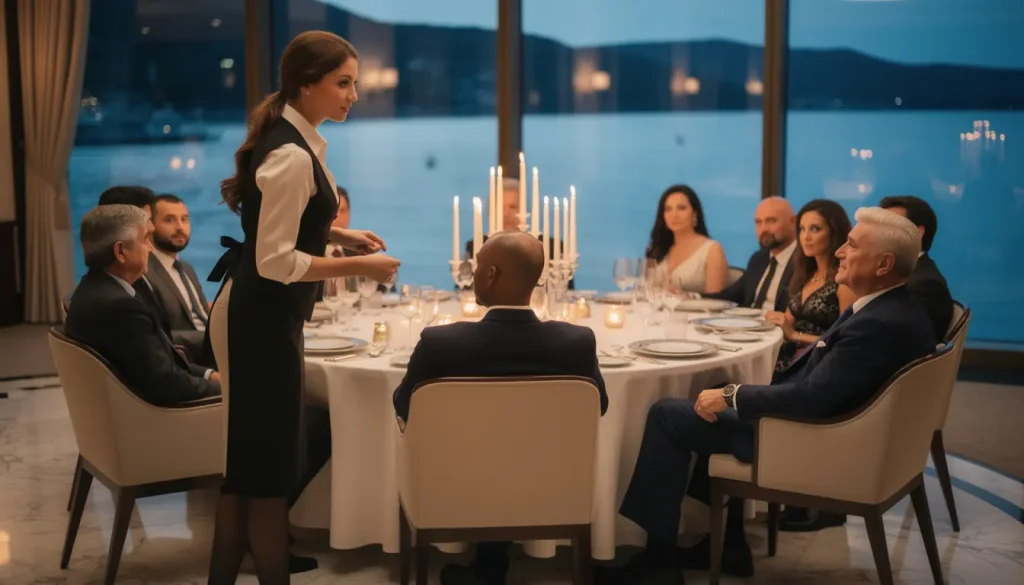
The crystal water pitcher felt cool and steady against Celeste’s palm as she moved between the tables.
The silver-rimmed glasses at Table Four caught the soft amber glow of the candlelight.
Her pouring motion was smooth, practiced, and entirely without tremor.
The two couples seated there had witnessed the entire confrontation from less than twenty feet away.
When Celeste leaned forward to set the pitcher down, neither of the women spoke.
The older man on the left, an attorney from Boston who spent every autumn at the resort, gave her a quiet, respectful nod that carried far more weight than an apology.
Celeste returned the gesture with a faint, polite inclination of her head and stepped back toward the service station.
The grand dining room of the Cliffmere Hotel slowly recovered its murmur, but the air remained charged with the residue of Everett Blackwood’s public unraveling.
Across the room, near the walnut double doors leading to the kitchen, Mr. Henderson had finally set down his leather-bound billing folio.
The hotel manager’s starched collar was damp around the edges, his thin silver tie pinned tightly against a shirt that had seen forty years of hospitality diplomacy.
He signaled her with a subtle, hesitant lift of two fingers.
Celeste walked toward the swinging doors, her rubber-soled service shoes making almost no sound across the parquet border.
Henderson pushed through the doors into the quiet service pantry, where the smell of roasted rosemary and garlic gave way to the sharp tang of industrial sanitizer and hot steel.
He turned to face her, his hands clasped behind his back in a military habit he had never quite abandoned.
“Celeste,” Henderson began, his voice dropping below the steady hum of the exhaust hoods.
“Yes, Mr. Henderson?”
The manager took off his wire-rimmed glasses, inspected them under the bare fluorescent tube, and polished the lenses with the corner of his pocket square.
“Mr. Blackwood’s suite on the fourth floor was settled twenty minutes ago,” Henderson said.
“His private chauffeur took his luggage down through the service elevator.”
“He did not stay for coffee.”
“I imagined he wouldn’t,” Celeste answered evenly.
Henderson put his glasses back on, studying the young woman who had stood on his payroll for eleven months without once mentioning a degree in international trade.
“The banquet supervisor told me you took three double shifts last week.”
“I did.”
“To cover your father’s respiratory therapy bills at the county hospital.”
Celeste did not look away.
“The hospital requires thirty percent down before admitting a patient into the progressive pulmonary rehabilitation wing.”
“My hourly wage covers the interest on his medication; the overtime covered the room deposit.”
Henderson’s jaw worked silently for a moment, a muscle twitching beneath his papery cheek.
“I have managed luxury dining rooms in Chicago, Boston, and Geneva for nearly half a century, young lady.”
“I have seen men with hundred-million-dollar portfolios throw soup at bussers because the broth was lukewarm.”
“I have seen women with private jets demand the termination of single mothers over a chipped butter dish.”
He took a step closer, his eyes remarkably clear behind his bifocals.
“In forty-eight years, I have never seen someone carry that much knowledge into a dining room and wield it with that much mercy.”
“Mercy?” Celeste asked softly.
“You could have exposed the entire fraudulent indemnity clause the moment he questioned your education,” Henderson replied.
“You could have shouted him down before the appetizer plates were cleared.”
“Instead, you waited until the document was physically on the table, allowed him to confirm his bad faith in front of fifteen witnesses, and dismantled his contract using nothing more than statutory definitions.”
He extended his right hand.
It was not the performative, transactional reach of Everett Blackwood.
It was the clean, steady hand of an old working man acknowledging an equal.
Celeste took it, feeling the dry, papery grip of fifty years of hospitality service.
“You are relieved of the remainder of your shift, Miss Rowan,” Henderson said gently.
“My tables are still occupied, sir.”
“Your tables will be handled by Marcus and David,” Henderson insisted.
“Your timecard will show a full shift, plus four hours of banquet closure overtime.”
“Mr. Henderson, company policy prohibits discretionary overtime on abbreviated shifts.”
Henderson allowed a faint, wicked smile to touch his thin lips.
“Mr. Blackwood’s administrative deposit for the private dining salon included a non-refundable facility surcharge of four thousand dollars.”
“I have already classified your contract analysis as an emergency technical compliance consultation on the departmental ledger.”
“The corporate office in St. Louis will find the audit entirely compliant.”
Celeste felt a rare, genuine laugh rise in her chest.
“Thank you, Mr. Henderson.”
“Go home to your father, Celeste.”
“He needs to know that the teacher who raised you didn’t waste his time.”
Twenty minutes later, Celeste stepped out the employee exit into the crisp, biting air of the lakeside terrace.
The October wind came off the water in long, cold gusts that smelled of damp fallen leaves and northern pine.
Her uniform was folded neatly inside her canvas shoulder bag.
She wore her worn navy wool pea coat, a faded charcoal scarf, and the sensible leather boots she had polished with black paste three mornings earlier.
The gravel path down to the staff parking lot was dark, illuminated only by small solar stakes planted in the cedar mulch.
Her ten-year-old sedan was parked under an overgrown willow tree near the edge of the property line.
The heater took four miles of winding county road to blow warm air against her stiff fingers.
She did not turn on the radio.
The silence inside the cabin was deep, restorative, and absolute.
Her father’s house stood four miles south of the lake, at the end of an unpaved gravel lane lined with rusted barbed wire and wild blackberry brambles.





