It was a small, single-story craftsman bungalow built in the late 1950s, with a sagging front porch and peeling white paint that caught the pale yellow beam of her headlights.
A single soft light glowed behind the drawn curtains of the front parlor.
Celeste turned off the engine and sat in the quiet dark for two minutes, feeling the accumulated exhaustion of three consecutive double shifts settle into the small of her back.
Then she took Lucien Moreau’s heavy engraved business card from the pocket of her coat.
The card was thick, heavy bond paper, with deep letterpress engraving that caught the faint moonlight filtering through the bare branches of the maples.
Moreau Maritime Arbitration & Trade Consulting, S.A.
Geneva — Paris — New York
Lucien Moreau, Senior Partner
Beneath the embossed telephone number, written in crisp, blue fountain pen ink, was a direct extension and a private cellular line.
She slipped the card back into her pocket, picked up her bag, and walked up the three wooden steps to the front door.
The brass deadbolt turned with its familiar, raspy click.
Inside, the house smelled of eucalyptus steam, peppermint tea, and the faint, dry scent of forty years of hardbound history textbooks.
In the corner of the small living room, near the brick fireplace that had not held a fire in three years, Arthur Rowan sat propped up against a mountain of pillows in a motorized hospital bed.
A thin plastic nasal cannula delivered a steady, soft hiss of supplemental oxygen across his upper lip.
He was seventy-one years old, his silver hair thin and wispy around his temples, his skin translucent from eight weeks of steroid treatments and intravenous antibiotics.
On his lap rested a battered hardbound copy of Thucydides’ History of the Peloponnesian War, held open with his thumb.
He lowered the book the moment the front door closed.
His dark brown eyes, identical to Celeste’s in their sharp, diagnostic clarity, took in her face before she had even untied her scarf.
“You’re home early,” Arthur said, his voice gravelly from the oxygen flow, but steady with the cadence of a veteran educator.
“Henderson let me off,” Celeste replied, hanging her coat on the brass peg behind the door.
She walked across the worn braided rug and pulled a straight-backed wooden chair up beside his mattress.
She sat down, taking his dry, paper-thin right hand between both of hers.
His pulse was slow, rhythmic, and familiar beneath her fingertips.
“Henderson never lets anyone off before midnight during an executive weekend,” Arthur noted, his eyes narrowing with affectionate suspicion.
“Did a guest break a bottle of port on the Persian runner?”
“No.”
“Did someone complain about the salt in the reduction?”
“No, Dad.”
“Then why are you sitting in my room at ten-fifteen on a Saturday night with color in your cheeks?”
Celeste smoothed the hem of the worn cotton quilt over his knees.
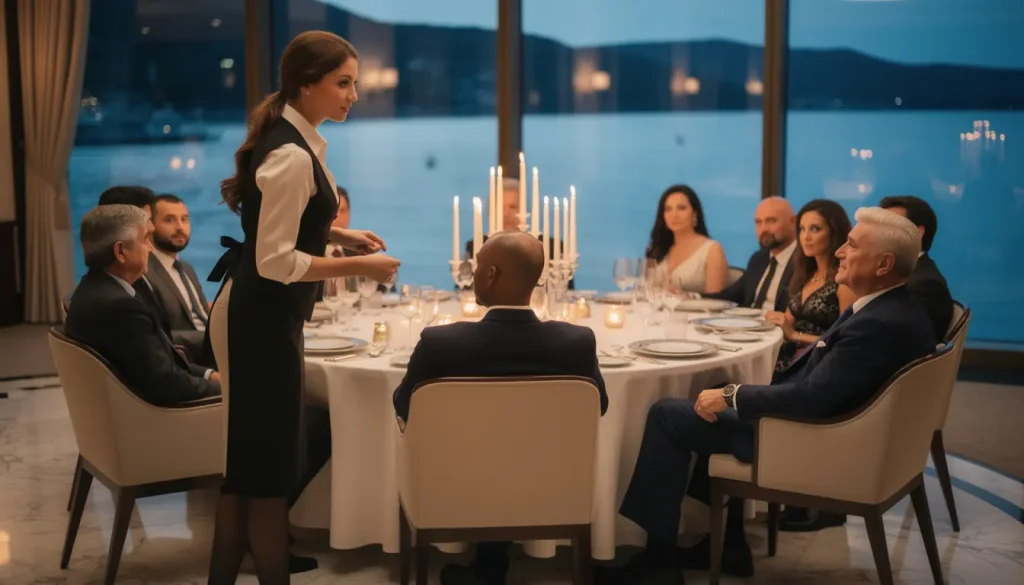
“Everett Blackwood had a private dinner in Salon B tonight.”
Arthur’s eyebrows lifted slightly.
“The real estate developer who bought the old paper mill parcels down on the river?”
“The same one.”
“He was on the regional evening news last Tuesday,” Arthur murmured, adjusting his oxygen tube.
“He gave an interview standing in front of a bulldozer, claiming the county planning board was full of incompetent obstructionists because they asked for an environmental runoff study.”
“He called me an ignorant nobody,” Celeste said quietly.
Arthur went entirely still.
The faded pages of Thucydides rested motionless against his lap.
“Why?” he asked, the educator’s calm dropping into an ancient, protective register.
“I placed a wine bottle three inches too far from his elbow.”
“And?”
“He told the table that the hotel hired people who couldn’t understand what they were discussing.”
“He said a waitress in an apron was a decorative accessory who couldn’t grasp real estate.”
Arthur did not raise his voice.
He looked at the framed black-and-white photograph resting on the bedside table, taken seven years earlier on the sunlit lawn of Georgetown University, where Celeste stood between him and her late mother in a black academic robe and a gold honors stole.
“What did you do, Celeste?”
“I answered him.”
“In English?”
“In French first.”
“Then?”
“Spanish for the investor from Madrid.”
“And Italian for the partner from Genoa.”
Arthur closed his eyes for three seconds, a slow, deep breath lifting his thin ribcage.
When he opened them, the corners of his eyes crinkled with an old, familiar light that had not appeared since his second hospitalization in August.
“Did you cite the statutes?” Arthur whispered.
“I cited Clause Fourteen of the 1998 Mediterranean Trade Accord.”
“The demurrage exemption loophole?”
“The very one.”
“The one you spent three weeks diagramming on the kitchen chalkboard during your master’s thesis?”
“Yes.”
Arthur threw his head back against the pillow and let out a dry, wheezing laugh that rattled the plastic medicine cups on the tray table.
“God Almighty,” the old teacher whispered, tears of pure, unadorned delight gathering in the creases of his eyelids.
“I would have given my pension to see the look on that man’s face.”
“His face looked like wet limestone,” Celeste said, smiling warmly.
She reached into her pocket, retrieved the heavy cream card, and laid it gently across the open pages of the Greek history book.
Arthur looked down at the engraving.
He read the firm’s name.
He read the title.
Then he saw the handwritten telephone extension on the back.
His fingers hovered over the heavy paper, trembling slightly as the full weight of the situation registered in his room.
“Lucien Moreau,” Arthur read aloud.
“The Moreau family has handled European trade dispute resolutions since the Treaty of Rome, Celeste.”
“He offered me a senior advisory position, Dad.”
Arthur looked up from the card, his gaze searching her face with sudden, defensive caution.
“In Geneva?”
“In New York.”
“Celeste, you cannot move to New York.”
“The clinics here—”





