stopped. “What changed?” “After you called. After she told me about the envelope. She started talking.” “About what?” “About everything.” The elevator doors opened. Neither of us moved. “Daniel,” Eleanor said, “she told me there are more women. Women Dustin hurt before her. Women who tried to leave and couldn’t.” “Because of his uncle.” “Because of his uncle. She said he has connections. Police. Judges. People who owe him favors.” I looked at her. “And she was afraid if she left, he would come after us.” Eleanor nodded. “She was trying to protect us.” I stepped into the elevator. “She shouldn’t have had to.” — The hallway on the third floor was quiet. Most of the rooms were dark. Visiting hours had ended an hour ago. But the nurses knew Eleanor. They let us through without a word. Room 312 was at the end of the hall. I stopped outside the door and looked through the window. Evelyn was lying in the bed, her face still swollen, her eyes closed. One arm was wrapped in a bandage. The other was connected to an IV drip. She looked small. She looked like the little girl who used to run to the door when I came home from deployment, her arms outstretched, her voice high and bright. She looked like she had been broken. I pushed open the door. Her eyes opened. “Dad.” Her voice was hoarse. Weak. I crossed the room and sat down in the chair beside her bed. I didn’t touch her. I didn’t reach for her hand. I just sat there, looking at her. “I’m sorry,” she said. “For what?” “For not telling you sooner. For not leaving. For—” “Stop.” She looked at me. “You have nothing to be sorry for,” I said. “Do you understand me? Nothing.” Her eyes filled with tears. “He said he would kill you. He said his uncle would find you and Mom and—” “I know.” “I believed him.” “I know that too.” She turned her head away, staring at the wall. “I should have known better. I should have known you could—” “Evelyn.” She looked back at me. “I spent fifteen years training Marines to survive situations they couldn’t control. I taught them how to stay alive when everything was falling apart. But I couldn’t teach you what you needed to know.” “What’s that?” “How to ask for help.” She closed her eyes. “I didn’t want to be a burden.” I leaned forward. “You are my daughter. You will never be a burden.” The tears spilled over. I reached out and took her hand. The one without the IV. She gripped my fingers like she was afraid I might disappear. “Dad,” she said, “the envelope.” “I know about it.” “There are so many pictures. So many women. I didn’t know what to do with it. I was going to give it to the police, but then I got scared, and then Dustin—” “Did he know you had it?” She shook her head. “I don’t think so. Not until tonight. He told me to hide it. He said it was important. He said his uncle gave it to him to keep safe.” “His uncle gave it to him?” She nodded. “I don’t know why. I don’t know what it means. But I knew it was wrong. I knew I couldn’t just—” “You kept it.” “I kept it.” I squeezed her hand. “Good.” She looked at me. “You’re not mad?” “I’m proud.” Her face crumpled. I pulled her into a careful hug, mindful of her ribs, and held her while she cried. When she finally pulled back, her eyes were red and swollen, but there was something new in them. Something I hadn’t seen in months. Hope. “Dad,” she said, “what happens now?” I looked at the door. Then at the window. Then at her. “Now we do this the right way.” — I stepped out of the room and found Eleanor waiting in the hallway. “She’s asleep,” I said. “Good. She needs it.” I looked around. The hall was still empty. The night shift was quiet. “I need you to do something for me.” Eleanor crossed her arms. “Name it.” “The envelope. I need you to get it before anyone else does.” “You think someone’s coming?” “I think the man on the phone told me not to take it out of the hospital. That means he either wants it to stay here or he’s planning to come get it himself.” Eleanor’s face went pale. “Should we call the police?” “I already did. Or you did. But I don’t trust them.” “Why not?” “Because Dustin’s uncle has connections. Evelyn said so. If the wrong cop walks in here, we lose everything.” Eleanor was quiet for a moment. Then she said, “What do you want me to do?” “Get the envelope. Put it somewhere safe. Not in the room. Not in the car. Somewhere no one would think to look.” “Where?” I thought for a moment. “The morgue.” She stared at me. “The morgue?” “Nobody looks there. Not unless they have to. And the night attendant owes me a favor.” Eleanor shook her head. “You’ve been retired for five years. How do you still have favors to call in?” I almost smiled. “Some things don’t expire.” She looked at me for a long moment. Then she nodded. “I’ll get it now.” “Be careful.” “I always am.” She turned and walked toward the elevator. I watched her go. Then I pulled out my phone and made another call. — It rang four times before he picked up. “Mercer?” His voice was rough with sleep. I had woken him up. He didn’t sound surprised. “I need your help.” There was a pause. “Where are you?” “Chicago. Mercy General.” Another pause. “What kind of help?” “The kind I shouldn’t need anymore.” I heard him sit up. Heard the creak of a bed. Heard a woman’s voice in the background asking who it was. He covered the phone. Then
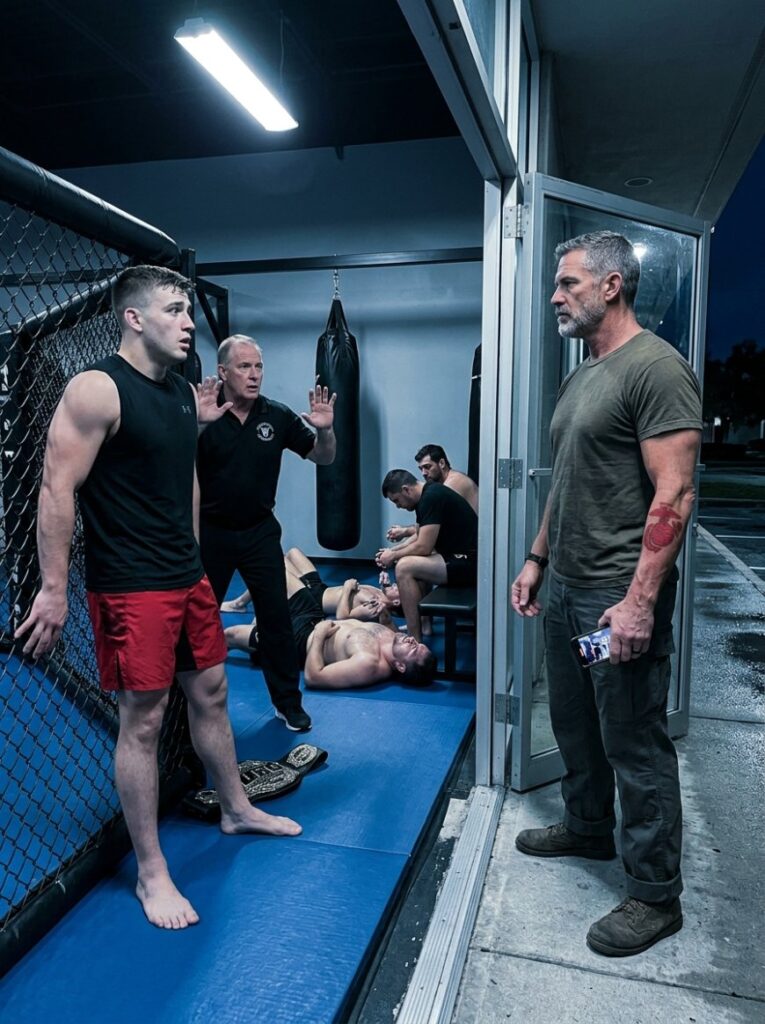
MMA boyfriend sent my daughter to the ER. His coach mocked my gray beard and promised I’d leave in a BODY BAG