he came back. “Give me the details.” I told him. All of it. The gym. The coach. Dustin. The uncle. The envelope. The photographs. When I finished, he was quiet for a long time. “You think it’s him,” he said. “I think it might be.” “The same guy?” “I don’t know yet. But the pattern fits. The control. The violence. The photographs.” He exhaled slowly. “Daniel, if this is the same guy, you know what that means.” “I know.” “This isn’t just some local trouble. This goes up. Way up.” “I know.” “Then what’s the plan?” I looked down the empty hallway. “I’m going to find out what’s in that envelope. Then I’m going to find out who’s in those photographs. Then I’m going to make sure every single person who touched my daughter answers for it.” “And if the uncle gets in the way?” I stared at the wall. “Then he finds out what I left behind too.” He was quiet for a moment. Then he said, “I’ll be there in two hours.” “Thank you.” “Don’t thank me yet.” The line went dead. — I sat down in the waiting room at the end of the hall. The clock on the wall said 11:47 PM. The hospital was quiet. The kind of quiet that felt like it was holding its breath. I thought about the man on the phone. *My name is Daniel Mercer.* The recognition in his voice. The pause. The way he had said my name like it meant something. He knew who I was. Or he knew of me. Either way, he understood what I had done for fifteen years. What I had taught men to do. What I had promised to leave behind. The gym had been the first step. But the envelope was the real fight. I closed my eyes and let myself remember. — Camp Lejeune. 2003. I was standing in a training hall with twenty-eight Marines in front of me. Young. Eager. Untested. They thought they knew what combat was. They thought they knew what violence meant. I was there to teach them that they didn’t. “The first rule,” I said, “is that you don’t get to choose when the fight starts. You only get to choose how it ends.” They watched me. Silent. Focused. “Some of you will be attacked by people who want to kill you. Some of you will be attacked by people who want to send a message. Some of you will be attacked by people who just want to see you bleed.” I walked down the line. “The one thing you will never do is panic. Panic is a choice. And you will not make it.” I stopped in front of a young man with a scar on his chin. “What’s your name?” “Ramirez, sir.” “Ramirez, if someone rushes you right now, what do you do?” He hesitated. “I—I would—” “You would die.” His face went red. “Because you hesitated. Because you thought. Because you tried to remember a technique instead of letting your training take over.” I stepped back. “Training is not about remembering. Training is about becoming. You don’t think about what to do. You do it. The moment you have to think is the moment you lose.” I looked at all of them. “Again.” They ran the drill for four more hours. By the end, half of them were on the floor. The other half were barely standing. None of them had panicked. That was the point. — I opened my eyes. The waiting room was still empty. But I felt different. Calmer. More focused. The man I had been fifteen years ago was still in there somewhere. The man who had taught Marines to survive. The man who had made himself a promise. But promises were made to be broken. Especially when they stood between me and my daughter. — A nurse walked past the waiting room. She glanced at me, then did a double-take. “Mr. Mercer?” I looked up. “I’m sorry to bother you. But there’s someone here to see you. He says he’s a friend.” I stood up. “Where?” “Lobby. He said his name is—” “I know his name.” I walked past her toward the elevator. — The lobby was quiet. A single figure stood by the entrance, hands in his pockets, watching the door. He was tall. Broad. Gray at the temples. He looked like a man who had spent his whole life in places where violence was a currency. He turned when he heard me approach. “Daniel.” “Marcus.” We didn’t shake hands. We didn’t hug. We just stood there, looking at each other. It had been five years since I had seen him. Five years since I had walked away from everything. “You look good,” he said. “You look old.” He laughed. “Retirement suits you.” “Does it?” He looked at me. “No. But it was the right choice.” I nodded. “Come on. I’ll explain everything.” — We sat in a small conference room on the second floor. I told him what I had learned. About Dustin. About the photographs. About the uncle. He listened without interrupting. When I finished, he leaned back in his chair. “The uncle,” he said. “What else do you know about him?” “Not much. Dustin was using his name to keep Evelyn in line. The coach was afraid of him. The voice on the phone was calm. Controlled. He knew who I was.” Marcus frowned. “He knew your name?” “He paused when I said it. Like he recognized it.” “That’s not good.” “No.” Marcus was quiet for a moment. “I did some digging on the way here. Called in some favors. The gym is owned by a shell company. The shell company traces back to a man named Victor Salazar.” I felt my stomach tighten. “Salazar?” “You know the name?” “I’ve heard it.” “Then you know what he is.” I nodded. Victor Salazar was a ghost. A man who had spent thirty years building an
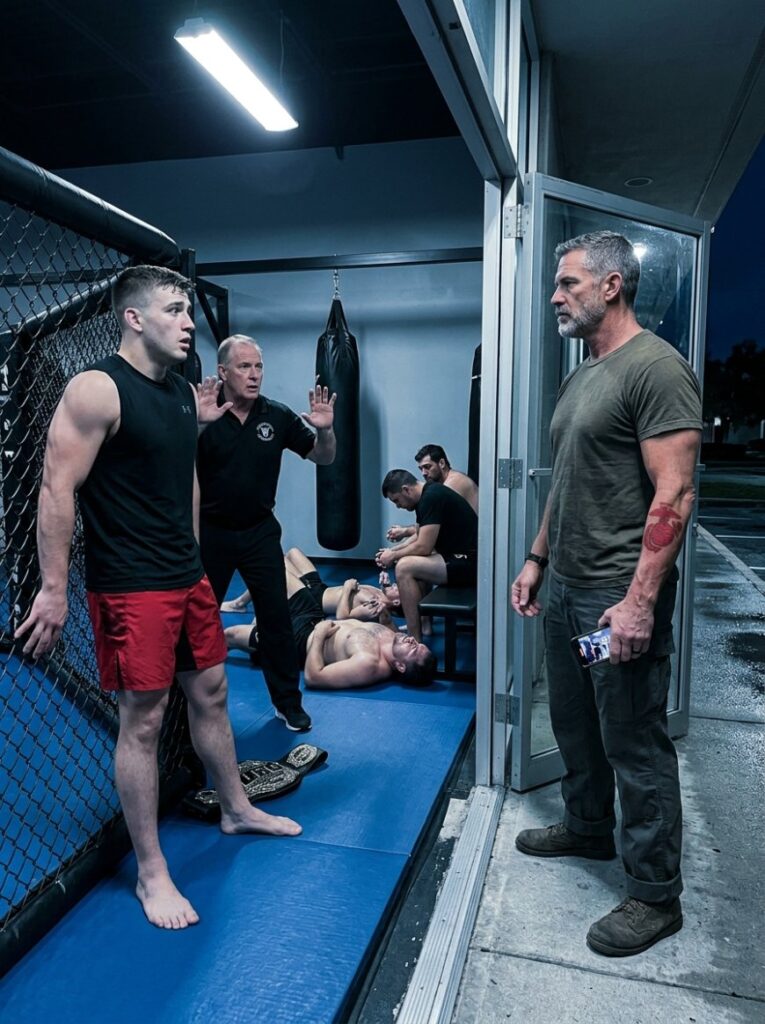
MMA boyfriend sent my daughter to the ER. His coach mocked my gray beard and promised I’d leave in a BODY BAG