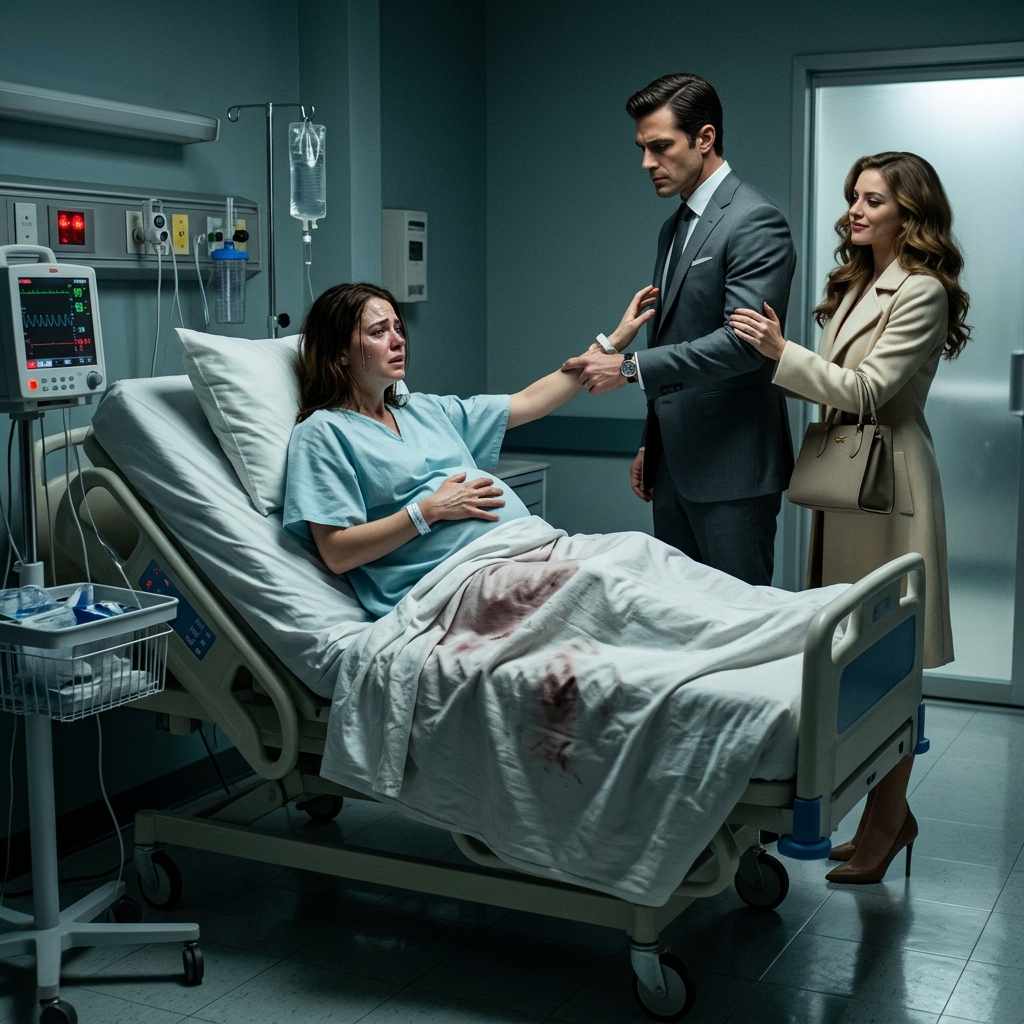
“Clare. The decelerations aren’t recovering between contractions. The placenta has separated across thirty percent of the margin. We’re going under general. Right now.”
“Will she breathe?” Clare gasped as hands unlocked the bed brakes and the frame lurched forward into the hall. “Miriam, tell me she’ll breathe.”
“We’re going to give her every chance in the world,” Feld said, her hand resting firmly on Clare’s shoulder as the gurney hit the corridor doors. “Breathe the gas when they tell you, Clare. Don’t fight it.”
The ceiling of the hallway moved overhead in an endless, rhythmic strobe of recessed lights. White, white, dark, white. Somewhere to her left, Martha walked alongside the wheels, her grip never slipping from Clare’s fingers until the red line on the floor—the boundary of the sterile suite—forced her back.
“Martha!” Clare called out, the terror finally breaking her voice into shards.
Martha stood behind the red line, tall, unmoving, her iPad clutched against her chest like an armor plate.
“The files are with Daniel, Mrs. Vance,” the older woman called back across the bright tile. “Everything is preserved. You bring that girl back out here. I will take care of the house.”
Then the heavy double doors swung shut, cutting off the world of accounts, Hamptons estates, and lying men, leaving Clare with nothing but the sour rubber of the anesthesia mask pressed against her nose, the scent of sevoflurane, and the silent, desperate thought that she refused to let die:
Let me hear her. Just once. Let me hear her cry.
Three days earlier, the morning had begun with the particular, hushed elegance of the East Hampton estate in late autumn.
The house, known locally as Grey Gables, was not Julian’s. It had been built in 1924 by Clare’s maternal great-grandfather, a railroad attorney who believed that cedar shingles should be thick enough to stop a musket ball and that baseboards should be cut from virgin cypress. It sat behind twelve-foot hedges of privet that muffled the sound of the surf off Georgica Beach, a fortress of cold privilege where Clare had spent her childhood summers watching her mother fade behind the drawn linen shades of the sunroom.
At eight o’clock on Tuesday morning, Dr. Feld’s voice had come through the car speaker with the cold finality of an audit: Complete previa, Clare. The ultrasound from yesterday shows zero clearance from the internal os. You are on bed rest. No travel, no stairs, no stress. If you see spotting—even a thimbleful—you do not wait for an ambulance. You get into the city.
Ten minutes later, Julian had walked into the breakfast room, smelling of bay rum and fresh laundry. He was wearing his traveling flannels, his leather weekender already loaded into the rear of the Mercedes at the portico.
“Berlin,” he had said, leaning down to press his cool lips against the part in her hair. His hand had rested on her shoulder—brief, light, the perfunctory touch of a man tipping a doorman. “The clean-energy consortium in Charlottenburg is finalizing the secondary debt round. If I don’t sign the covenants in person, the Germans will drag the due diligence into the first quarter.”
“Julian, the previa is complete,” she had said, her fingers clutching the bone-china rim of her tea cup. “Feld says the risk of severe separation doubles every week from thirty-one onwards. If I go into labor here…”
“That’s why Martha is here,” he replied smoothly, checking his cuffs. “And you have the driver. If there’s an issue, you’re at Southampton Hospital in eight minutes. I’ll have the satellite phone on during the flight. I land at Tegel by seven tomorrow morning, local time. I’ll call you before you’ve finished your oatmeal.”
He had walked out into the pale salt air, his step springy, almost celebratory.
At eight-forty, Clare’s phone had buzzed on the mahogany table.
It was Elena Torres, her roommate from Yale Law who had spent the last decade running an art-restitution practice out of a townhouse on East Sixty-Fourth Street. The message contained no greeting. Only twelve high-resolution digital photographs taken through the smoked-glass partition of the Virgin Atlantic Clubhouse at Terminal 4, JFK.
In the first six, Julian was sitting at a corner banquette beneath a modern brass chandelier. He was not reviewing bond indentures. His arm was wrapped around the shoulders of Lily Brooks, pulling her against his ribcage with a relaxed, possessive ease that Clare had not seen from him since their honeymoon in Amalfi. Lily was laughing, her throat arched back, her burgundy silk scarf falling over his knee.
The seventh photograph was a telephoto close-up of the cocktail table. Between two martini glasses lay two blue leather passport wallets and two boarding passes, the print clear enough to read with a two-finger zoom:
AF 007 — JFK TO CDG.
PAX: VANCE, JULIAN / BROOKS, LILY.
CLASS: PREMIERE.
Paris.
Clare had sat in the breakfast room for ten minutes while the tea grew a thin, translucent skin over its surface. She had called his private cell once. It rang twice and clicked into voicemail. She called again; it went directly to the automated tone—the unmistakable sign of a manual disconnect.
She had not cried. Some ancient, long-dormant Montgomery instinct had clicked into place behind her ribs, cold and heavy as iron ore.
She had rung the service bell.
Martha Higgins had entered carrying a silver pot of hot water. When Clare slid the phone across the table, Martha set the pot down on a cork mat, took a pair of tortoise-shell spectacles from her apron pocket, and looked at the screen.
She did not gasp. She did not offer the standard, fluttering condolences of household staff. She merely scrolled through the twelve images with her thumb, her face as impassive as a bank teller counting five-dollar notes.





