“Her grandfather was Thomas Brooks of the Brooks-Calthorpe syndicate,” Martha had said quietly. “The family lost the real estate portfolio in ninety-two, but Lily kept the registry connections. She’s an art advisor to several private equity funds. Julian brought her to the Hamptons property two years ago for the benefit auction, Mrs. Vance.”
“I know who she is, Martha,” Clare had said, her voice dropping into a register that surprised them both. “I want to know why she’s traveling on an Air France ticket bought with my grandfather’s money.”
Martha had pushed her glasses up the bridge of her nose. “Your father hired me fifteen years ago, Clare, not because I know how to polish silver, but because I spent twenty years tracking off-balance-sheet special purpose vehicles for Arthur Andersen before they dissolved. Your husband thinks I am an illiterate domestic who likes seaside gardens.”
“What do you need?” Clare had asked.
“Your written authorization to access the joint domestic servers from this terminal,” Martha replied. “And thirty-six hours of uninterrupted access to the secondary trust records in Delaware.”
“Take it,” Clare said. “Everything.”
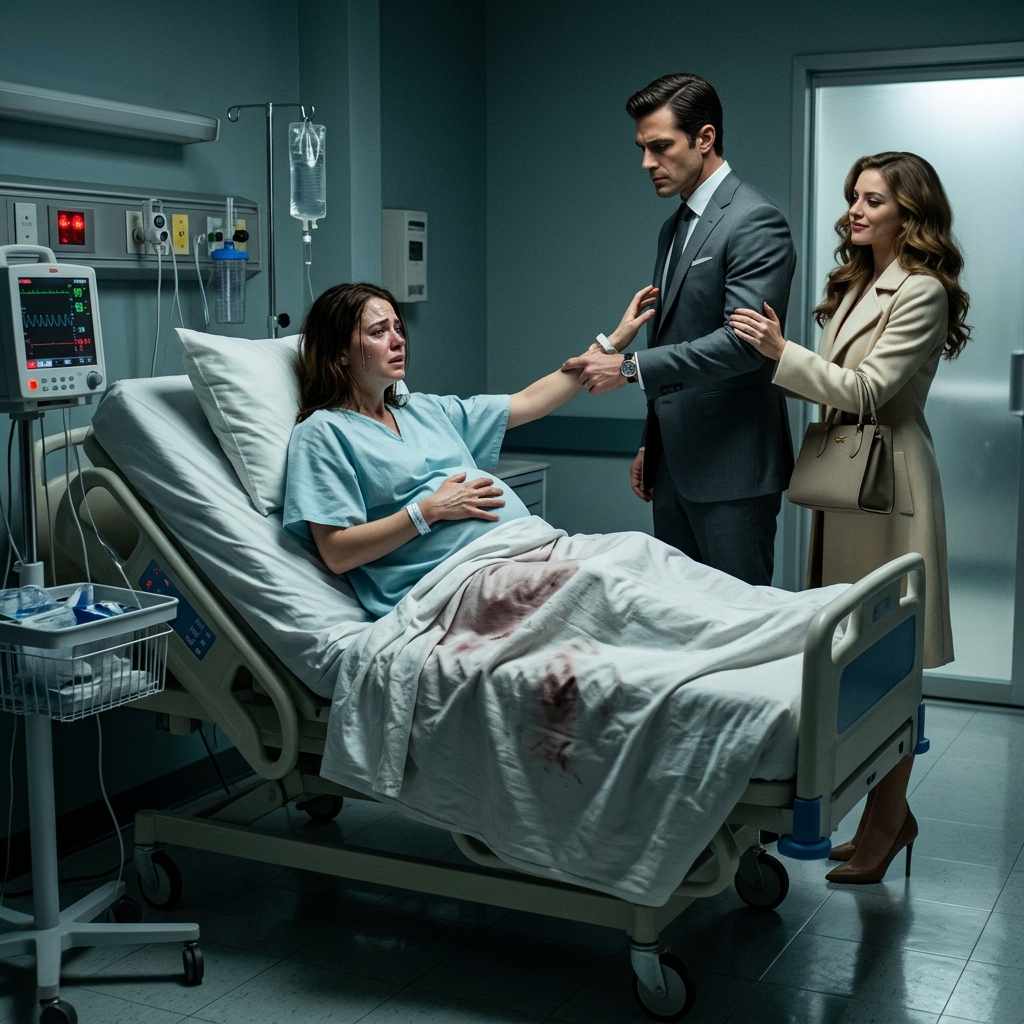
That was seventy-two hours ago. Now, the clean salt air of the Hamptons was gone, replaced by the mechanical hiss of an oxygen flowmeter and the smell of surgical betadine.
Clare woke to the sound of a ventilator bellows.
The ceiling was different—perforated acoustic tile, off-white, stained with an old water ring in the corner. Her mouth was dry as desert sand; an endotracheal tube had left the root of her tongue feeling swollen and raw.
When she tried to lift her hand, an agonizing pull across her lower abdomen drove a sharp, ragged gasp into her throat.
“Don’t pull the dressing, Clare,” a voice said.
Martha rose from the chair beside the window. The sky outside was black, streaked with the yellow sodium glare of Eleventh Avenue.
“The baby,” Clare croaked. Her throat caught; she began to cough, which triggered another wave of fiery agony across the surgical incision. “Martha… the baby.”
Martha took a plastic cup with a bendable straw from the bedside stand, guiding it to Clare’s cracked lips. “Drink. Just a swallow.”
Clare took the water, barely tasting the plastic. “Tell me.”
“She is in the NICU on the third floor,” Martha said, her voice dropping into a steady, anchor-like cadence. “Four pounds, six ounces. Born at three-forty-one p.m. Her Apgar scores were four and seven. They had to intubate her for eighty minutes because the surfactant in her lungs hadn’t fully cleared, but she is currently breathing on CPAP. Dr. Kalu says she is angry, stable, and has all ten toes.”
A tear slipped from Clare’s eye, tracking through the dried salt on her temple. “She’s alive?”
“She is alive, Mrs. Vance. And she has the Montgomery stubbornness. The nurses told me she kicked the pulse oximeter off her foot twice before they taped it down.”
Clare let her head sink back into the pillow. A violent, shuddering sob escaped her chest, followed by another, until the bed shook with the relief of it. She cried for five minutes while Martha sat beside her, one dry hand resting firmly over Clare’s trembling wrist, holding her to the world with the silent endurance of a granite pier in high surf.
“What time is it?” Clare asked when the weeping subsided into a dull, thrumming ache.
“Just past midnight. Friday morning.”
“Julian?”
Martha’s expression shifted. The lines around her mouth deepened into cold trenches. “He called my mobile at ten-fifteen. He was at a restaurant in the Meatpacking District. I could hear glassware and jazz in the background.”
“What did he say?”
“He asked if the procedure was completed. He used the word completed, like an inspection on a drainage pipe. I told him both of you had survived surgery. He said he was relieved, that he was in the middle of a working dinner with the overseas underwriters, and that he would come by during visiting hours in the morning.”
“Was Lily with him?”
“I heard her laugh, Clare,” Martha said softly. “She has a distinctive laugh. It sounds like two silver spoons clinking together.”
Clare looked up at the ceiling. The pain in her abdomen throbbed in time with her heart, but beneath it, the cold, clear space in her mind was expanding. The grief was still there, but it had ceased to be an ocean; it had frozen into a sheet of black ice, solid enough to stand on.
“Martha,” she said.
“Yes, Mrs. Vance.”
“Where is Daniel?”
“In the conference room down the hall. He has been here since nine.”
“Bring him in.”
“Clare, you have had eight units of IV fluid, major abdominal surgery, and—”
“Bring him in, Martha,” Clare repeated. “I am not spending another night as Julian Vance’s wife without knowing the balance sheet.”
Five minutes later, the door opened to admit Daniel Mercer.
At fifty-eight, Daniel looked less like a high-powered Manhattan litigator and more like an underpaid archivist at a maritime museum. His rumpled tweed jacket bore leather patches at the elbows; his gray silk tie was slightly skewed, and he carried a battered leather briefcase whose brass corners had worn down to raw tin. But behind his tortoise-shell glasses, his eyes possessed the terrifying, unhurried focus of a man who had spent thirty years watching billionaires destroy themselves over misplaced decimal points.
He did not offer dramatic sympathy. He sat in the visitor’s chair, opened his briefcase with two crisp metallic clicks, and laid a three-inch manila folder on the pull-down tray over Clare’s bed.
“Emma is doing remarkably well, Clare,” he said, his voice quiet, dry, and warm. “I looked in through the glass twenty minutes ago. She has your chin.”
“Thank you, Daniel,” she whispered. “Now tell me what my husband has done.”





