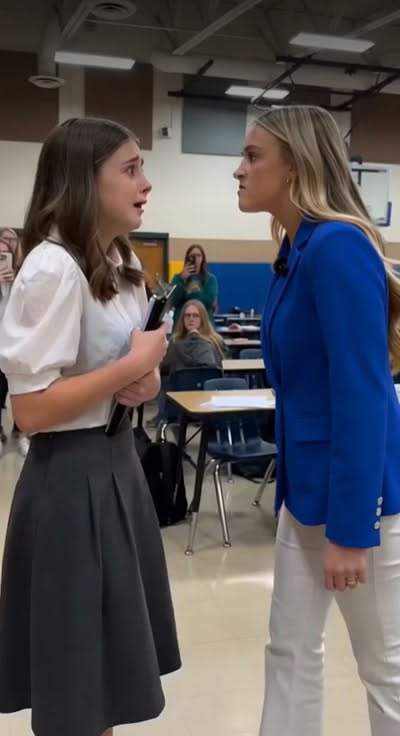
Chloe took a deep breath, clutching the mic like a talisman. The curtain parted. The spotlight hit her, a blinding pillar of white light. The audience hushed. Up in the booth, Elias hit the cue for the backing acoustic guitar track. It swelled through the auditorium, crystal clear.
Chloe raised the microphone to her lips. She closed her eyes, opened her mouth, and sang.
Nothing happened.
No sound came out. Only the hollow, distant echo of her unamplified voice, completely drowned out by the backing track.
Panic seized Chloe’s face. She tapped the grill of the microphone. Thump, thump. Nothing. The audience began to murmur. A ripple of confusion washed over the five hundred faces in the dark.
“Elias!” I hissed into my headset, my fingers flying across my tablet to check the frequency. “What’s happening? Is the channel muted?”
“No!” Elias sounded frantic, his voice cracking. “Channel three is wide open! I’m getting no signal! The mic is completely dead!”
On stage, the backing track continued to play, a cruel, beautiful melody mocking the silence of the singer. Chloe looked out into the sea of people, her eyes filling with tears. Someone in the back row laughed. It was a sharp, piercing sound that broke the tension in the worst possible way. Chloe lowered the mic, her shoulders shaking, and ran off the opposite side of the stage.
The auditorium erupted into chaotic chatter. Mr. Harrison rushed past me, his face pale. “Cut the track! Close the curtain!”
I signaled Elias, and the heavy velvet curtains swept shut. The disaster was complete.
But my mind was already racing. A wireless microphone doesn’t just die. Not when it was tested five minutes ago. Not when it had a brand-new battery.
I rushed to the stage left wing where Chloe had fled. She was sitting on a crate, sobbing into her hands. The dead microphone had rolled out of her grip and lay on the dusty floorboards. I knelt down and picked it up.
I turned it over in my hands.
There was no neon green battery-check sticker on the base.
My blood turned to ice. This wasn’t a technical failure. This was a swap. Someone had taken the live mic from the prop table and replaced it with a dead, uncharged decoy.
“Maya!”
I spun around. Jenna Fielding was marching toward me, her white boots clicking loudly against the stage floor. She had a look of performative outrage plastered across her face, Mr. Harrison trailing anxiously behind her.
“This is completely unacceptable, Mr. Harrison!” Jenna loudly declared, ensuring her voice carried across the wings to where the other performers were gathering. “This reflects terribly on the school. And on my family’s center!”
“I know, Jenna, I’m trying to figure out—” Mr. Harrison stammered.
“It’s obvious what happened,” Jenna interrupted, pivoting sharply to point an accusatory finger directly at the sound booth window at the back of the auditorium, and then at me. “The tech crew completely dropped the ball. They didn’t charge the equipment. I saw that freshman, Elias, messing with the mics earlier. He clearly forgot to put batteries in Chloe’s mic. It’s negligence. And Maya, as head of the crew, you’re responsible.”
She was laying the groundwork. Controlling the narrative before the dust even settled. She knew that if she blamed Elias, an anxious freshman, he would fold under the pressure. The school would apologize to Chloe, Elias would be suspended from the AV club, Jenna’s family would demand “better oversight,” and Jenna would win the talent show unopposed.
“That’s not what happened,” I said, my voice cutting through the panic.
Jenna stopped, turning to look at me as if a piece of furniture had suddenly spoken. “Excuse me?”
“I checked the mic myself,” I said, taking a step forward. I held up the dead microphone. “Elias put a green sticker on the charged mic. This one doesn’t have it. Someone swapped it while the jazz band was playing.”
Jenna’s eyes narrowed for a fraction of a second—a micro-expression of calculating rage—before the mask of concern slipped back into place. “Don’t be ridiculous, Maya. You’re just trying to cover your own incompetence. You and your little thrift-store crew messed up, and now poor Chloe has to pay the price.”
“I have the digital logs,” I said, keeping my voice perfectly steady, even as my heart hammered violently against my ribs. “The soundboard records every connection, every battery level, and every time a mic is powered on or off. It timestamps it to the millisecond. We can see exactly when the live mic was turned off and moved.”
Mr. Harrison looked between us, bewildered. “Maya, if someone sabotaged this…”
“They did,” I said, never breaking eye contact with Jenna. “And I’m going to pull the log right now.”
Jenna’s perfect facade cracked. Just a hairline fracture, but I saw it. The panic. But Jenna Fielding was not someone who retreated. When cornered, she attacked.
“Mr. Harrison,” Jenna snapped, her voice adopting the imperious tone her mother used when firing contractors. “This girl is having a hysterical breakdown to avoid taking responsibility. We have a restless audience out there. I am going to go out there, on behalf of the student body, and apologize for the tech crew’s catastrophic failure. I will calm the crowd down. Then, I suggest you relieve Maya of her duties.”
Before Mr. Harrison could protest, Jenna pushed past the velvet curtain and stepped out onto the apron of the stage, right in front of the closed curtain. She clicked on her personal, custom-wrapped microphone.
“Ladies and gentlemen,” Jenna’s voice boomed through the auditorium, smooth and commanding. The crowd instantly quieted down. The queen was speaking. “I am so incredibly sorry for the technical difficulties. Unfortunately, our student tech crew failed to properly prepare the equipment for tonight’s performance.”
A collective groan of disappointment and judgment rippled through the audience. I heard a few people booing.





