Projected onto the massive screen behind us, in crisp, high-definition twenty-foot letters, was the live feed of the AV soundboard’s digital system log.
I turned to the audience and pointed at the screen.
“Read the logs!” I shouted.
The screen displayed a scrolling list of technical data, but Elias had brilliantly highlighted the relevant lines in bright yellow marker-tool on his tablet.
– CH 3 (CHLOE_MIC_A) – BATTERY CHECK: 99% – STATUS: ACTIVE – TALENT SHOW START – CH 3 (CHLOE_MIC_A) – SIGNAL LOST / DEVICE POWERED OFF
“At 7:55,” I yelled, the adrenaline overriding the throbbing pain in my face. “While the jazz band was playing, Chloe’s working microphone was manually powered down!”
Jenna took a step back, her eyes darting around the room. “This is fake! She’s hacking it!”
“Keep reading!” I demanded.
Elias scrolled down, highlighting the next crucial piece of evidence. The system didn’t just log the microphones; it logged the ambient backstage comms. We always kept an ambient room mic active near the prop table to hear stage cues.
Elias didn’t just show the log. He unmuted the audio file, routing it directly into the auditorium’s massive surround-sound speakers.
A sharp burst of static hissed through the room, followed by the unmistakable clatter of backstage noise. And then, a voice echoed through the theater, amplified to deafening volumes.
“Hurry up, give me the dead one.”
It was Jenna’s voice. Sharp, demanding, unmistakable.
“I told you to take the green sticker off, you idiot. Just put it on the table before the tech girl gets back. Let Chloe choke on it.”
The recording cut out, leaving a heavy, suffocating silence in its wake.
The silence that followed felt louder than the slap. It was a dense, crushing weight that pressed down on the entire room. The phones that were recording me were suddenly pointed squarely at Jenna.
The digital record was absolute. It showed everything: the start-of-class battery check, the exact millisecond the microphone was swapped, and the damning audio log that proved Jenna’s accusation was a complete, calculated reversal of reality. It backed up my version of the story one hundred percent.
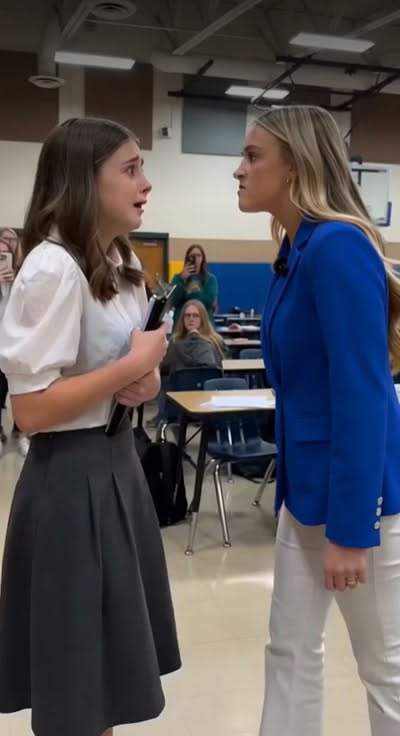
Jenna Fielding stood frozen on the stage. The bright yellow blazer, the perfect white jeans, the custom microphone—none of it mattered anymore. The illusion of her perfection was completely, irreparably shattered. She looked small. For the first time in her life, she couldn’t buy, bully, or charm her way out of the truth.
Principal Davis was the first to break the silence. He stormed down the center aisle, his face a mask of absolute fury, bypassing the stairs and practically vaulting onto the stage. Mr. Harrison was right behind him, flanked by a school resource officer.
“Jenna,” Principal Davis said, his voice echoing without a microphone. It was cold and utterly uncompromising. “My office. Right now.”
“Mr. Davis, you don’t understand, it was out of context—” Jenna started, her voice cracking, shrinking away from him.
“Do not say another word,” he snapped. “We have the logs. We heard the recording. And we all saw you strike another student on this stage. Now. Move.”
The school resource officer gently but firmly grasped Jenna by the elbow. The queen of Crestview High was escorted off the stage, her head bowed, her white boots dragging across the floorboards. As she passed me, she didn’t look up. The crowd watched her go in stunned, breathless silence.
Mr. Harrison walked over to me. He looked at the red welt forming on my cheek, his eyes filled with profound regret. “Maya… I am so sorry. Are you okay?”
I took a deep breath, letting the tension slowly bleed out of my muscles. My cheek burned with a fierce heat, but standing there in the glaring light of the stage, I had never felt more grounded. I adjusted the collar of my vintage blouse, smoothed down my charcoal skirt, and looked out at the sea of faces.
“I’m fine, Mr. Harrison,” I said quietly.
I turned and walked back toward the wings. The heavy velvet curtains were still open, but the show wasn’t over. As I stepped into the shadows backstage, I saw Chloe. She was standing up, staring at me with wide, tear-streaked eyes. She had heard everything.
I walked over to the prop table, reached into the lockbox where we kept the backup equipment, and pulled out a fresh, fully charged wireless microphone. I turned it on, checking the green indicator light on the base, and handed it to her.
“The mix is perfect,” I told her, my voice steady. “Go sing.”
Chloe took the microphone. She wiped her eyes, her posture straightening as she looked at me, a silent, overwhelming gratitude passing between us. She nodded, took a deep breath, and walked out onto the stage.
I retreated back into the dim, comforting darkness of the stage-right wings. I tapped my headset.
“Elias,” I said softly. “Cue track three. Let’s finish the show.”
Up in the booth, Elias hit the button. The acoustic guitar swelled through the auditorium once more. And this time, when Chloe opened her mouth, her voice soared through the room, clear, powerful, and absolutely undeniable.





