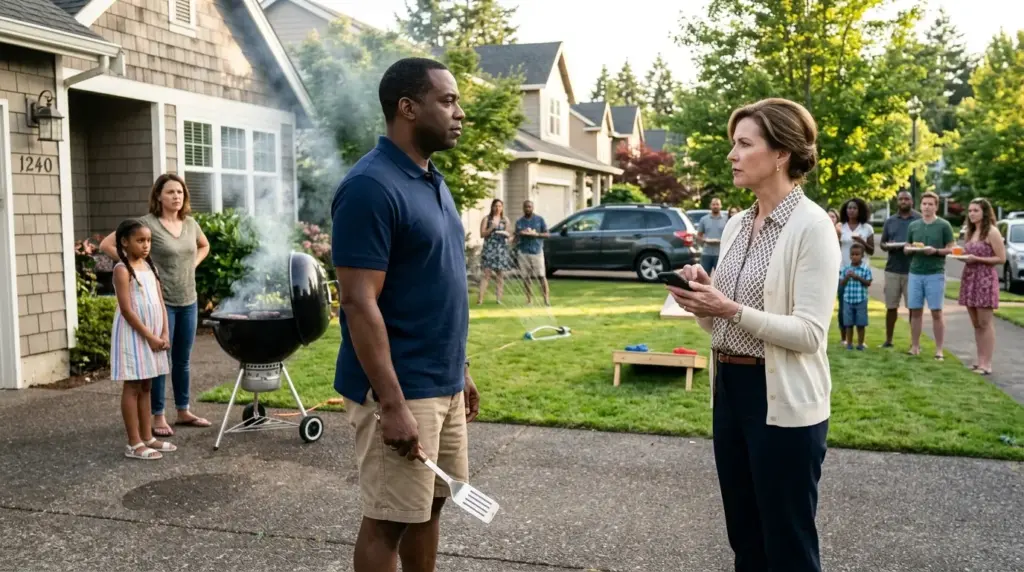
The lead officer approaches. His name tag reads Hayes. Young, maybe twenty-seven, probably four or five years on the force—unlikely to know every deputy chief by sight, especially in cargo shorts.
“We received a call about a disturbance. Whose residence is this?”
Franklin keeps his hands visible, voice calm. “Mine, officer. Franklin Torres. This is my wife, Maya. These are our neighbors.”
“Can I see some identification, sir?”
Franklin reaches slowly for his wallet: deliberate movements, no sudden gestures. He hands over his driver’s license.
Hayes examines it, keys his radio: “Dispatch, checking ID for Franklin Torres. T-O-R-R-E-S. Date of birth: October 19th, 1982. Stand by.”
A second officer moves toward the guests: “I need everyone to provide identification.”
Tension spikes. Jennifer Anderson’s son, sixteen, Black, reaches for his pocket, then freezes, his calculation visible: reaching for ID might look like reaching for something else. The Coleman twins press close to their parents. Different tones for different people—Franklin catalogs it all.
Patricia stands at her property line, speaking to a third officer: “I’m the homeowners association president. I’ve had to call about issues here before, multiple times. These people moved in three weeks ago and are already causing problems.”
The officer glances at his notes: “How many times have you called, ma’am?”
“Several. We have standards.”
Twenty-three times, Franklin thinks. He doesn’t know that yet, but he will.
Dispatch crackles back: “No wants, no warrants on Franklin Torres.”
Hayes shifts his weight, studies Franklin closer. “Sir, have you been drinking today?”
“No, officer.”
“You’re certain? I smell alcohol.”
“My guests may have had beer. I haven’t. You’re welcome to test me.”
Something in Franklin’s language makes Hayes pause: the precision, the lack of defensiveness, the way he stands—grounded, not submissive.
“What do you do for work, Mr. Torres?”
Here. This moment. Franklin could deflect, could say “city management,” but he’s tired. Tired of watching his daughter cry. Tired of being treated like a threat in his own driveway.
“I work for the city, officer.”
“City of Portland?”
“Yes.”
“What department?”
“Portland Police Bureau.”
Hayes’s expression shifts—subtle, but Franklin catches it. Twenty years reading faces. “What’s your position?”
“Administration.” Not a lie; technically accurate, just incomplete.
Hayes keys his radio: “Dispatch, can you confirm employment for Franklin Torres with Portland Police Bureau?”
A longer pause. Franklin imagines dispatch pulling records, seeing the badge number, the rank.
“Stand by.”
Thirty seconds crawl like thirty minutes. Franklin watches Hayes’s discomfort grow, watches other officers sense something shifted, watches Patricia standing confident, waiting for vindication.
Dispatch comes back, voice different now—more formal: “Unit 447, be advised: that’s Deputy Chief Franklin Torres, Badge 101, Administrative Division, Portland Police Bureau.”
Time stops.
Hayes’s face cycles through stages: confusion, shock, horror, panic. His hand moves from his hip to his brow, snaps into a salute so sharp it could cut glass: “Evening, Chief.”
The words carry. Other officers hear through radios. Five backs straighten: two salute, three nod. The entire energy transforms like someone flipped a switch.
Franklin returns the salute: professional, calm. “Officers, at ease.”
Patricia finally realizes something’s wrong, steps forward: “What’s going on here?”
Hayes doesn’t acknowledge her. He’s focused on Franklin, probably calculating his performance review. “Sir, we responded to a call about a disturbance.”
“I know what you responded to, Officer Hayes.” Franklin’s voice stays calm, but carries authority now. “I was standing here when Ms. Whitman made the call. I’ve been watching how this unfolded.”
Patricia interrupts, voice rising: “These people were having an unauthorized gathering!”
Franklin turns to her. When he speaks, it’s educational—the tone of someone with authority who knows how to wield it. “Ma’am, I’m Deputy Chief of Police for the City of Portland. I oversee 950 officers. This is my home. This is my family. This is a barbecue with twelve guests. There is no violation of any municipal code, county ordinance, or state law.”
Patricia’s mouth opens, closes, opens again. “You didn’t… I had no way of knowing!”
“You didn’t ask.” Franklin lets that settle. “You made assumptions based on what you saw: a Black family having a cookout. And you called 911.”
“I was ensuring neighborhood safety!”
“You were weaponizing emergency services.” Still calm, still controlled. “And now I’m going to review exactly how you’ve been using them.” He turns to Hayes. “Officer, I need full documentation: your body cam footage and footage from all responding units, the CAD report with full call details, the audio recording of Ms. Whitman’s 911 call. All of it on my desk Monday morning, 8:00 a.m.”
“Yes, sir. Absolutely, sir.”
“Additionally, I want a record search: every 911 call placed by Patricia Whitman in the last twenty-four months. Every address involved, every responding unit, every outcome. Complete report.”
Hayes glances at Patricia, back to Franklin: “Sir, that could be extensive.”





