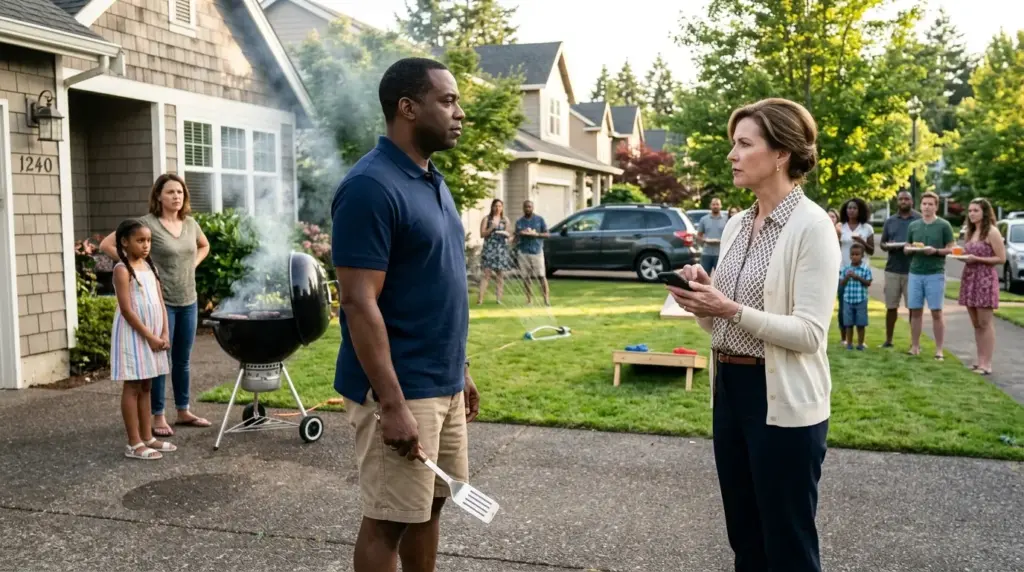
“Then start early Monday.” Franklin’s tone makes it clear this isn’t a request. “Because if there’s a pattern of misuse of emergency services in my district, I need to know about it.”
Patricia’s voice cracks: “I have every legal right to call police when I feel unsafe!”
“And I have every professional obligation to review whether those calls represent legitimate safety concerns or harassment.” Franklin doesn’t raise his voice. “We’ll be in touch, Ms. Whitman, through official channels.”
He addresses all six officers: “Dismissed. Enjoy your evening.”
They return to their vehicles faster than they arrived. Lights turn off, engines start; three squad cars disappear around the corner.
The neighborhood is still watching. Dozens of phones captured everything, video already spreading: Nextdoor, Facebook, Twitter, TikTok. Patricia Whitman’s face, frozen in that moment of realization, preserved forever.
She stands another moment, then turns, walks back to her house. Curtains close, lights go off, but the damage is done.
Franklin’s guests leave within twenty minutes—polite excuses. Only Mrs. Henderson stays, standing beside Maya in silent solidarity.
Zoe tugs her father’s hand: “Daddy, why did those police officers salute you?”
Franklin picks her up. “That’s my job, sweetheart. I help make sure police officers do the right thing.”
“Did they do the right thing today?”
Eight years old, already learning the complicated answer.
“They responded to a call, honey. They did what they were trained to do. But sometimes we need to look at why the call was made.”
Later, after the kids are in bed, after Mrs. Henderson leaves, after the house goes quiet, Franklin sits on the back porch steps. The grill is cold; chicken sits uneaten in containers.
Maya joins him, sits close. “You could have told her from the start.”
“I could have.”
“Why didn’t you?”
Franklin stares at his hands. “Because I needed to see it. How my officers respond when they think I’m just another Black man at a barbecue. When the badge is invisible and all they see is skin color.”
“And what did you see?”
“Exactly what I trained them not to do. Right here at my door.”
Maya takes his hand. “What happens Monday?”
“Monday, I pull those records. Every call Patricia Whitman made, every address, every outcome. Because if she did this to us with neighbors watching, what has she been doing when no one’s paying attention?”
Monday morning, Franklin Torres walks into Portland Police Bureau headquarters at 6:47 a.m.—an hour early, because some work can’t wait. His office overlooks downtown Portland. Three monitors display Computer Aided Dispatch records. He pulls data most civilians don’t know exists, but he can access with six keystrokes: Patricia Whitman, 2847 Oakwood Drive, Oakridge.
He starts with Saturday’s call: Incident number PPB24158392. Caller reported suspicious gathering with multiple unknown individuals. Dispatcher classified it as suspicious activity, possible criminal gathering; three units dispatched.
Franklin reads the dispatch notes, sees Patricia’s language: Don’t recognize these people. Feel unsafe. This isn’t normal for our neighborhood. Each phrase triggering response protocols Franklin himself helped design. Then he sees: Caller has prior history with address-based concerns in this district.
Prior history.
He runs a search: Patricia Whitman, all calls, last 24 months.
The system loads; numbers populate: one call, two, five, ten, fifteen, twenty… twenty-three total calls in eighteen months.
Franklin pulls up a map function, plots every address she reported: six clusters. He cross-references property records: every address—families of color. Every single one. Not random: a pattern.
He clicks through individual calls:
-
“Loud music” at 847 Maple Street, call time 3:15 p.m. Saturday. Officers responded, found children playing music at 62 decibels—well under the 85-decibel ordinance.
-
“Suspicious vehicles” at 923 Maple Street, call time 7:30 p.m. Wednesday. Officers found family members visiting, vehicles properly registered.
-
“Unleashed dog” at 1104 Oakwood Drive. Officers found dog in fenced backyard, no violation.
-
“Gathering without permit” at 2156 Maple Street. Officers found a birthday party with eleven guests, no permit required.
Twenty-three calls: zero citations, zero arrests, zero actual violations. But twenty-three police interactions. Twenty-three moments where families had to explain themselves to armed officers. Twenty-three times children watched their parents get questioned.





