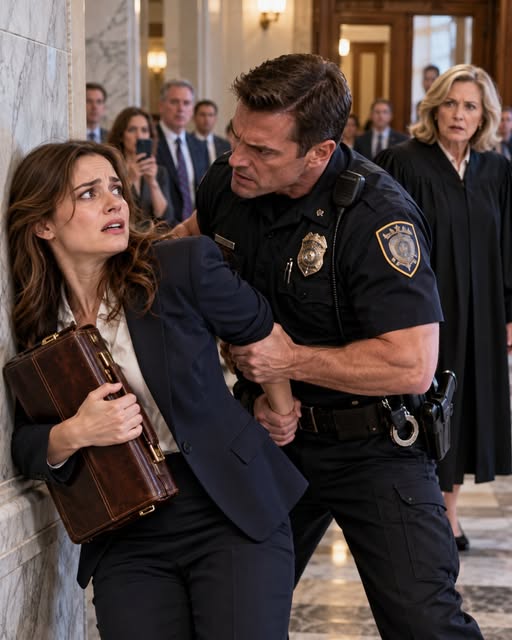
It didn’t need to be fast. It only needed to transmit the index: the file names, the account numbers, the bank identifiers, and the ninety-second audio file recorded through the lapel mic on Elena’s coat while Evelyn Carter was explaining the precise mechanics of her six-million-dollar retirement plan.
Beside the transponder lay a heavy, cream-colored vellum envelope that had been placed in the case seventy-two hours ago by her confidential source at the Cleveland municipal train station.
Across the front, written in the cramped, angular hand of someone who had spent fifty years writing with fountain pens, were three lines:
TO BE OPENED ONLY UPON ATTEMPTED SEIZURE BY THE BENCH.
THE APPOINTMENT WAS A TRAP.
GO TO DOCK FOUR.
Elena tore the envelope open with her teeth.
Inside was a heavy brass key stamped with the number 402, a plastic magnetic keycard with the magnetic stripe worn down to a gray thread, and a single sheet of tracing paper showing a pencil-drawn architectural elevation of the Justice Center’s 1912 foundation.
At the bottom of the tracing paper was a single signature:
Marcus Cole, Chief of Investigations (Ret.), Ohio State Highway Patrol.
Elena stared at the name in the faint light filtering through the brick gaps.
Marcus.
Her partner. The man who had spent six months pretending to be an alcoholic private investigator operating out of an unheated office on Lorain Avenue. The man who had brought her into the case, claiming he was too old, too slow, and too well-known to the Cleveland syndicate to carry the paper himself.
He hadn’t been working from the outside.
He had built the trap from the inside out.
The descent down the maintenance shaft was forty feet of vertical rust and freezing drafts.
Elena’s knuckles were bleeding where they scraped against the spalling brickwork. The briefcase, looped over her neck by its nylon strap, banged against her hip with every rung, a dead weight that tried to peel her away from the wall.
She reached the bottom at the secondary air intake—a room with a ten-foot concrete ceiling that hummed with the massive, low-frequency thrum of two industrial centrifugal blowers installed during the Carter administration.
The air here was warm, smelling of motor grease and dry drive belts.
She unlatched the intake grate, dropped the four feet to the concrete floor, and hit the ground in a roll, coming up with the briefcase held tight against her ribs.
To her right was the main basement corridor: painted gray concrete, fluorescent strips humming overhead, the sound of boots and radio static echoing down from the central elevator core.
“TEAM TWO, SWEEP THE EAST RUN,” a voice squawked through an open security door thirty yards away. “SHE HASN’T CLEARED THE MAIN ROTUNDA. SHE’S STILL ON THE PROPERTY.”
She turned left.
The keycard Marcus had provided was ancient, its plastic brittle around the lanyard hole. She slid it into the reader of the unmarked metal door labeled MECHANICAL ACCESS 4B — AUTHORIZED PERSONNEL ONLY.
The reader didn’t chime. It gave a heavy, mechanical clack, the solenoid dropping with an industrial shudder.
Elena slipped through the door into the abandoned pneumatic tube concourse—a subterranean gallery that had once connected the county court to the old municipal jail before the towers were built in the seventies.
The walls were bare limestone, wet with groundwater that seeped from the bluffs above the lake. Long, rusted steel tubes, six inches in diameter, ran along the ceiling like the exposed intestines of a great beast. The air was dead, cold, and silent, untouched by the alarms that were still screaming through the floors above.
She walked quickly, her boots splashing through three inches of brackish water that had pooled in the low spots of the concrete.
At the end of the two-hundred-yard concourse stood a pair of heavy iron fire doors marked DOCK FOUR.
Dock Four had been decommissioned in 1994 when the river bulkhead had settled, dropping the loading bay eighteen inches below the high-water mark of the Cuyahoga. It was used now only for storage of old file cabinets and condemned salt-spreaders.
Elena took the heavy brass key stamped 402 from her pocket.
She inserted it into the mortise lock of the service door set into the center of the iron gate. The cylinder was stiff, but it turned with a clean, heavy snap.
She pushed the door open.
The loading bay was dark, illuminated only by the gray daylight reflecting off the oily, slow-moving water of the river through the partially open roll-up door.
In the center of the bay, idling with a low, irregular rumble, sat an unmarked, salt-crusted Ford Crown Victoria, its headlights off, its tailpipes spitting small puffs of white water vapor into the cold air.
The driver’s side door opened.
Marcus Cole stepped out.
He was sixty-eight, wearing a faded Carhartt duck jacket over a gray hooded sweatshirt, a knit watch cap pulled down over his ears. His beard was short, white, and bristly; his nose had been broken twice by union bouncers in the eighties, giving his face the crooked, pugnacious profile of an old terrier that had survived too many badger fights.
In his left hand he held an unlit cigar; in his right, a ceramic mug of black coffee.
“You’re seven minutes late, El,” Marcus said, his voice sounding like two dry pine boards being slid across each other.
Elena stopped five feet from the bumper. She didn’t drop the briefcase. She stood there, her overcoat torn at the shoulder, her knuckles bloody, her chest heaving with the cold, wet air of the river.
“You knew,” she said.
Marcus took the cigar from his mouth, looked at the wet tip, and tucked it into his breast pocket. “I knew Evelyn Carter was the only person in this county with the structural authority to run six million dollars of Mexican fentanyl through the court property records without tripping an audit by the State Auditor.”





