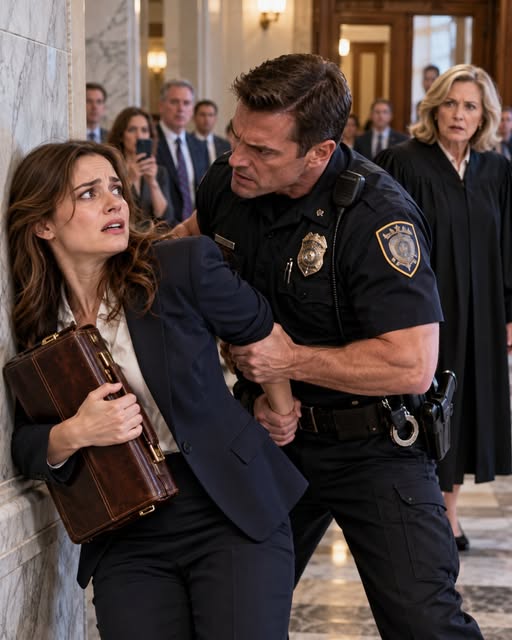
“It was sealed to protect you,” Carter said. She reached out, her fingers resting lightly on the edge of the leather blotter. “If Davies knew I was the one directing the audit, he wouldn’t have sent a patrolman to grab your bag. He would have had two detectives put a pipe through your brake lines on the turnpike. You know how the Fourth District operates. You saw what happened to Detective Miller in twenty-three.”
“Miller committed suicide in his personal vehicle,” Elena said.
“Miller had four milligrams of succinylcholine in his left quadricep that the county coroner conveniently overlooked until the state toxicology report came back three weeks after the cremation,” Carter hissed. “Now stop playing defense attorney in my private office. Place the briefcase on the blotter. I have the special prosecutor from the Attorney General’s office waiting on a secure line in the conference annex.”
Elena looked down at the briefcase.
The lock was cold against her thumb.
Five digits.
She had spent forty-eight hours in a motel room in Independence with Marcus Cole, cross-referencing three years of evidence manifests against the docket sheets of Courtroom 3B. Marcus had been an investigator for thirty years; he was a man who didn’t trust anything that couldn’t be weighed on an analytical balance or confirmed by two independent wiretaps.
There’s an anomaly in the dismissals, El, Marcus had told her at two in the morning, his reading glasses reflecting the blue light of three laptops. Look at the case numbers. Seventy-eight felony drug possession indictments between November twenty-three and last Thursday. All of them Fourth District collars. All of them involving weights over five hundred grams. All of them assigned to Carter’s docket by ‘random wheel’ draw.
Carter’s the senior administrative judge, Elena had answered. She takes the high-value suppressions.
She didn’t suppress them because the cops were dirty, Marcus had said, tapping a yellow legal pad with his pencil. She suppressed them because the chain of custody had an intentional clerical error on line four of the state form. Every single time. Same error. Same missing property clerk signature. The state drops the charges, the drugs are ordered ‘retained for training purposes’ or transferred back to central property, and six months later the property record is expunged during the biannual inventory purge.
Elena looked up from the case into Evelyn Carter’s gray, unblinking eyes.
“The chain of custody requires this evidence to be logged into the court record in open session, Your Honor,” Elena said. “With the court reporter present, the clerk of courts verifying the seals, and the state archives custodian signing the transfer manifest. If I open this case in chambers without an active record, the evidence is legally compromised. Any defense counsel will move for immediate suppression under Rule Sixteen.”
Carter’s mouth softened. A faint, terrible shadow of a smile appeared at the corners of her thin lips—a smile that held neither warmth nor anger, only the cold, geometric satisfaction of a mathematician watching an equation resolve itself to zero.
“You really are the best investigator the state ever trained, Elena,” Carter said softly.
She did not reach for her intercom. She did not reach for the telephone.
With a smooth, unhurried motion, Judge Carter opened the top right-hand drawer of her partners’ desk.
Her hand did not come out with a pen, a transcript, or an order of contempt.
It came out with a snub-nosed Charter Arms .38 Undercover revolver. The bluing on the barrel was worn away at the muzzle from years in a leather purse; the walnut grips were dark with the oil of old handling. She rested the frame of the revolver on the edge of the leather blotter, the muzzle pointing directly at the center of Elena’s wool overcoat.
Elena’s heart did not race. It did something far worse: it seemed to stop, settling into her chest like a block of frozen brine. Her ears began to hum with the low, high-frequency whine of an electrical transformer.
“There is no grand jury empaneled for next Tuesday, is there?” Elena asked. Her voice was remarkably steady. It was the training. When the weapon comes out, the voice must remain in the lower third of the register; raise it, and you accelerate the nervous finger on the sear.
“There is no grand jury,” Carter agreed. She did not lift the gun from the blotter, but her index finger curled smoothly around the trigger shoe. “The docket numbers you were provided were generated by an administrative alias on the county mainframe. A closed system. It exists only on the terminal in this room and on the secondary server in the basement records room.”
“Why?”
“Because Captain Davies didn’t have the brains to manage an operation of this size,” Carter said, her voice dropping into the conversational, didactic cadence she used when instructing young law clerks on civil procedure. “Davies is a common thief with a gold badge. When the port shipments began coming through the river bulkheads in twenty-two, Davies thought he could simply skim two bricks off every pallet and sell them to the crews on West 65th. He was sloppy. He created paper trails that a junior auditor from the Department of Taxation could have unraveled in a long weekend.”
“So you intervened,” Elena said.
“I took over the receivership,” Carter corrected. “If the product was going to hit the street anyway, it needed to be managed with institutional precision. I used Davies’ own precinct to seize the wholesale shipments from his competitors. I brought the cases into this building. I dismissed the indictments under procedural grounds that made me the darling of the local bar association’s civil rights committee. And then the inventory was transferred out through the county medical examiner’s hazardous waste incinerator route.”
“Four point two million,” Elena whispered, the numbers from the Grand Cayman routing logs flashing across her memory.





