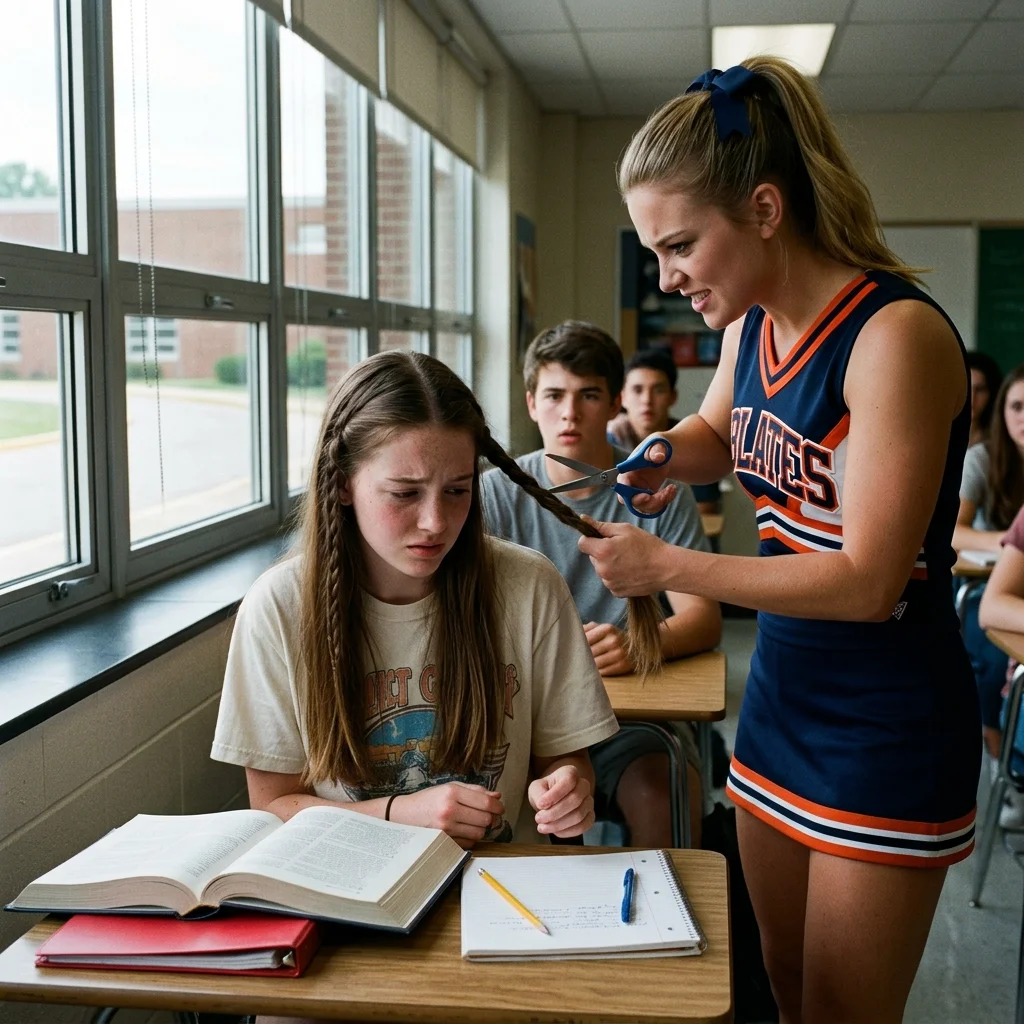
Noah froze, his jaw clenching as he looked toward the front of the room. “Mr. Danner! Are you blind? Look at what she’s doing!”
Mr. Danner did not look at Sloane. He looked directly at me—at the scholarship girl from the duplexes on the south side of the river tracks, whose tuition waiver contributed zero dollars to the faculty pension matching fund, whose aunt drove a twelve-year-old Honda Civic with a rusted muffler instead of pledging fifty grand at the spring auction.
“Miss Vance,” Mr. Danner said, his voice flat, nasal, and meticulously stripped of human warmth, “I am trying to record the morning attendance for the front office. I suggest you stop inciting a theatrical disturbance in my classroom and resolve your personal grooming disagreements on your own time.”
The words did not land like a slap; they landed like cold water poured into an open wound.
Behind me, Sloane let out a low, purring laugh that vibrated against the crown of my head. “You hear that, Elin? Even the adults are tired of your victim complex.”
To understand how a seventeen-year-old girl could hold a pair of shears against another student’s carotid artery while a licensed educator watched the clock, you had to understand the currency of Oakhaven Preparatory Academy.
Oakhaven sat on forty manicured acres of rolling ridge-land overlooking the valley, fenced in by wrought-iron palisades that had been forged in the nineteen-twenties to keep the children of timber and rail barons insulated from the mill workers down by the river. My presence inside those gates was a statistical anomaly. When my parents died in a multi-car pileup on Interstate 80 when I was nine, I had gone to live with my mother’s older sister, Clara Vance, in a narrow, two-bedroom clapboard house that smelled permanently of cedar shavings, radiator steam, and peppermint tea.
To the people in Oakhaven, my Aunt Clara was invisible. She worked from a cluttered home office at the back of our hallway with the blinds drawn, logging long, silent hours as what she simply called a “federal contract auditor,” driving a dented gray sedan and buying our groceries with a calculator in her hand at the discount market on Fourth Street. When I scored in the ninety-ninth percentile on the state secondary entrance exams in eighth grade, winning the solitary Founders’ Merit Scholarship to Oakhaven, I had begged Clara not to make me go. I knew what kids who drove Range Rovers to tenth-grade homeroom did to girls who bought their wool cardigans at St. Vincent de Paul for four dollars a pound.
“You don’t go into a room like that to make friends with the wallpaper, Elin,” Aunt Clara had told me at our kitchen table three years ago, her calm gray eyes steady behind her wire-rimmed reading glasses as she stitched a loose buckle back onto my leather satchel. “You go in to learn how they build their walls. Because one day, somebody in a room just like that is going to think they can step on somebody smaller than them because nobody is checking the math. And when that day comes, you need to know how to read the ledger.”
For two and a half years, I had kept my head down. I maintained a 4.0 unweighted grade-point average, ate my packed peanut-butter-and-apple sandwiches in the library basement microfiche alcove, and let the daily pinpricks—the whispered comments about my faded Levi’s, the dry-cleaning tags left anonymously taped to my locker door, the “Thrift-Store” nickname that followed me down the polished terrazzo hallways like a stray dog—slide off my spine.
Everything had remained survivable until the second Tuesday of October.
That was the afternoon I stayed late in the athletics annex to tutor a ninth-grade scholarship student named Maya Lin in algebra. When I walked past the unlocked equipment cage behind the girls’ locker room at five-fifteen, I found Maya backed against a rack of lacrosse helmets, sobbing so hard she was hiccuping, while Sloane Ketter and Jenna Vance stood over her with an open Venmo ledger on an iPad.
Sloane, as captain of the Spirit and Pep Committee, had invented something she called the “Freshman Legacy Assessment.” If a ninth-grade girl wanted her name kept on the tryout roster for the winter basketball spirit squad—or if she simply wanted to avoid having her gym clothes dumped into the urinal troughs before third-period swim—she had to pay a four-hundred-dollar “uniform maintenance deposit” in cash or untraceable peer-to-peer transfers directly into an account registered to Jenna’s older cousin. Maya’s parents ran a dry-cleaning counter on Mercer Street; Maya had emptied her own babysitting jar—two hundred and eighty dollars in crumpled tens and twenties—and Sloane was currently informing her that because she was a hundred and twenty dollars short, her little brother’s middle-school robotics project in the shared annex was going to have an “unfortunate accident with a fire extinguisher.”
I hadn’t yelled. I had remembered Aunt Clara’s rule about ledgers.
I stood behind the half-open steel mesh door of the equipment cage for four minutes and twelve seconds with my five-year-old Android phone pressed against a gap in the wire, recording the entire exchange in 1080p. Over the next six days, moving through the school with the quiet invisibility that only the poor possess among the rich, I spoke to seven other freshman girls. Five were too terrified of Victoria Ketter—Sloane’s mother, the chairwoman of the Oakhaven Capital Campaign and a woman whose real estate development firm held the construction contracts for the new four-million-dollar aquatic center—to put their names on paper.
Two of them, Maya Lin and a girl named Sarah O’Connor whose father was a retired postal clerk, gave me signed, dated bank statements showing twelve hundred dollars in cash withdrawals handed directly to Sloane outside the north gymnasium doors at 7:40 AM on consecutive Mondays—directly beneath the lens of Security Camera 12.





