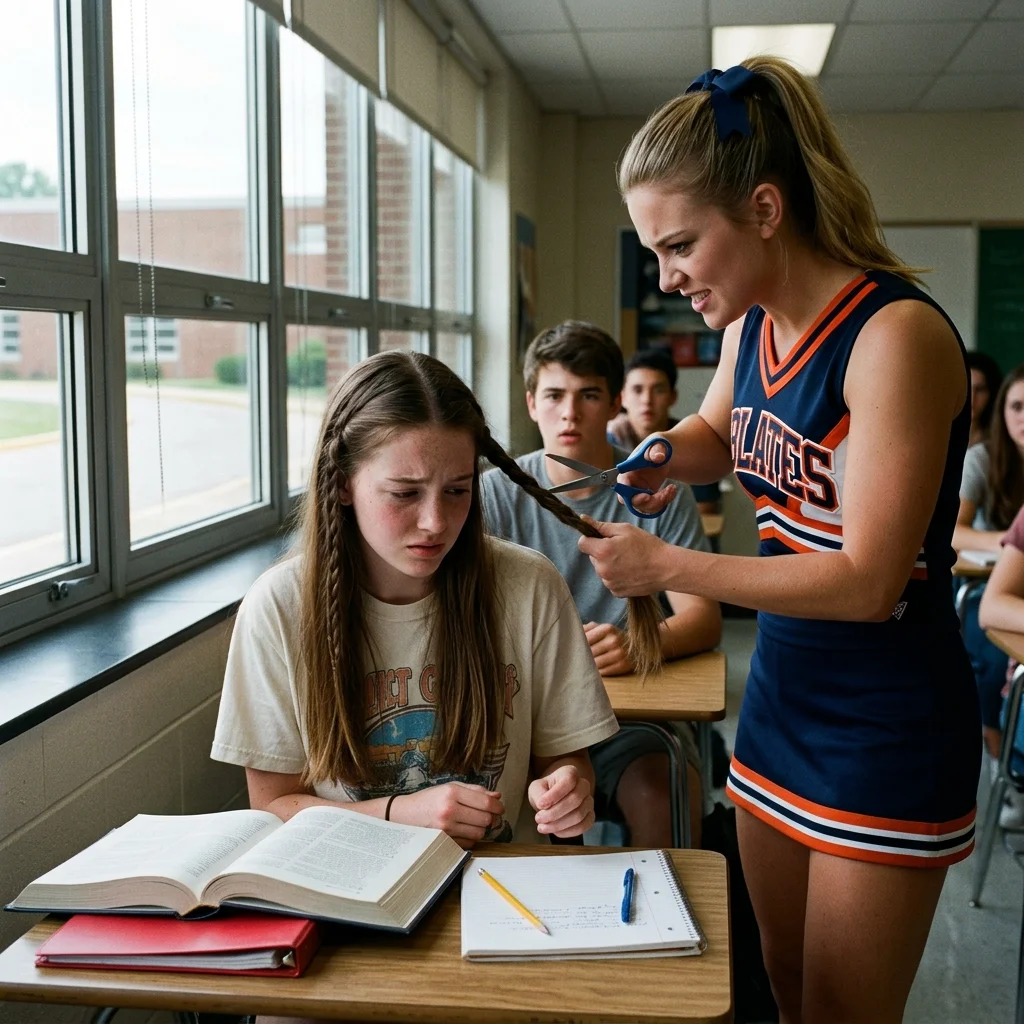
I remembered what my Aunt Clara had actually been doing in that locked back bedroom on the south side of the river for the last three weeks.
I remembered the night ten days ago—right after the fryer grease was poured into my locker—when I had woken up at two in the morning to get a glass of water and heard Clara speaking in a low, clipped voice into a heavy black satellite phone I had never seen before, surrounded by three illuminated dual-monitor arrays displaying encrypted treasury wire transfers and municipal bond clearinghouse ledgers.
“I don’t care if the U.S. Attorney wants to wait until the end of the fiscal quarter to unseal the indictments, Marcus,” Clara had said into that phone, her voice possessing a terrifying, whip-crack authority that made the hair on my arms stand up in the dark hallway. “Victoria Ketter and Arthur Sterling are laundering fourpoint-two million dollars of federal Title I school-modernization grants through dummy concrete subcontractors on that aquatic center build, and tonight her daughter ruined my niece’s winter coat while Sterling wiped the security server. Move the forensic audit team to the Oakhaven field office by Friday morning. If anyone in that building lays a single finger on Elin before we serve the warrants, I won’t just freeze their bond accounts—I’ll bury them under the courthouse.”
I hadn’t understood all the financial terminology that night. When Clara had come out of the office five minutes later and found me standing by the sink, she had simply wrapped her wool shawl around my shoulders, poured me a cup of warm milk, and made me promise two things.
First: she had given me a small, antique sterling-silver lapel pin shaped like a compass rose, which she pinned to the left pocket flap of my flannel shirt every morning before I left for the bus. “Never take it off during school hours, Elin. If things ever go past words, press the center stone for three seconds.”
Second: “Whatever they do, do not swing back. Let them put their crimes on their own cameras. Keep your hands clean, and count to sixty.”
Three minutes ago, when Sloane had first grabbed my braid and Chloe had pinned my right wrist to the desk, my left thumb had slid beneath the flap of my shirt pocket and pressed the tiny onyx center of the silver compass pin for three full seconds, activating the dual-band cellular emergency beacon and high-gain bone-conduction audio transmitter wired into its casing.
Every word Sloane had spoken—every click of the shears, Noah’s warning, and every syllable of Mr. Danner’s declaration that I wasn’t important enough to stop an assault—had just been transmitted in real time over an encrypted federal channel to a mobile command unit parked less than four miles from the school gates.
Sloane opened the jaws of the nine-inch titanium shears one more time, bringing the lower blade flush against my right cheekbone, right beside the remaining tuft of hair over my ear.
“Still not crying, Thrift-Store?” Sloane hissed, her pupils dilated with the frantic, ugly high of a bully who realizes her victim isn’t breaking on schedule. “Fine. Let’s take the rest of the side off right down to the skin. Let’s see how proud you look walking down the hall bald—”
“You should put those down now, Sloane,” I said.
My voice was so quiet, so completely devoid of tremor or fear, that Jenna’s thumb actually slipped off her phone screen.
Sloane blinked, her hand pausing half an inch from my skin. Then she threw her head back and barked out a shrill, jagged laugh. “Or what, Elin? Are you gonna write another little essay to Principal Sterling? Are you gonna have your aunt drive over here in her rusted-out Civic and throw food stamps at us?”
“No,” I said softly, looking at the brass second hand sweeping past the twelve on the wall clock above the blackboard. “My aunt doesn’t drive the Civic when she’s on the clock.”
A low, sub-audible vibration began to hum through the soles of my thrifted sneakers.
At first, nobody else noticed it. Then the loose glass panes in the tall, eastern-facing casement windows of Room 204 began to rattle in their putty frames—a rhythmic, heavy thrum-thrum-thrum that made the water inside the plastic cup on Mr. Danner’s lectern form tight, concentric ripples.
Noah Briggs stopped struggling against the two linebackers and turned his head toward the window. “What the hell is that?”
Down below on Oak Ridge Drive, the electronic wrought-iron security gates of Oakhaven Preparatory Academy—which were kept locked between 8:30 AM and 3:15 PM—did not slide open on their slow mechanical track. A loud, pneumatic hiss echoed across the lawn as the emergency fire-override box was triggered remotely from the street, dropping the hydraulic barrier arms instantly.
Four massive, matte-black Chevrolet Suburban HD tactical transport vehicles—unmarked, rides raised on heavy-duty suspension, with reinforced steel push-bumpers and pitch-black armored glass—turned off the highway in a tight, nose-to-tail diamond formation at forty miles an hour.
Behind them came two unmarked silver Ford Taurus sedans with blue-and-red grill strobes pulsing silently behind their radiators, followed by a white municipal mobile forensics van.
The entire third-period class abandoned their desks and surged toward the eastern windows. Even Chloe let go of my wrist, drawn like iron filings to a magnet as the convoy roared up the crushed-bluestone circular driveway, scattering the school landscapers’ leaf blowers like dry twigs.
“Who is that?” Jenna breathed, lowering her phone as the lead Suburban chewed to a halt directly across the brick pedestrian plaza at the base of the main flagpole, blocking the circular drive completely. “Is the Governor visiting? Did somebody call in a bomb threat?“





