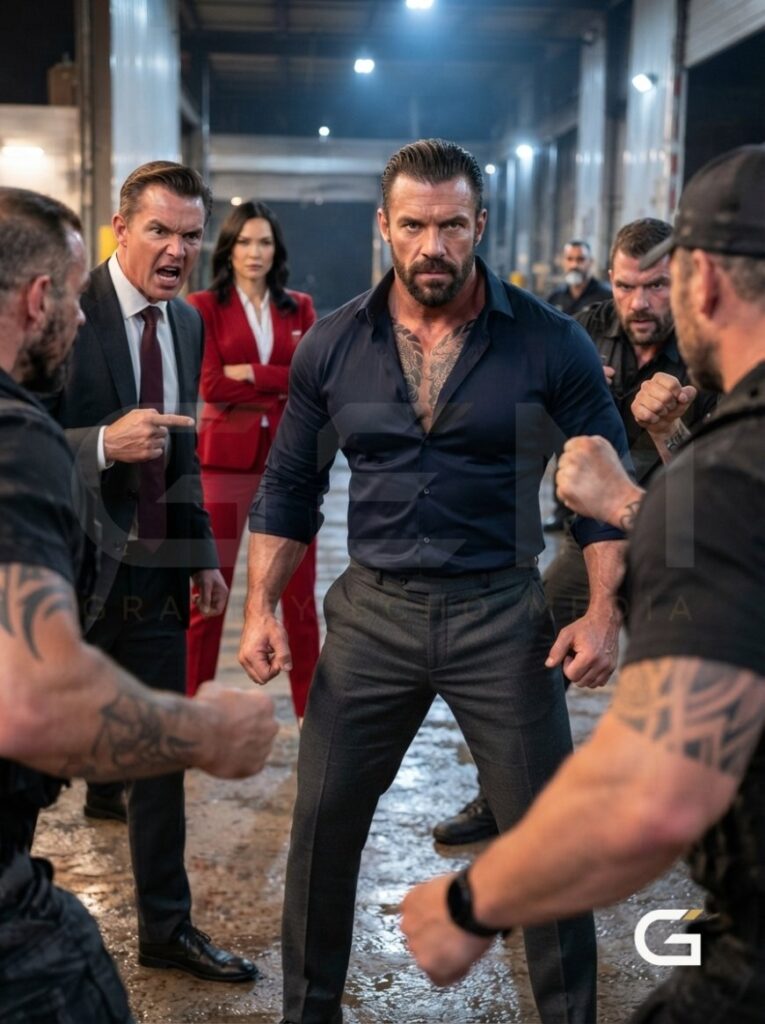
Behind Grant, the dark doorway at the far end of the bay—the one leading to the main building’s eastern corridor—had gone completely still. He’d noticed it a minute earlier, but he didn’t turn to look. He’d learned a long time ago that you never take your eyes off the threat in front of you, even when the smaller threat is hiding in your peripheral vision.
Ten seconds passed. Twenty. Preston said nothing.
“Alright,” Grant said, and turned to go.
“That drive has nothing to do with any of this,” Preston blurted.
Grant stopped. He didn’t turn around.
“You’re lying,” he said.
“You know you’re lying. And you know I know. So here’s what’s going to happen.” He turned back, slow, deliberate. “You’re going to call off whatever you’ve got planned for Natalie Brooks. Tonight. You’re going to make sure nobody touches her. And then you’re going to go back to your motorcade and your dinner jacket and your very expensive watch. And you’re going to hope I never hear your name again.”
“Or what?” Preston asked. But there was no defiance in it. Just a man who’d never been on this side of a threat and had no idea what to do with the feeling.
Grant looked at him for a long moment. Then he looked at Derek.
“Get him out of here,” he said.
“And tell him what happens if I see him again.”
Derek nodded once, silent. He walked past Preston, grabbed him by the arm—not roughly, but with enough force to make it clear this wasn’t a suggestion—and steered him toward the service doors. Preston didn’t fight. His shoulders had slumped, his designer suit suddenly looking like a costume he’d been caught wearing.
The doors swung shut behind them, and the loading bay went silent.
Grant stood there alone for a minute. Then he exhaled, slow, and flexed his right hand. His knuckles ached. His shoulder had started to stiffen. He’d taken two hits that night—one to the ribs from the second man and one to the shoulder from Derek, who, to his credit, could actually fight a little. Nothing broken. He’d had worse.
He turned toward the dark doorway.
“You can come out now,” he said.
For a beat, nothing. Then a figure stepped out of the shadows. Natalie Brooks. The flash drive still clipped to her lanyard, her eyes wide, her breathing shallow.
She’d been there the whole time.
She’d seen all of it.
“You didn’t leave,” Grant said.
“I couldn’t.” She took a shaky step forward, then another. “I went up to the east corridor and then I doubled back. I thought—” Her voice faltered. “I thought if I stayed close, I could call for help before it got back to the loading bay. But then the doors opened and I saw you and I just… froze.”
“Good,” Grant said. “Better you stayed out of it.”
“No.” She shook her head. “Not good. He could have killed you. Six men. Derek Slade has a reputation. Do you know who he is?”
“I know who he is.”
“He’s been arrested twice for aggravated assault. He works security for three different firms, and every single one of them has had complaints about excessive force. He’s not some random bouncer. He’s *dangerous*.”
Grant looked at her.
“He is,” he agreed. “But he’s also a young man who watched one fight when he was nineteen and decided he wanted to be a fighter because of it. And that means he isn’t lost yet.”
Natalie stared at him.
“How did you—how did you *do* that?” she asked. “You didn’t even hit most of them and they just… stopped.”
“They stopped because they figured out it wasn’t worth it,” Grant said. “That’s all a fight is. Two people deciding how badly they want to keep going. The moment one of them quits, it’s over. No matter who’s still standing.”
She was silent for a second. Then she said, very quietly:
“You’re him, aren’t you? The one Derek named.”
Grant didn’t answer.
“I’ve been watching the news for twelve years,” she went on. “I remember when you disappeared. My brother—my brother *loved* you. He had a poster of you in his room. It stayed up until he left for college.”
She paused.
“He died two years ago. Cancer. And I remember thinking, when he was sick, that I wished I could tell him something good one more time. Just one thing. Something that would make him smile.”
Grant’s expression didn’t change, but his voice, when he answered, had gone very still.
“What was his name?”
“Eli. Eli Brooks.”
The name hit him somewhere in the chest, the way certain names do even when you’ve never heard them before.
“I’m sorry,” Grant said. “Cancer’s a harder fight than mine.”
Natalie nodded. Her eyes were wet, but her voice stayed steady.
“He would have loved this,” she said. “He would have loved knowing the Iron Wolf took down six guys in a loading bay and then told the executive VP to get lost.”
Grant allowed himself the smallest smile. It didn’t reach his eyes, but it was real.
“Don’t call me that,” he said.
“Why not? It’s what people knew you as.”
“Because that man was a brand. He wore a lot of things that weren’t his own name.” Grant flexed his hand again, slower this time. “I’d rather just be Grant.”
Natalie studied him for a long moment. Then she nodded, slowly, like she was filing him away in a category she’d never used before.
“Okay, Grant,” she said. “Then come with me. I need to show you something.”
—
The conference room on the second floor was empty and dark. Natalie flicked on one row of lights—not enough to be obvious from the windows, just enough to work by—and slid a slim laptop onto the polished table.
Grant took a seat at the far end, keeping his back to the wall out of old habit. He didn’t comment on it.





