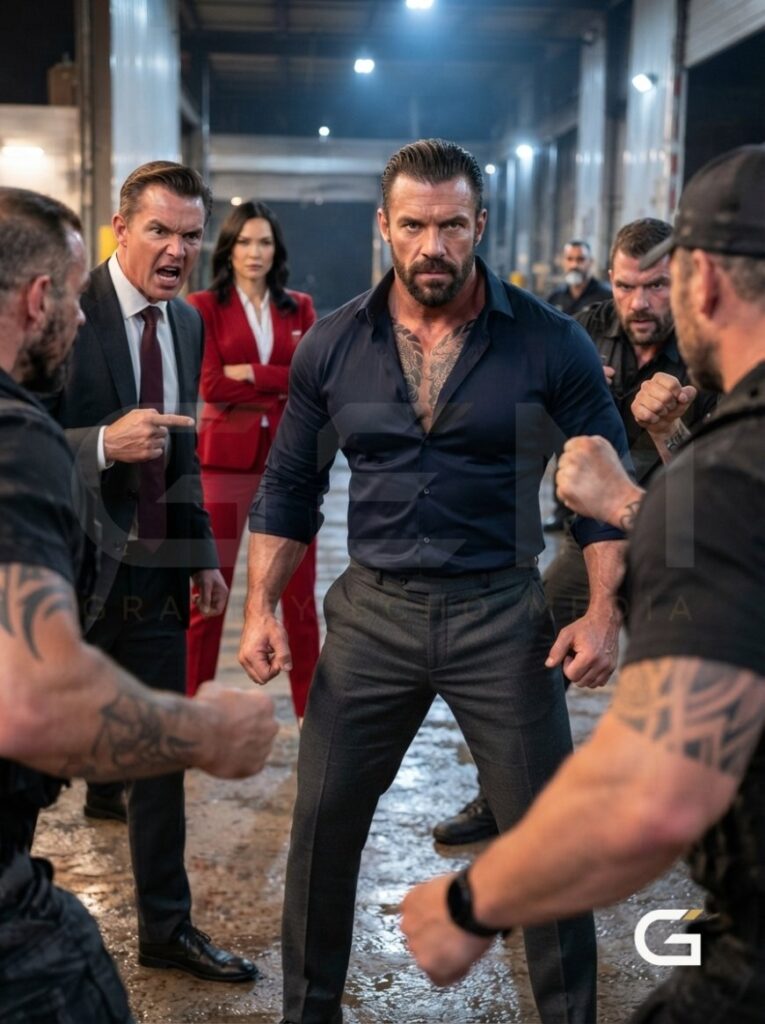
Ray nodded. He looked relieved. He and the other guard turned and walked back toward the elevator bank.
Preston watched them go. For the first time, Grant saw something crack behind his eyes. Not fear. Something worse. Calculation.
“You’re making a mistake,” Preston said.
“I’ve made plenty,” Vanessa said. “This isn’t one of them.”
“The board convenes Tuesday. If you go in there with a laptop and a maintenance worker’s story, you’ll look like a CEO who lost control of her own company.”
“I’ll look like a CEO who found out what was happening in her own company.” Vanessa’s voice didn’t rise. “There’s a difference.”
Preston took a step closer. His voice dropped. “You don’t want to do this. You don’t know who else is involved.”
“Then I’ll find out.”
He stared at her. Then his eyes moved to Natalie. Then to Grant. And for a split second, his gaze lingered on Grant the way a man looks at a locked door he can’t open.
“I know who you are,” Preston said quietly. “I looked you up after the loading bay. You think you’re untouchable. You’re not.”
Grant met his gaze. “I never thought I was.”
“Then you’re stupider than you look.”
“No,” Grant said. “I just stopped caring about people like you a long time ago.”
Preston’s jaw worked. He turned and walked away. His footsteps echoed down the corridor, slower than they had been, but steady. He didn’t look back.
Vanessa watched until he disappeared into the elevator. Then she let out a breath she’d been holding for what looked like hours.
“General counsel,” she said. “Then the board chair. Then I’m freezing every payment linked to Ridgeline. If he tries to move anything tonight, it’ll bounce.”
Natalie closed the laptop. “What do you need from me?”
“A copy of everything. On a drive I pick. Not the one around your neck.” Vanessa glanced at Grant. “And you. I don’t know your real name. I don’t want to. But if you’re still in the building tomorrow, come find me. I might have a job for someone who can handle himself.”
Grant shook his head. “I’m not looking for a job.”
“Everyone’s looking for something.”
“Not me,” Grant said. “I’m just trying to get through the night.”
Vanessa studied him for a moment. Then she nodded, once, and walked out of the room with her phone already against her ear.
Natalie turned to Grant. Her eyes were bright, but she wasn’t crying. She looked like someone who’d been holding her breath for six months and had finally let it out.
“That’s it,” she said. “It’s over.”
“It’s not over,” Grant said. “But it’s out of your hands now. That’s the best you can hope for.”
She laughed—a short, surprised sound. “You’re not very good at comfort.”
“I never was.”
They walked out of the conference room together. The gala was still going on somewhere above them, the music a faint thread through the concrete. But down here, the building was quiet. Just the hum of the service lights and the distant tick of the elevator.
At the loading bay exit, Natalie stopped. “Where are you going?”
“Home,” Grant said. “I have a cot and a locker and a shift at six.”
“You saved my life tonight.”
“I helped,” he said. “You did the rest.”
She looked at him. “Eli would have wanted to meet you. He would have asked you a hundred questions. He would have asked you about the fight with Dominic Cruz in ’08. He would have asked you what it felt like to walk away.”
Grant was quiet for a moment. “What would you have told him?”
“I would have told him you’re still walking.”
Grant nodded. He didn’t say anything else. He pushed open the door and stepped out into the cold air of the parking lot. The sky was starting to turn gray at the edges. Dawn was still an hour away.
He heard the door close behind him. He didn’t look back.
His shoulder ached. His knuckles throbbed. And somewhere in the distance, a city was waking up without knowing anything had changed.
But it had. For Natalie. For Eli’s memory. For a man who’d spent twelve years trying to disappear.
Grant pulled his jacket tighter and walked toward the bus stop. He had a shift at six. He’d be there.
That was enough.
The bus came at 5:12, running two minutes late. Grant took the seat in the back, left hand wrapped around the cold metal pole, right hand resting flat on his thigh.
His shoulder had settled into a dull, deep bruise. The kind that would take weeks to fade.
He watched the city slide past—shuttered storefronts, delivery trucks, a woman in an apron hosing down a sidewalk. Nobody looked up. Nobody knew.
At the maintenance entrance, he badged in. The locker room smelled of bleach and old sweat. He peeled off his jacket, hung it on the hook, and stood under the shower until the water ran cold.
The mirror showed him what he expected. A man in his forties, scar over his eyebrow, fresh welt on his collarbone. Nothing he hadn’t seen before.
He clocked in at 5:58. Two minutes early.
Ray was already in the hallway, pushing a cart of cleaning supplies toward the east wing. He looked at Grant. Grant looked back.
Ray gave a single nod—not friendly, not afraid, just acknowledging something.
Grant nodded back. They passed each other without a word.
The east wing was still trashed from the gala. Abandoned glasses, crumpled napkins, a single silver shoe under a table.
Grant swept the floor in long, even strokes. The motion was familiar.
The ache in his shoulder was familiar. The quiet was familiar.
But somewhere between the third and fourth row, he noticed he wasn’t counting the minutes anymore. He wasn’t watching the clock. He was just working.
At 7:30, his phone buzzed in his pocket. He didn’t check it until his break.





