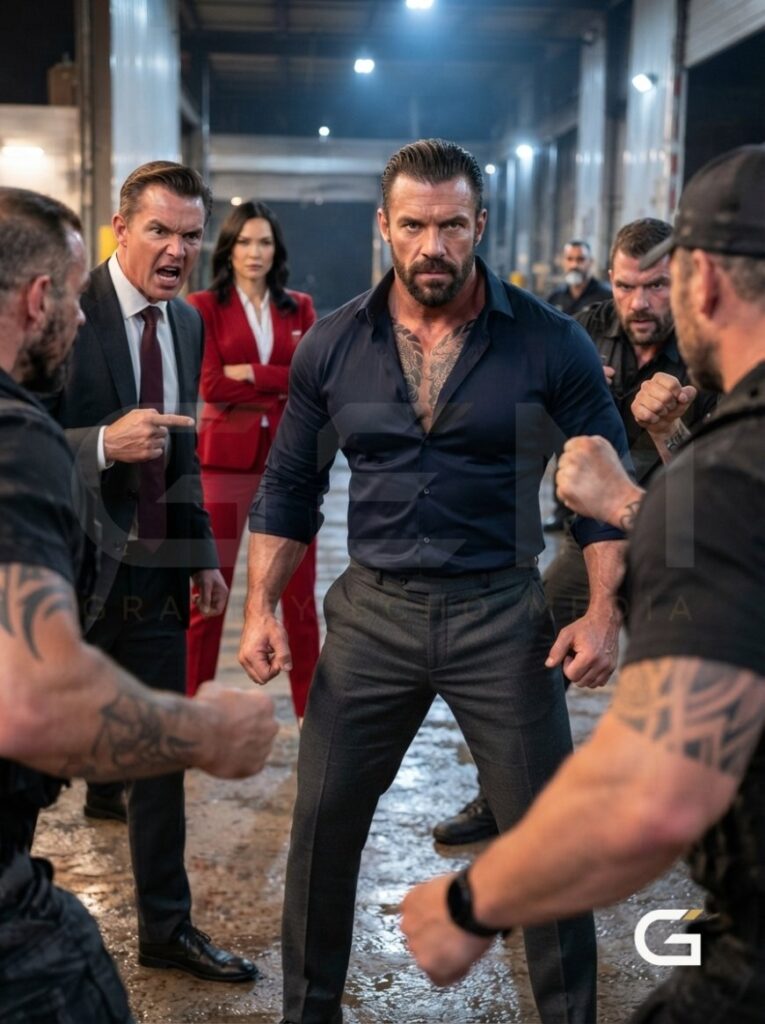
“The audit started six months ago,” Natalie said, pulling up a directory of folders. “I run internal review at Caldwell Dynamics. Most of what I do is boring—policy compliance, expense audits, that kind of thing. But in April, one of the junior accountants flagged a payment that didn’t make sense. A five-hundred-thousand-dollar invoice from a logistics vendor called Ridgeline Services. We’d never used them before.”
She clicked a file open.
“I pulled the file on Ridgeline. It was a shell. No website, no address beyond a P.O. box in Delaware, no employees on file with the state. But the payment cleared because someone in accounts payable approves it manually every quarter.”
“Who?”
“That’s the part that took me two months to prove.” She opened another window—a cascade of bank statements, wire transfers, and internal authorization logs. “Every payment came through with a signature stamp that traced back to Preston Whitmore’s office. Not his name. His office. He set it up so the paperwork looked like it came from an assistant.”
Grant leaned in. His eyes moved across the screen the way they used to move across a fighter’s shoulders before a bout—reading patterns, looking for the tell.
“How much?”
“Forty-seven million,” Natalie said. “Over eighteen months. All routed through different shell vendors. All approved by the same stamp. And all tied to a single upcoming transaction.”
“The acquisition.”
She paused.
“How did you know about the acquisition?”
“Vanessa mentioned it at the gala. The $1.8 billion deal. She said it was closing soon.” Grant’s eyes stayed on the screen. “That’s why he went after you. You weren’t just auditing him. You were auditing the *deal*.”
Natalie nodded. “Eight days before close, I found the real reason he needs that drive. The Ridgeline payments weren’t the crime. They were the practice run.”
She pulled up a new file—a valuation model, dense with numbers Grant couldn’t fully parse but recognized the *shape* of. Rows and rows of asset values with a second column beside them, slightly higher. Variance percentages in red.
“He’s been inflating the asset valuations of the target company for months,” she said. “Quietly. Through intermediaries. Every inflated number feeds into a projected payout schedule that triggers the moment the deal closes.”
Grant leaned back. “How much of it is his?”
“More than a hundred million. Personally.” She tapped the screen. “He wasn’t trying to hide a theft. He was trying to hide the *scale* of it. If the deal goes through with his numbers, he walks away with enough money to disappear forever. If it fails—or if the audit goes public before close—he loses everything.”
“Which is why he needed the drive.”
“Which is why he needed the drive.”
Grant sat with that for a moment.
Then he said, “You’re not safe yet.”
Natalie’s fingers paused on the keys.
“What?”
“Tonight, he sent six men to handle me. That was his ego talking—he wanted me humiliated. Fine. But he’s not stupid. He knows Derek won’t stay bought. He knows the men who walked out are going to talk. And tomorrow morning, when he wakes up, he’s going to realize something very specific.”
“What?”
“That the only thing standing between him and a hundred million dollars is one woman with a flash drive and a maintenance worker who refused to back down.” Grant’s voice stayed level. “He’s not going to send more guys. He’s going to try something smarter.”
Natalie went pale.
“You think he’ll—”
“I think you need to move the evidence somewhere safe. Tonight. Not on that drive. Not on this laptop. Somewhere he can’t reach.” Grant glanced toward the locked door and the darkened hallway beyond it. “And I think you need to tell Vanessa Caldwell everything. Before he has a chance to get to her first.”
Natalie bit her lip. “I don’t know if I can trust her. She’s the CEO. Preston reports to her. She hired him.”
“She didn’t hire him because she trusted him,” Grant said. “She inherited him when the previous CEO retired. Everyone I’ve ever met in that building tonight had a reason to flatter him. Vanessa walked away from him in the hallway like he was furniture. She’s not his ally.”
“How do you know?”
“Because I’ve spent the last twelve years watching people the way I used to watch fighters,” Grant said. “And that woman’s body language doesn’t lie.”
Natalie stared at him for a long beat. Then she closed the laptop and slipped it into her bag.
“Alright,” she said. “Come with me.”
—
They took the service stairwell down to the ground floor, avoiding the lobby, avoiding the east wing where the gala was still carrying on in its low murmur of classical music and champagne bubbles. The corridor lights were dim. Somewhere above them, the band slid into a slow waltz.
Grant walked half a step behind Natalie, his shoulder aching, his mind working. Twelve years ago he would have ended that fight in the loading bay in twenty seconds flat, and half of the men would have needed ambulances. Tonight, he’d used just enough force. He’d walked away. He’d given Derek Slade a chance.
He wasn’t sure the man he used to be would have done any of that.
That thought was still turning over in his head when they reached the eastern wing and Natalie stopped short at the edge of a set of double doors.
“Wait,” she whispered.
Grant stopped. He listened.
Voices. On the other side of the doors. Two of them, low and tense.
One was Preston.
The other was Vanessa Caldwell.
“I’m telling you,” Preston was saying, “she’s been unstable for months. She’s been making accusations against executives for weeks. I’ve been trying to manage her internally, keep things quiet. But if this reaches the board, it’s going to look like I was covering something up.”





