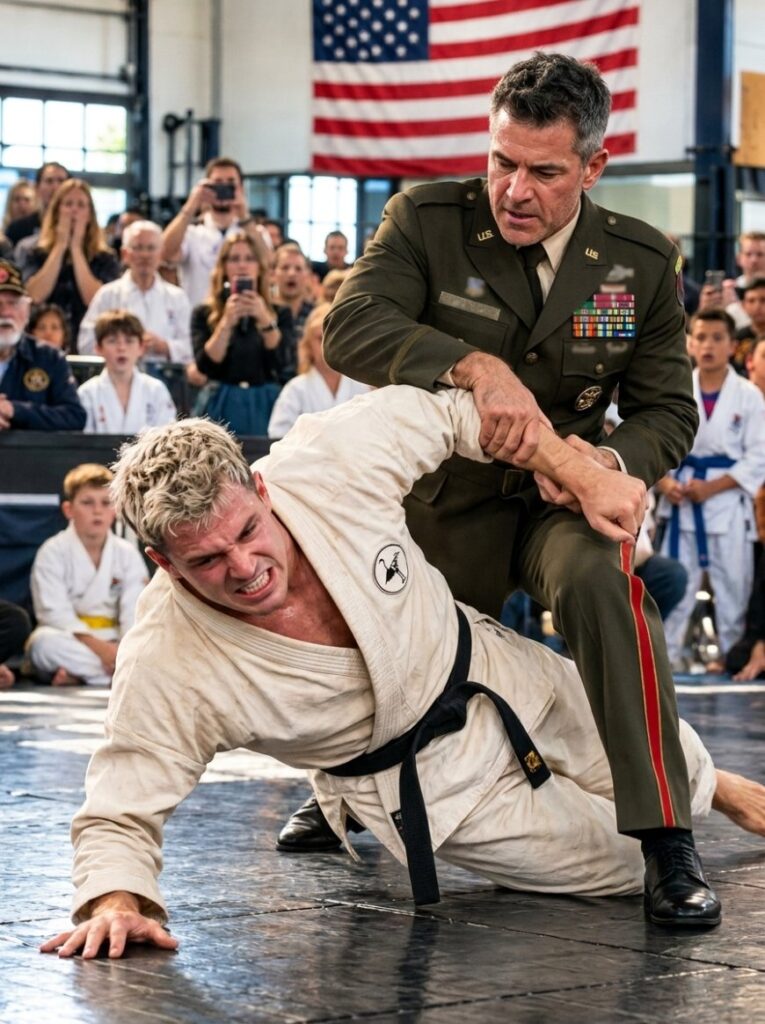

The word hung in the air like smoke.
Rook.
I heard it echo off the cinder block walls, bounce across the polished hardwood, and land somewhere deep in my chest where I had buried everything I used to be.
My socks felt suddenly thin against the mat.
Blake was still on his knees where I’d left him, one hand braced on the floor, his chest heaving. His eyes darted between me and the old Marine making his way down the bleachers.
“What did you just call him?” Blake’s voice had lost its swagger. It sounded thin. Almost young.
Briggs didn’t answer him.
He kept coming, one careful step at a time, his grandson hovering behind him with the fallen cane clutched in both hands like a sword he didn’t know how to use.
The gym had gone church-quiet.
Forty parents. Twenty-three students. Every single one of them frozen in place, phones lowered now, watching something they didn’t understand but could feel in their bones.
Briggs stopped at the edge of the mat.
His eyes traveled down to my feet.
Bare socks on black canvas.
Then back up to my face.
“You’re standing exactly like him,” he whispered. “Same weight distribution. Same angle. Same God-awful stillness.”
I said nothing.
Behind me, I heard someone’s chair scrape against the floor. A mother gathering her children. Good. They should go.
“You died,” Briggs said. His voice cracked on the word. “I watched them fold the flag. I handed it to your wife.”
My jaw tightened.
“I don’t have a wife.”
“I know.” His eyes were wet. “That’s what made it worse.”
Blake pushed himself to his feet.
“Somebody explain what the hell is happening right now.”
Briggs finally looked at him.
Really looked at him.
The way a man looks at a bug he’s deciding whether to crush.
“You want to know what’s happening?” Briggs took one step onto the mat. His grandson reached for him, but he waved the boy back. “You just tried to fight a man who spent sixteen years doing things you can’t imagine for people you’ll never meet.”
Blake’s face twisted.
“He’s a plumber.”
“He’s a ghost.”
The word landed like a slap.
I closed my eyes.
When I opened them, Briggs was standing directly in front of me. Close enough that I could smell the coffee on his breath and the menthol cream he’d rubbed into his knee that morning.
“Operation Black Lantern,” he said quietly. “August 14th. Fourteen men went in. Seven came out.”
I didn’t blink.
“They told us you stayed behind to cover the extraction.” His voice dropped lower. “They told us you were dead before the helicopter cleared the ridge.”
“That’s what I needed them to say.”
Briggs flinched like I’d hit him.
“Why?”
I looked past him.
Toward the door.
Toward the parking lot where my son was waiting in my truck, probably staring at the gym through the windshield, probably wondering why his father had taken so long.
“Because dead men don’t get hunted.”
The words came out flat.
Matter-of-fact.
The way I’d practiced them in my head a thousand times over nine years, never once imagining I’d actually have to say them out loud.
Briggs shook his head slowly.
“That’s not the whole story.”
“No.”
“Then tell me the rest.”
“No.”
“Damn it, Damon—”
“Master Guns.”
The title stopped him cold.
Old habit.
Old respect.
Old chains I thought I’d cut.
“This isn’t the place,” I said. “These are children. That’s my son in the truck outside. Whatever you think you know—whatever you think you remember—it stays buried.”
Briggs stared at me.
Then he laughed.
One short, bitter sound that echoed off the trophy wall.
“Buried,” he repeated. “You think anything about that night stayed buried?”
My stomach tightened.
“What do you mean?”
He reached into his jacket.
I tensed.
Old instinct.
Old training.
My weight shifted before I could stop it, left foot sliding back half an inch, hands loosening at my sides.
Briggs noticed.
Of course he noticed.
He’d trained men like me for thirty years.
“Easy, son.” He pulled out a folded photograph. Worn at the edges. Creased down the middle from being carried in a wallet for too long. “Look at this.”
I didn’t move.
He unfolded it himself and held it up.
Six men in desert camouflage, faces smeared with dirt, standing in front of a burned-out Humvee. The sun was setting behind them, turning everything orange and gold.
I knew the photo.
I’d taken it.
Second from the left was Briggs. Younger. Darker hair. Less scar tissue.
Third from the right was me.
I looked like a stranger.
Harder.
Leaner.
Eyes that hadn’t learned how to soften yet.
Blake moved closer, craning his neck to see.
“That’s him?”
Briggs nodded.
“The man you just tried to humiliate spent four years on a team that doesn’t officially exist. He ran operations in six countries. He trained with people who make your trophy collection look like a participation ribbon at a church picnic.”
Blake’s face went red.
Then white.
Then something else entirely.
Something I recognized because I’d seen it in the mirror for years.
Fear.
Not of me.
Of the gap between who he thought he was and who he actually was.
“You’re lying,” he said. But there was no force behind it. Just reflex.
Briggs turned the photo over.
On the back, in faded blue ink, were fourteen names.
Seven crossed out.
Mine was last.
Not crossed out.
Underlined.
Twice.
“Why is his name underlined?” Blake asked.
Briggs looked at me.
“Because we never found his body.”
The silence that followed was absolute.
Not even the HVAC system dared to hum.
I took the photo from Briggs’s hand.
Studied my own face from another lifetime.
I looked happy in that picture.
Or close to it.
The way young men look happy when they don’t yet know what the cost of everything will be.
“I need you to listen to me very carefully, Sam.”





