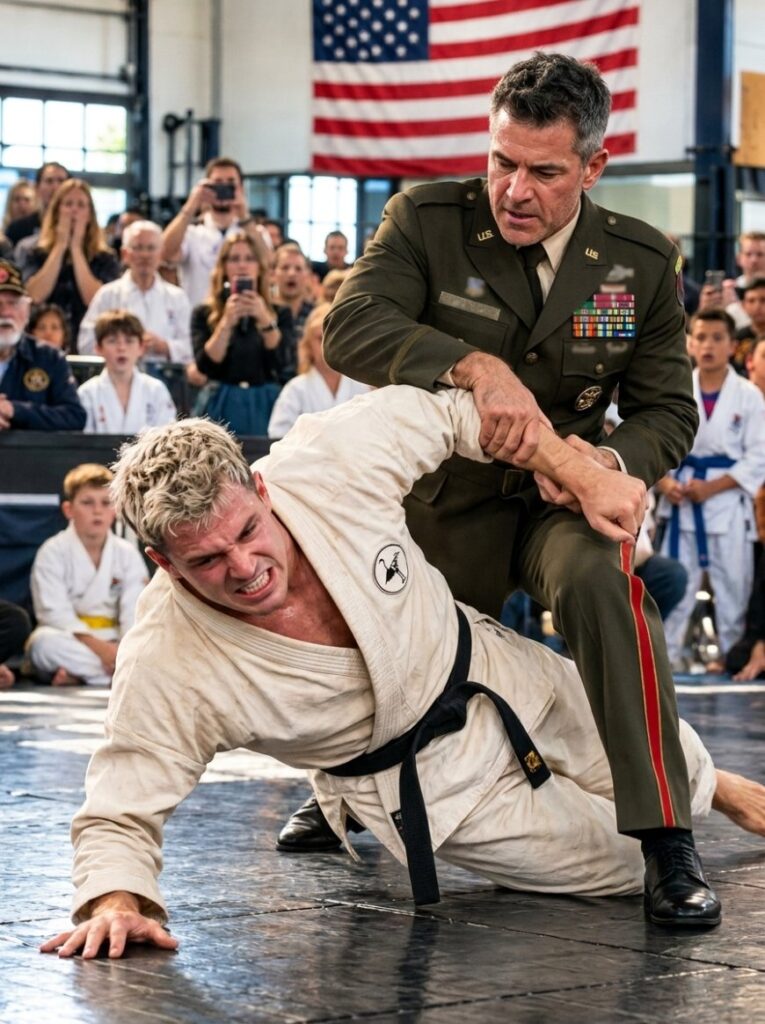
My voice was quiet.
The kind of quiet that had a weight to it.
The kind of quiet that made grown men check their weapons.
“They gave me a flag. They gave me a medal. They gave me a widow’s pension for a woman who was never my wife.” His voice broke again. “Then they gave me a desk in Quantico and told me to forget.”
“I didn’t know.”
“Of course you didn’t. Nobody did.”
“I had to leave.”
“You could have called.”
The words hit harder than they should have.
He was right.
I could have called.
One phone number.
One confirmation code.
One sentence.
I’m alive.
But I hadn’t.
Because calling meant reaching back into a world that had almost swallowed me whole.
Calling meant risk.
Risk meant exposure.
Exposure meant everything I’d built for Evan could burn in a single afternoon.
So I’d stayed silent.
For nine years.
A coward wearing the face of a protector.
Briggs wiped his eyes with the back of his hand.
“You’ve got a son.”
“Yes.”
“He’s the one.”
“The one what?”
The old Marine looked toward the door.
“Cody told me you had a boy with you. When we pulled you out of that valley, you kept talking about him. Kept saying his name over and over. Evan. Evan. Evan. Even when you were unconscious, you were saying it.”
I felt something crack inside my chest.
“I don’t remember that.”
“Because you don’t remember anything from those first three days. You were in and out. Delirious. The doc said you had a concussion, a collapsed lung, and enough blood loss to kill three men.”
He paused.
“You wouldn’t let go of my hand.”
I looked away.
At the trophy wall.
At the fluorescent lights reflecting off the polished floor.
At anything that wasn’t this old man’s face.
“There was a woman,” Briggs said.
My head snapped back around.
“What?”
“In the valley. After we left.” He folded his arms. “Intelligence reports mentioned a female operative on the ground. Never identified. Never confirmed. But she was there.”
I said nothing.
“You were extracted separately. Three days after we pulled out. A black site medical facility in Ramstein. No record of how you got there. No record of who brought you.”
I still said nothing.
Briggs stepped closer.
“Who found you, Damon?”
The front door of the gym opened.
A gust of cold evening air swept across the mat.
I turned.
Evan stood in the doorway.
His face was pale, and his hands were shaking, and he looked smaller than he had when I’d sent him to the truck. He’d clearly watched everything through the glass. The fight. The words. The photo.
The name.
“Dad?”
My son’s voice was barely a whisper.
I crossed the mat in three steps.
“Evan.”
Behind me, Briggs called out.
“Damon, wait—”
But I was already kneeling in front of my boy, my hands on his shoulders, my eyes searching his face for damage that wasn’t physical.
“You were supposed to stay in the truck.”
“I heard shouting.”
“Evan—”
“Was that true?”
I closed my eyes.
Please, God, not yet.
He’s thirteen.
“You told me you were in the Navy.”
“I was.”
“But not a mechanic.”
“No.”
“You lied to me.”
His voice cracked, and the sound of it tore through me like shrapnel.
“I didn’t lie. I just—”
“Didn’t tell me the truth.”
I couldn’t argue with that.
Because he was right.
I’d told Evan a version of the story. A safe version. A version with no blood, no operational names, no nights where I’d woken up screaming with his mother’s name in my mouth.
He’d asked once, when he was seven, why I had scars on my back.
I’d told him I fell through a glass door as a kid.
He’d believed me.
Because children believe their fathers.
Until they don’t.
Behind me, I heard Blake’s voice.
“So you’re some kind of war hero?”
Briggs answered before I could.
“He’s not a hero.”
Blake snorted.
“That’s what I thought—”
“He’s something worse.”
The gym went quiet again.
Briggs walked toward us slowly, his cane tapping against the floor.
“A hero does what’s right. A hero walks away when the fight is over. A hero goes home.” He stopped beside Evan. “Your father did what was necessary. There’s a difference.”
I looked up at him.
“Sam, don’t.”
But he was already looking at Evan.
“My name is Samuel Briggs. I served with your father for three years. He saved my life twice. He saved eight other men more times than I can count.”
Evan stared at him.
“He was the best operator I ever trained. The best I ever knew. And when the mission went sideways, he did the thing that none of us could do.”
“What?” Evan whispered.
“Stayed behind.”
The word settled between us like a stone.
I stood slowly.
This wasn’t the conversation I’d wanted to have.
Not tonight.
Not here.
Not ever.
“Evan, we need to go.”
“No.”
His voice was stronger now.
“No.”
He pulled away from my hand.
“Tell me.”
I looked at him.
At his bruised ribs. At the way he was holding himself together with nothing but willpower. At the tears he was refusing to shed.
At the boy who had asked me an hour ago if I was proud of him.
“I didn’t want you to know,” I said quietly.
“Why?”
“Because knowing could hurt you.”
“Not knowing already hurts!”
The words echoed off the walls.
Several parents were still watching from the bleachers.
I glanced at them.
“Give us the room.”
Nobody moved.
“Now.”
Something in my voice made the whole gym stand up at once. Mothers grabbed their children, fathers grabbed their wives, and within sixty seconds the bleachers were empty.
Even the students filed out without a word.
Blake stayed.
Briggs stayed.
Evan stayed.
I nodded at Blake.
“You too.”
He opened his mouth to argue.
Then closed it.
Then walked.





